
Bridging Generative and Predictive Paradigms via Hidden-Self-Distillation
Abstract
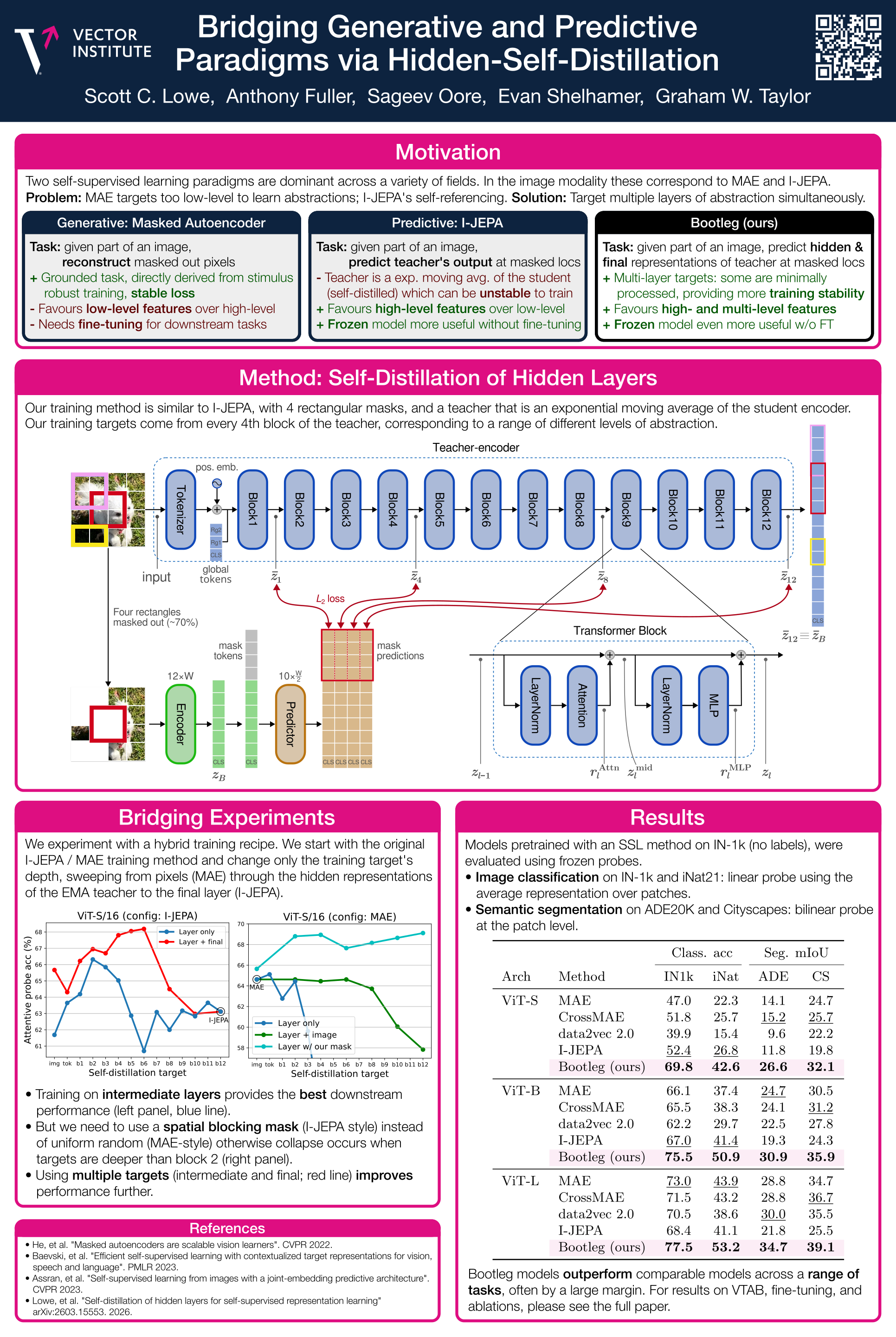
The landscape of self-supervised learning (SSL) is currently dominated by generative approaches (e.g., MAE) that reconstruct raw low-level data, and predictive approaches (e.g., I-JEPA) that predict high-level abstract embeddings. While generative methods provide strong grounding, they are computationally inefficient for high-redundancy modalities like video, and their training objective does not prioritize learning high-level, conceptual features. Conversely, predictive methods often suffer from training instability due to their reliance on final-layer self-distillation. We introduce Bootleg, a method that bridges this divide by tasking the model with predicting continuous latent representations from multiple hidden layers of a teacher network. This hierarchical objective forces the model to capture features at varying levels of abstraction simultaneously. We demonstrate that Bootleg significantly outperforms standard baselines on ImageNet-1K classification (+6–12% over I-JEPA frozen probes) and ADE20K segmentation (+10%). This positions Bootleg as an ideal "representation interface'" for next-generation multimodal models, where the optimal training signal lies neither at the pixel level nor the semantic peak, but in the rich intermediate hierarchy.