
Retrieval Mechanisms Surpass Long-Context Scaling in Time Series Forecasting
Abstract
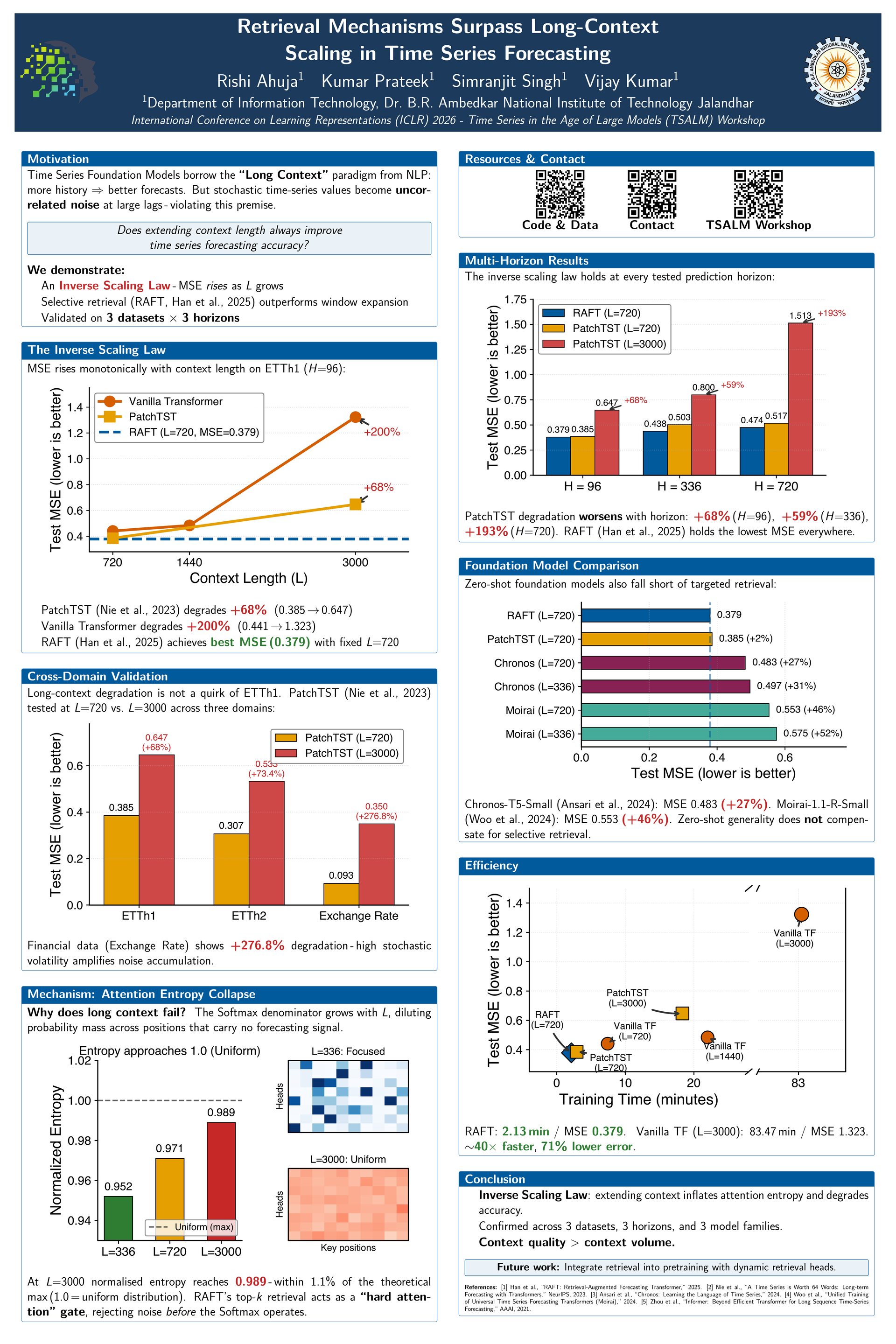
Time Series Foundation Models (TSFMs) have borrowed the long context paradigm from natural language processing under the premise that feeding more history into the model improves forecast quality. But in stochastic domains, distant history is often just high-frequency noise, not signal. Hence, the proposed work tests whether this premise actually holds by running continuous context architectures (PatchTST included) through the ETTh1 benchmark. The obtained results contradict the premise: an inverse scaling law shows up clearly, with forecasting error rising as context gets longer. A 3,000-step window causes performance to drop by over 68\%, evidence that attention mechanisms are poor at ignoring irrelevant historical volatility. Retrieval-Augmented Forecasting (RAFT) is evaluated as an alternative. RAFT achieves a mean squared error (MSE) of 0.379 with a fixed 720-step window and selective retrieval, well below the 0.647 MSE of the best long-context configuration despite requiring far less computation. In addition, the retrieval step injects only the most relevant historical segments as dynamic exogenous variables, which gives the model a context-informed inductive bias it cannot build on its own from raw sequences. Therefore, foundation models going forward need to shift architecturally toward selective retrieval.