
Toward An Agentic Approach in Anti-Money Laundering Investigation for Typology Classification
Abstract
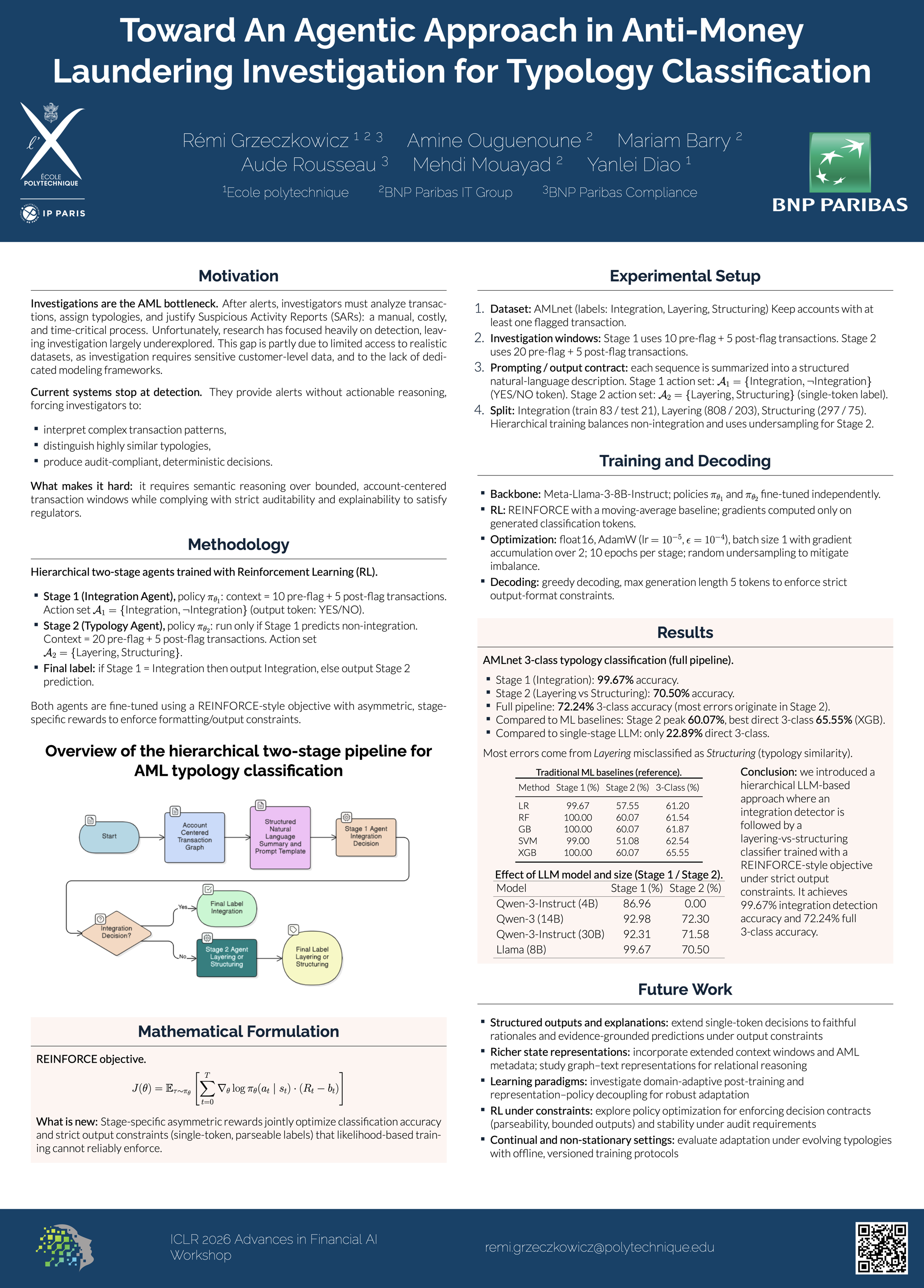
Effectively conducting Anti-Money Laundering (AML) investigations in complex, high-volume financial environments while remaining compliant, efficient, and human-centric remains a central challenge for modern compliance systems. While most prior work focuses on money laundering (ML) detection, the investigation phase, remains comparatively underexplored, despite its central role in compliance workflows. In this paper, we study LLM-based money-laundering typology classification in an investigation-assistance setting, where models must assign Integration, Layering, or Structuring labels to an account-centred transaction window under strict output-format and auditability constraints. We propose a two-stage hierarchical investigation pipeline leveraging an agentic approach. A first LLM acts as a high-precision detector for Integration cases, while a second LLM, trained using a REINFORCE-style objective, discriminates between Layering and Structuring with single-token, fully parseable outputs. This design aims to optimize analyst time and reduce manual investigation effort while preserving human oversight. Experiments on the AMLnet dataset show that our approach achieves 99.67% accuracy for Integration detection and 70.50% accuracy for Layering versus Structuring, yielding 72.24% overall three-class accuracy. It outperforms traditional machine-learning baselines by 7–12 accuracy points (depending on the experiment) and substantially exceeds the performance of a single-stage LLM classifier (22.89). Beyond empirical results, we outline research directions for agentic AML investigation systems, including the choice of learning paradigms, the design of RL contracts under regulatory and audit constraints, and graph–text fusion strategies for operational agentic systems in production.