
WHEN DRIFT DETECTORS CRY WOLF: FALSE ALARM RATES IN CONTINUOUS ML MONITORING
Abstract
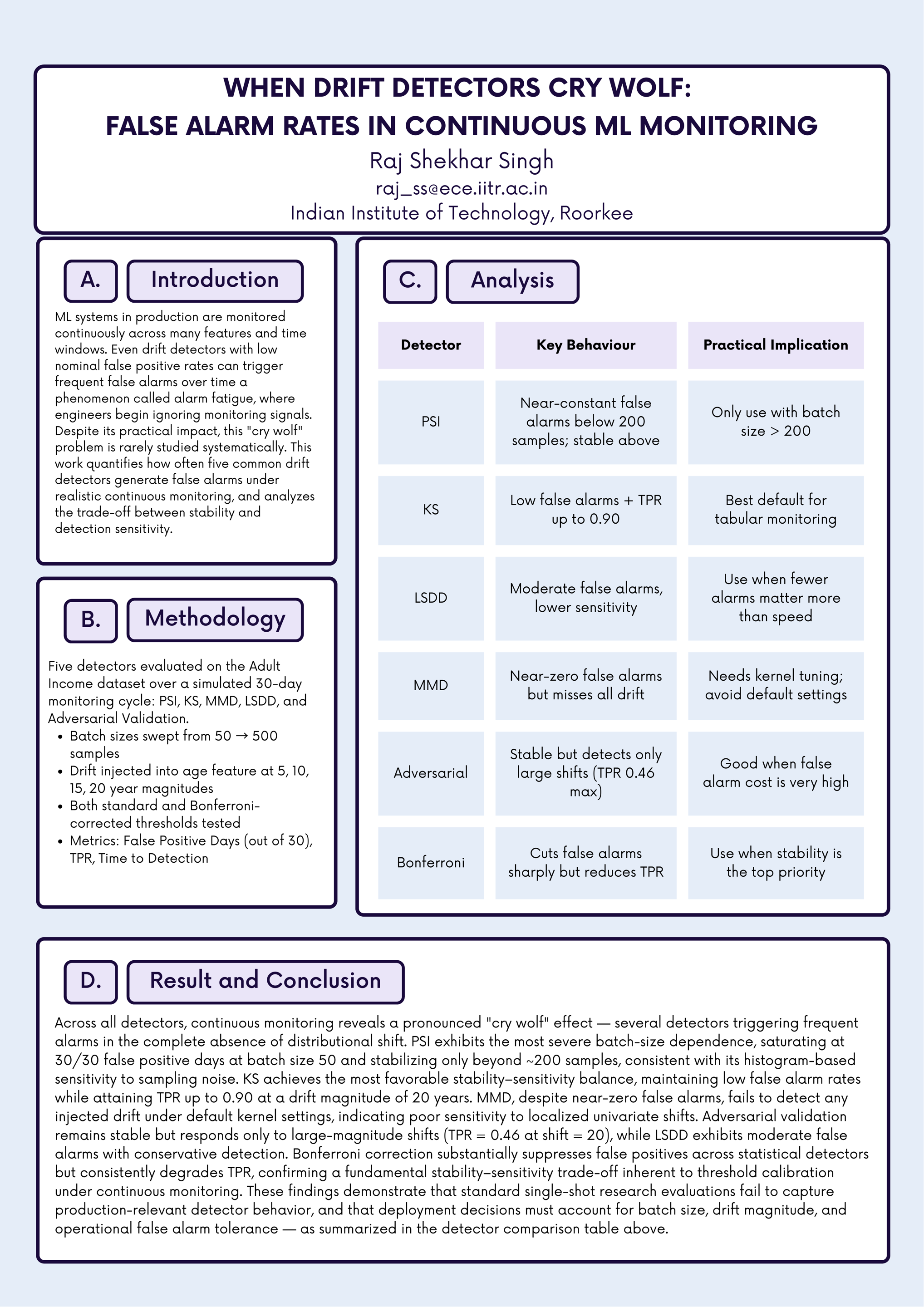
Drift detection is a core component of production machine learning monitoring systems, where detectors are used to compare incoming data with a reference distribution and trigger alerts when changes occur. However, these detectors are often evaluated in research settings that emphasize detection accuracy under synthetic shifts, while overlooking false alarms under continuous monitoring. In production environments, models are monitored repeatedly over time and across many features, and even small false positive rates can accumulate into frequent alerts, leading to alarm fatigue. We empirically analyze false positive behavior across five commonly used drift detectors: PSI, KS, MMD, LSDD, and adversarial validation. Consistent with existing literature, PSI exhibits strong sensitivity to batch size, producing frequent false alarms at small sample sizes; however, we further observe that its behavior stabilizes and improves substantially once batch sizes exceed approximately 200 samples. In contrast, KS, MMD, and LSDD display persistent fluctuations across batch sizes, while remaining comparatively more reliable than PSI in low-data regimes. Applying a Bonferroni correction reduces false positive rates, but often at the cost of reduced true positive sensitivity, reinforcing the well-known stability - sensitivity trade-off in drift detection. This work provides a systematic comparison of false positive behavior across multiple drift detectors under continuous monitoring conditions. We identify tradeoffs across detector families and provide practical guidelines for selecting and calibrating drift detectors in production ML systems