
Evaluating Performance Drift from Model Switching in Multi-Turn LLM Systems
Raad Khraishi ⋅ Iman Zafar ⋅ Katie Myles ⋅ Greig Cowan
Abstract
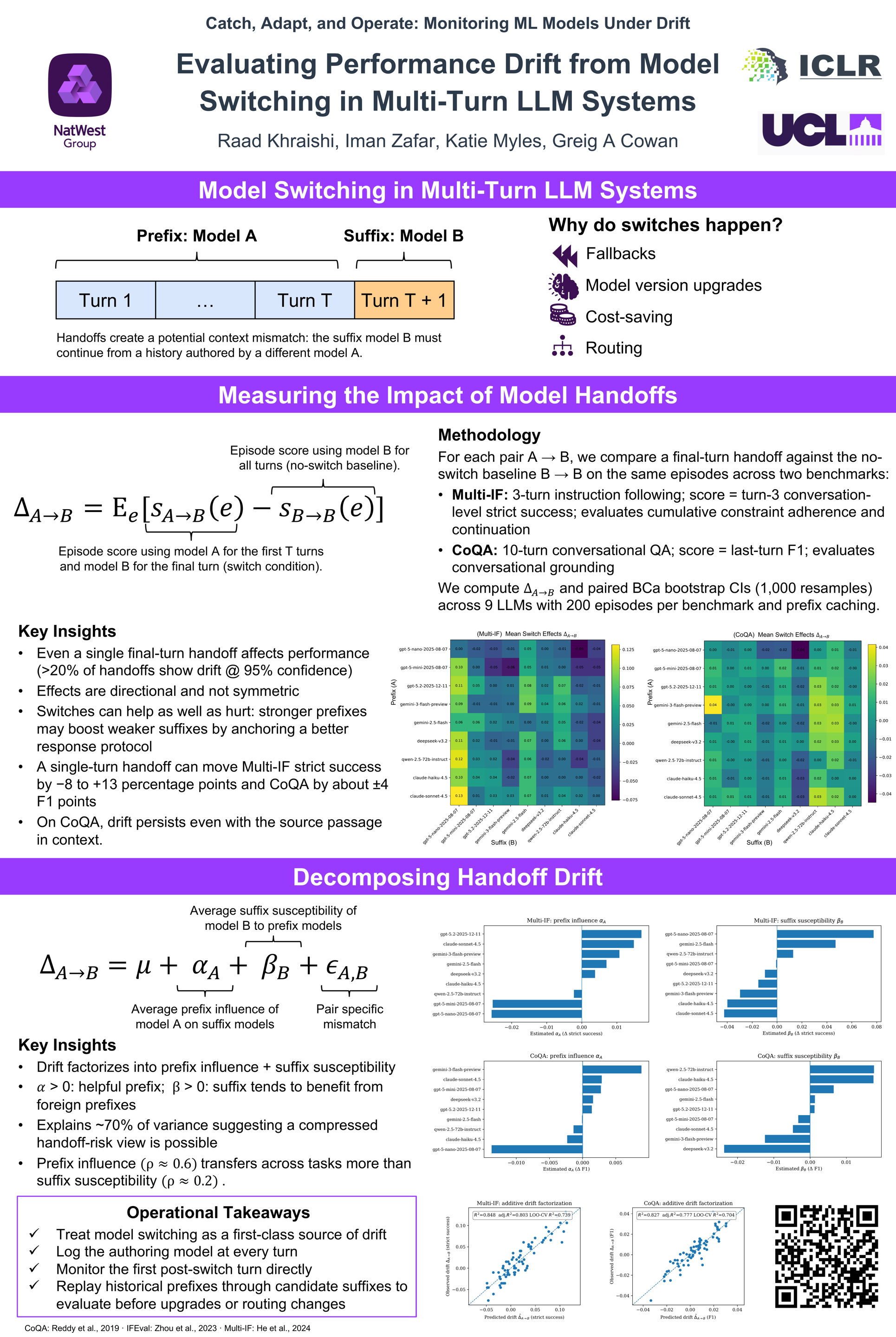
Deployed multi-turn LLM systems routinely switch models mid-interaction due to upgrades, cross-provider routing, and fallbacks. Such handoffs create a context mismatch: the model generating later turns must condition on a dialogue prefix authored by a different model, potentially inducing silent performance drift. We introduce a switch-matrix benchmark that measures this effect by running a prefix model for early turns and a suffix model for the final turn, and comparing against the no-switch baseline using paired episode-level bootstrap confidence intervals. Across CoQA conversational QA and Multi-IF benchmarks, even a single-turn handoff yields prevalent and statistically significant, directional effects and may swing outcomes by $-8$ to $+13$ percentage points in Multi-IF strict success rate and $\pm 4$ absolute F1 on CoQA, comparable to the no-switch gap between common model tiers (e.g., GPT‑5‑nano vs GPT‑5‑mini). We further find systematic compatibility patterns: some suffix models degrade under nearly any non-self dialogue history, while others improve under nearly any foreign prefix. To enable compressed handoff risk monitoring, we decompose switch-induced drift into per-model prefix influence and suffix susceptibility terms, accounting for $\mathord{\sim}70\%$ of variance across benchmarks. These results position handoff robustness as an operational reliability dimension that single-model benchmarks miss, motivating explicit monitoring and handoff-aware mitigation in multi-turn systems.
Chat is not available.
Successful Page Load