
Soft Mellowmax Monte Carlo Planning
Abstract
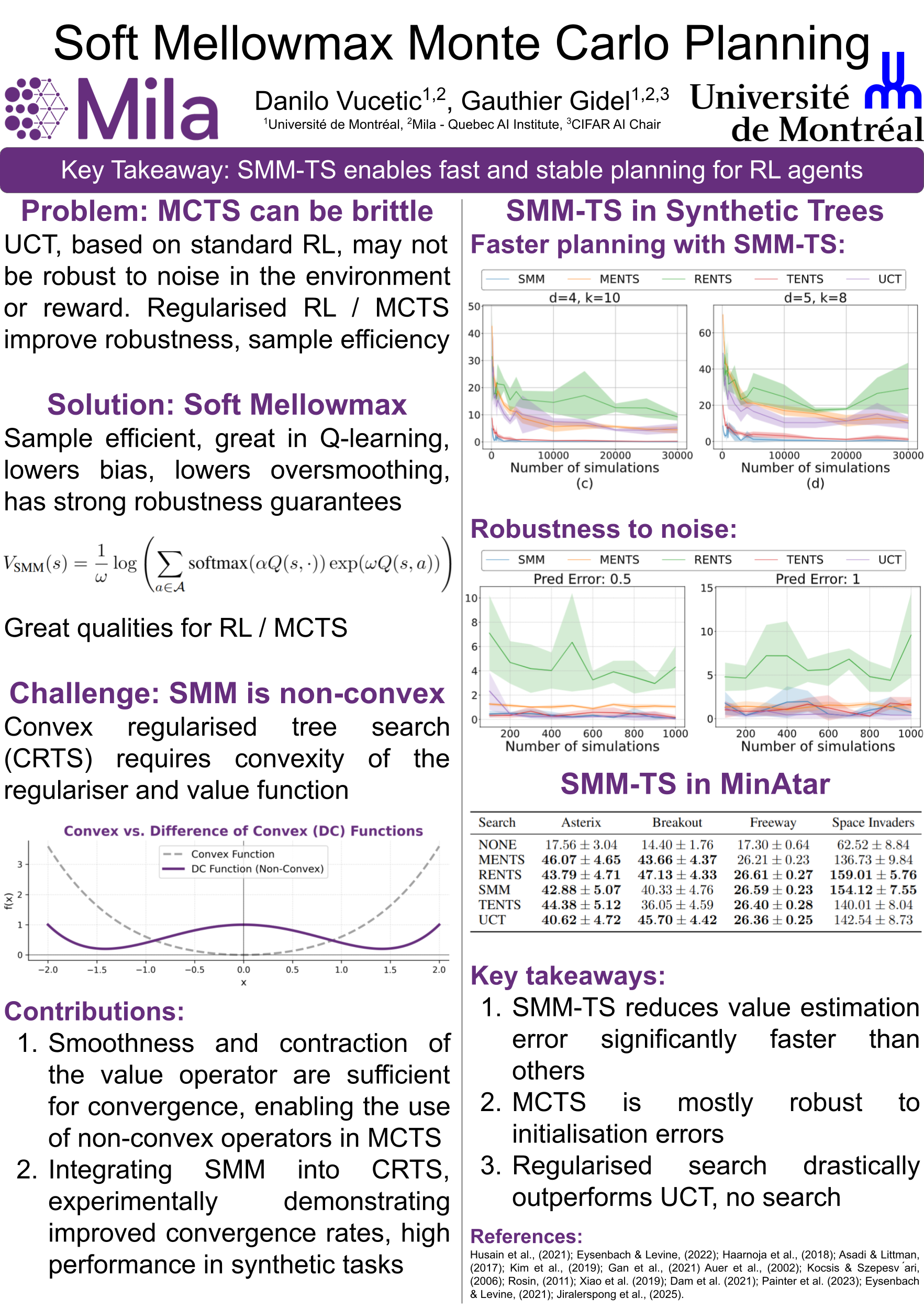
Soft mellowmax (SMM) recently emerged as an alternative operator in Q-learning, achieving impressive performance in games and scientific discovery tasks. Despite SMM's ability to achieve high returns and its enticing robustness, diversity, and sample efficiency characteristics, SMM has not yet been translated into a Monte Carlo tree search algorithm. To address this gap, a soft mellowmax-based Monte Carlo tree search algorithm, SMM-TS, is proposed and theoretically justified. It is empirically demonstrated that SMM-TS converges significantly faster than other tree search methods in synthetic environments, while maintaining competitive performance in games. The fast convergence of SMM-TS makes recursive self-improvement loops more scalable, while the stability gained via planning and the robustness of the operator make SMM-TS more practical for agents operating in uncertain and changing environments.