
ProtoTTA: Prototype-Guided Test-Time Adaptation
Abstract
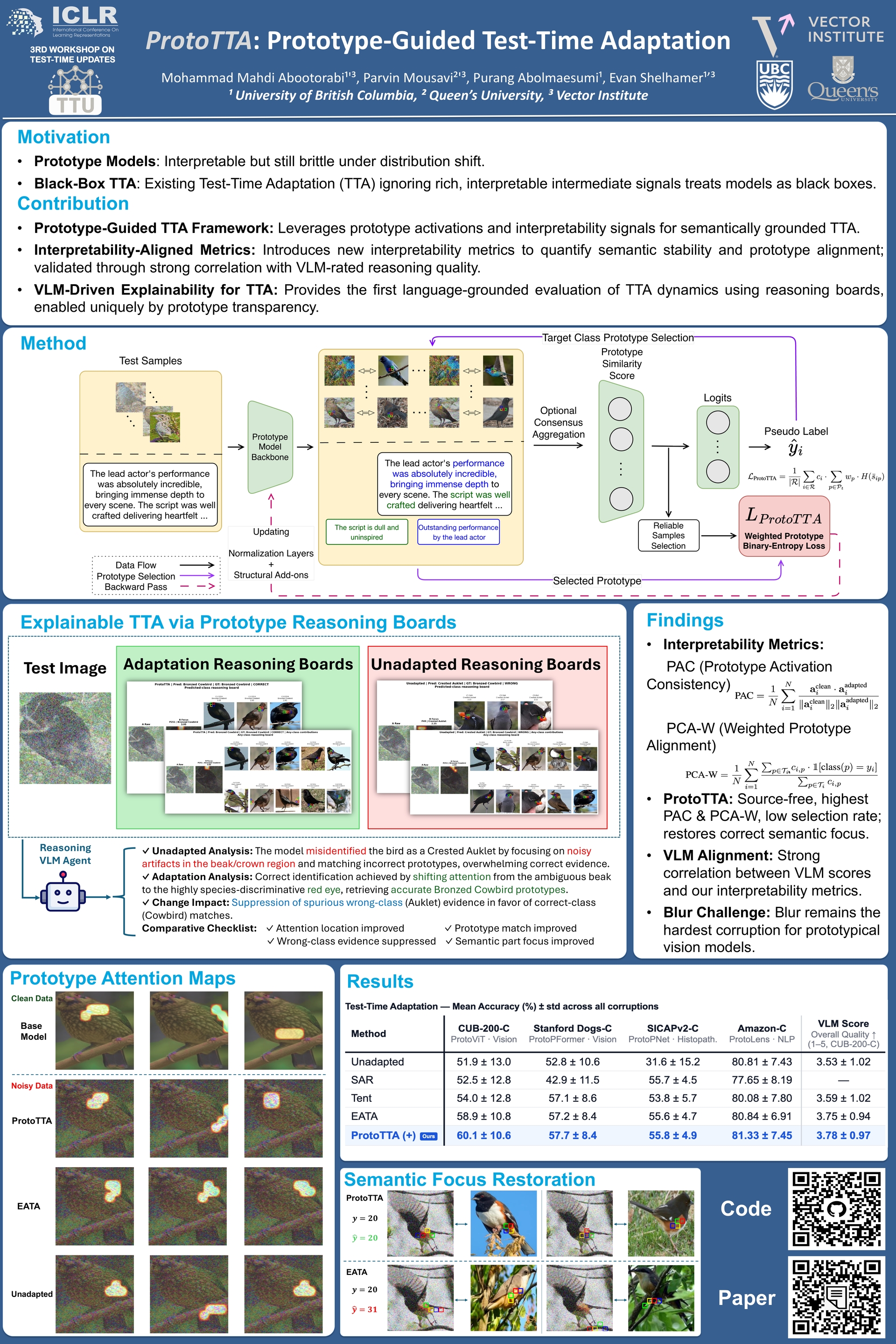
Deep networks that rely on prototypes—interpretable representations that can be related to the model input—have gained significant attention for balancing high accuracy with inherent interpretability, which makes them suitable for critical domains such as healthcare. However, these models are limited by their reliance on training data, which hampers their robustness to distribution shifts. While test-time adaptation (TTA) improves the robustness of deep networks by updating parameters and statistics, the prototypes of interpretable models have not been explored for this purpose. We introduce ProtoTTA, a general framework for prototypical models that leverages intermediate prototype signals rather than relying solely on model outputs. ProtoTTA minimizes the entropy of the prototype‑similarity distribution to encourage more confident and prototype-specific activations on shifted data. To maintain stability, we employ geometric filtering to restrict updates to samples with reliable prototype activations, regularized by prototype-importance weights and model-confidence scores. Experiments across four prototypical backbones on four diverse benchmarks spanning fine-grained vision, histopathology, and NLP demonstrate that ProtoTTA improves robustness over standard output entropy minimization while restoring correct semantic focus in prototype activations. We also introduce novel interpretability metrics and a vision-language model (VLM) evaluation framework to explain TTA dynamics, confirming ProtoTTA restores human-aligned semantic focus and correlates reliably with VLM-rated reasoning quality. Code is available at: https://github.com/DeepRCL/ProtoTTA