
Human-Like Lifelong Memory: A Neuroscience-Grounded Architecture for Infinite Interaction
Abstract
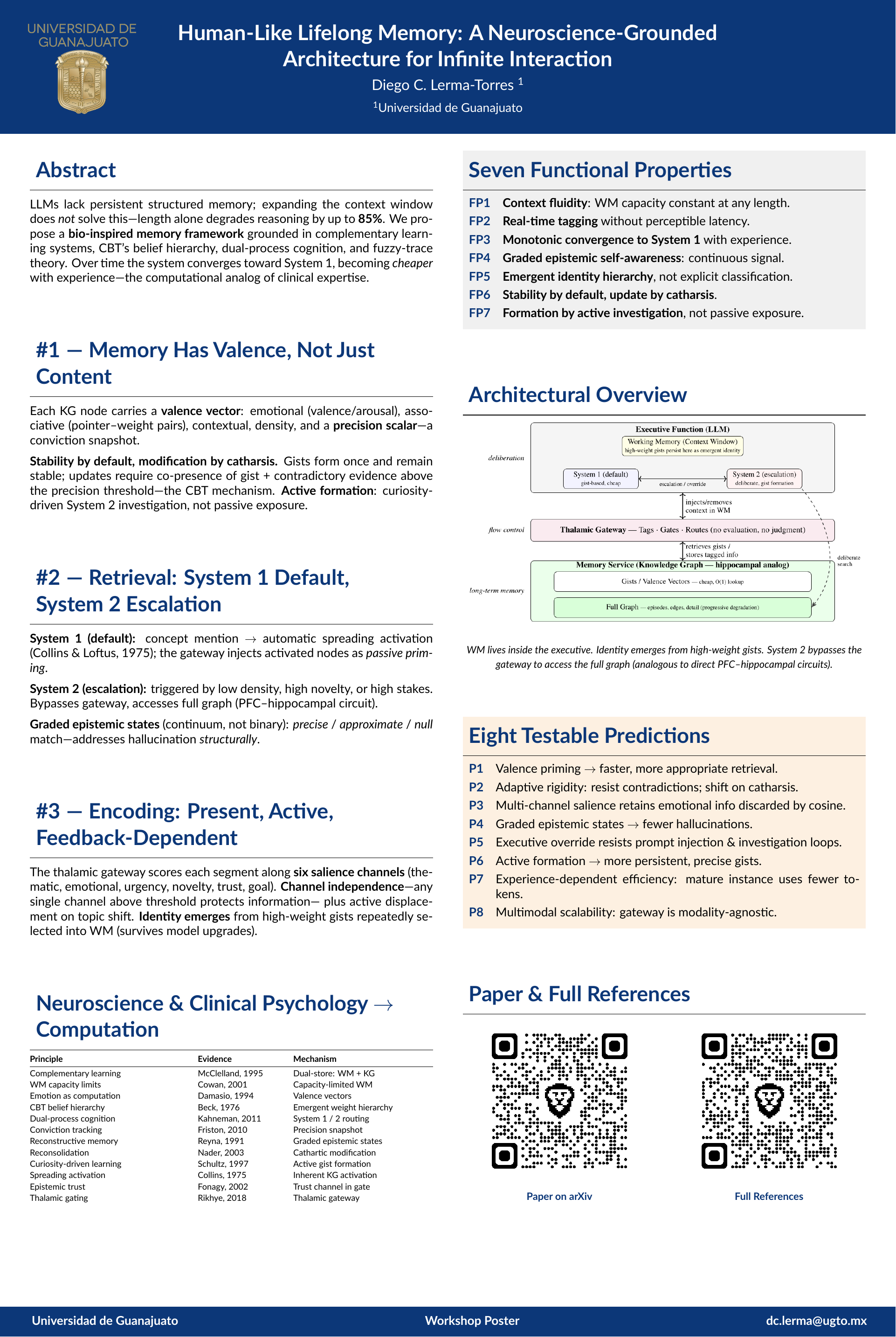
Large language models lack persistent, structured memory for long-term interaction and context-sensitive retrieval. Expanding context windows does not solve this: recent evidence shows that context length alone degrades reasoning by up to 85%—even with perfect retrieval. We propose a bio-inspired memory framework grounded in complementary learning systems theory, cognitive behavioral therapy's belief hierarchy, dual-process cognition, and fuzzy-trace theory, organized around three principles: 1. Memory has valence, not just content—pre-computed emotional-associative summaries (valence vectors) organized in an emergent belief hierarchy inspired by Beck's cognitive model enable instant orientation before deliberation; 2. Retrieval defaults to System 1 with System 2 escalation—automatic spreading activation and passive priming as default, with deliberate retrieval only when needed, and graded epistemic states that address hallucination structurally; and 3. Encoding is active, present, and feedback-dependent—a thalamic gateway tags and routes information between stores, while the executive forms gists through curiosity-driven investigation, not passive exposure. Seven functional properties specify what any implementation must satisfy. Over time, the system converges toward System 1 processing—the computational analog of clinical expertise—producing interactions that become cheaper, not more expensive, with experience.