
Beyond single-axis designs: multi-objective optimization for complex perturbation atlases
Abstract
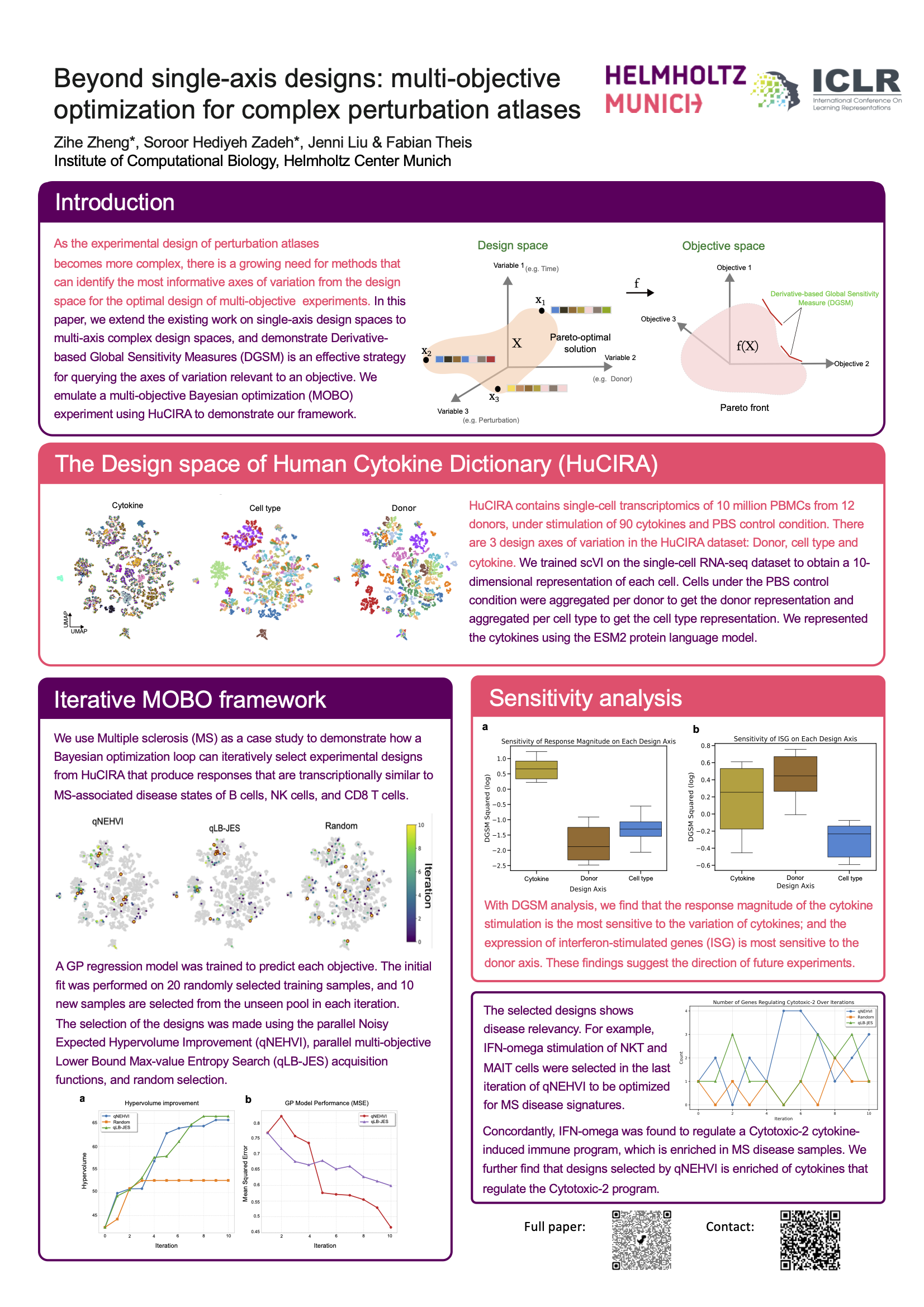
Single-cell perturbation screens enable detailed profiling of complex cellular responses but experiments remain costly in both time and resources. Bayesian optimization (BO) has been proven effective in data-limited and evaluation-expensive settings, including industrial and molecular design. Recent emergence of large-scale perturbation atlases have opened up the opportunity to inform and guide the design of future experiments. As the experimental design of perturbation atlases becomes more complex, there is a growing need for methods that can identify the most informative axes of variation from the design space of these atlases for the optimal design of experiments that are often inherently multi-objective. In this paper, we extend the existing work on single-axis design spaces to multi-axis complex design spaces, and construct a design space for the Human Cytokine Dictionary (HuCIRA). We introduce Derivative-based Global Sensitivity Measures (DGSM) for single-cell perturbation experimental design and demonstrate that DGSM is an effective strategy for querying the axes of variation relevant to an objective from the HuCIRA perturbation atlas. To demonstrate the practical effectiveness of our framework for representing multi-axis design spaces in large-scale perturbation atlases, we emulate a multi-objective Bayesian optimization (MOBO) experiment using HuCIRA, showing that the selected experimental designs jointly optimize perturbation objectives. We envision that our proposed framework can be used in the design and utilization of current and future perturbation experiments and atlases.