
Global Particulate Matter Forecasting Using Lightweight, Region-Specific Deep Learning Models
Ansh Kushwaha ⋅ Kaushik Gopalan
Abstract
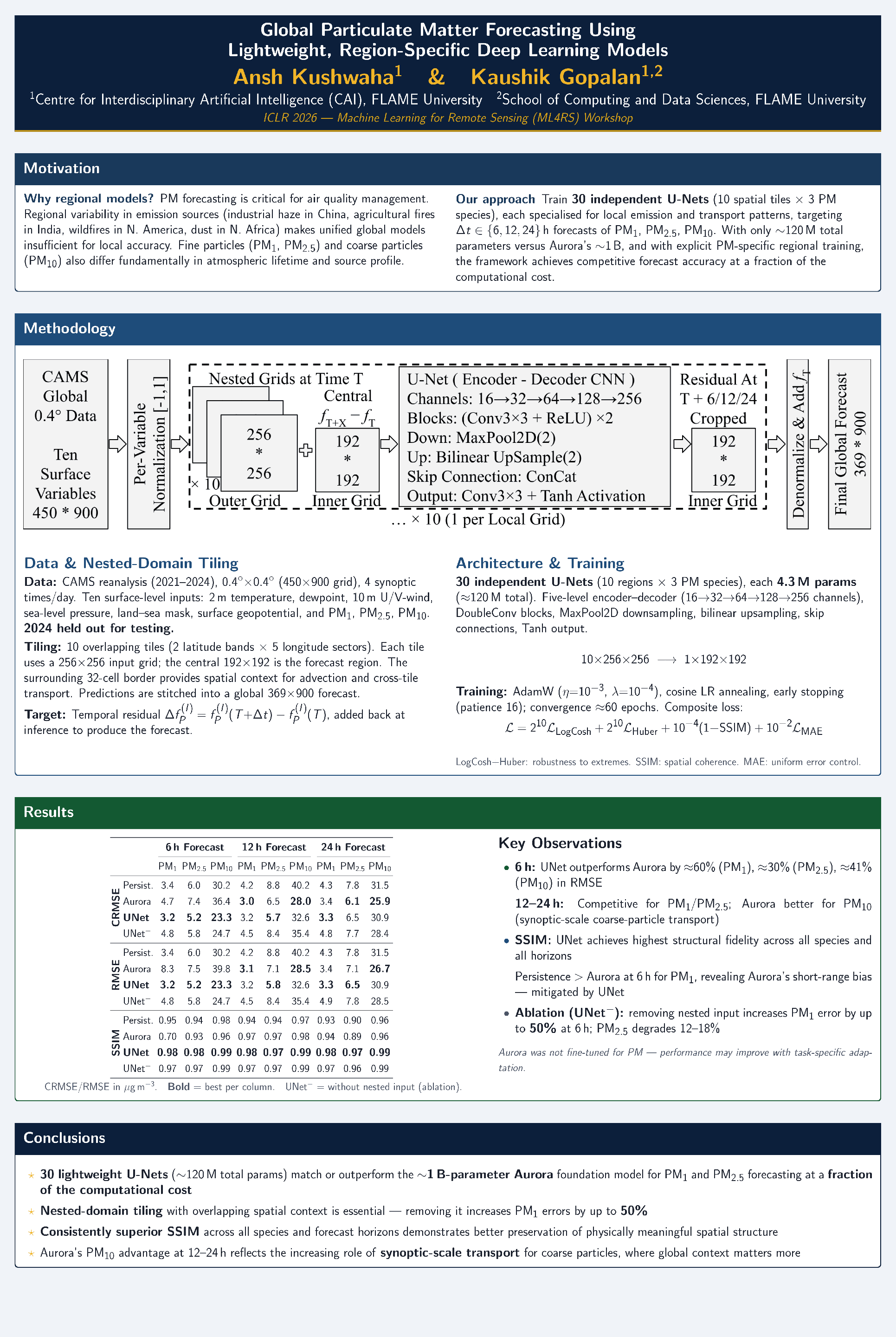
Global particulate matter (PM) forecasting is critical for air quality management, yet regional variability in emission sources and atmospheric processes poses challenges for unified modeling approaches. We present a lightweight nested-domain deep learning framework using U-Net architecture for short-range forecasting of $PM_{1}$, $PM_{2.5}$, and $PM_{10}$. Our approach trains separate models for 10 different spatial regions and 3 PM species, using overlapping $256 \times 256$ input grids to predict $192 \times 192$ forecast regions with explicit spatial context. Using CAMS reanalysis data spanning 2021--2024, we train independent U-Net models for each region/PM species combination using a model size of $\approx 4$ million parameters per model, for a total of $\approx 120$ million parameters for all the models combined. Evaluated against the $\approx 1$ billion-parameter Aurora foundation model, our framework achieves competitive root mean square error at 6--24 hour forecast horizons while consistently resulting in slightly higher structural similarity indices. These results demonstrate that lightweight, regionally-specialized models offer a viable alternative to large-scale foundation models for PM forecasting, providing computational efficiency without sacrificing forecast accuracy.
Chat is not available.
Successful Page Load