
Death of the Novel(ty): Beyond N-Gram Novelty as a Metric for Textual Creativity
Arkadiy Saakyan ⋅ Najoung Kim ⋅ Smaranda Muresan ⋅ Tuhin Chakrabarty
Abstract
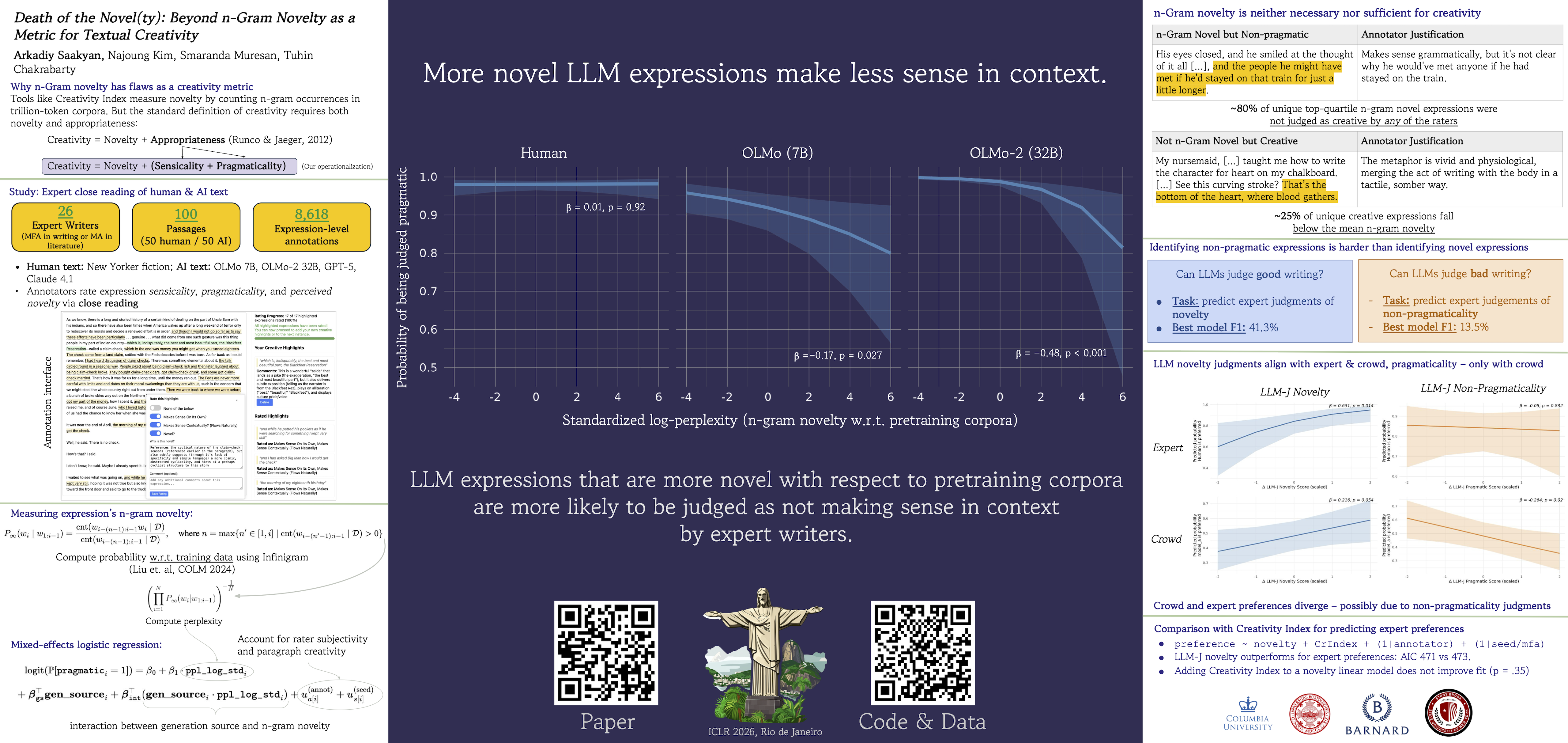
$N$-gram novelty is widely used to evaluate language models' ability to generate text outside of their training data. More recently, it has also been adopted as a metric for measuring textual creativity. However, theoretical work on creativity suggests that this approach may be inadequate, as it does not account for creativity's dual nature: novelty (how original the text is) and appropriateness (how sensical and pragmatic it is). We investigate the relationship between this notion of creativity and $n$-gram novelty through 8,618 expert writer annotations of novelty, pragmaticality, and sensicality via \emph{close reading} of human- and AI-generated text. We find that while $n$-gram novelty is positively associated with expert writer-judged creativity, approximately 91% of top-quartile $n$-gram novel expressions are not judged as creative, cautioning against relying on $n$-gram novelty alone. Furthermore, unlike in human-written text, higher $n$-gram novelty in open-source LLMs correlates with lower pragmaticality. In an exploratory study with frontier closed-source models, we additionally confirm that they are less likely to produce creative expressions than humans. Using our dataset, we test whether zero-shot, few-shot, and finetuned models are able to identify expressions perceived as novel by experts (a positive aspect of writing) or non-pragmatic (a negative aspect). Overall, frontier LLMs exhibit performance much higher than random but leave room for improvement, especially struggling to identify non-pragmatic expressions. We further find that LLM-as-a-Judge novelty ratings align with expert writer preferences in an out-of-distribution dataset, more so than an n-gram based metric.
Video
Chat is not available.
Successful Page Load