
GoR: A Unified and Extensible Generative Framework for Ordinal Regression
Abstract
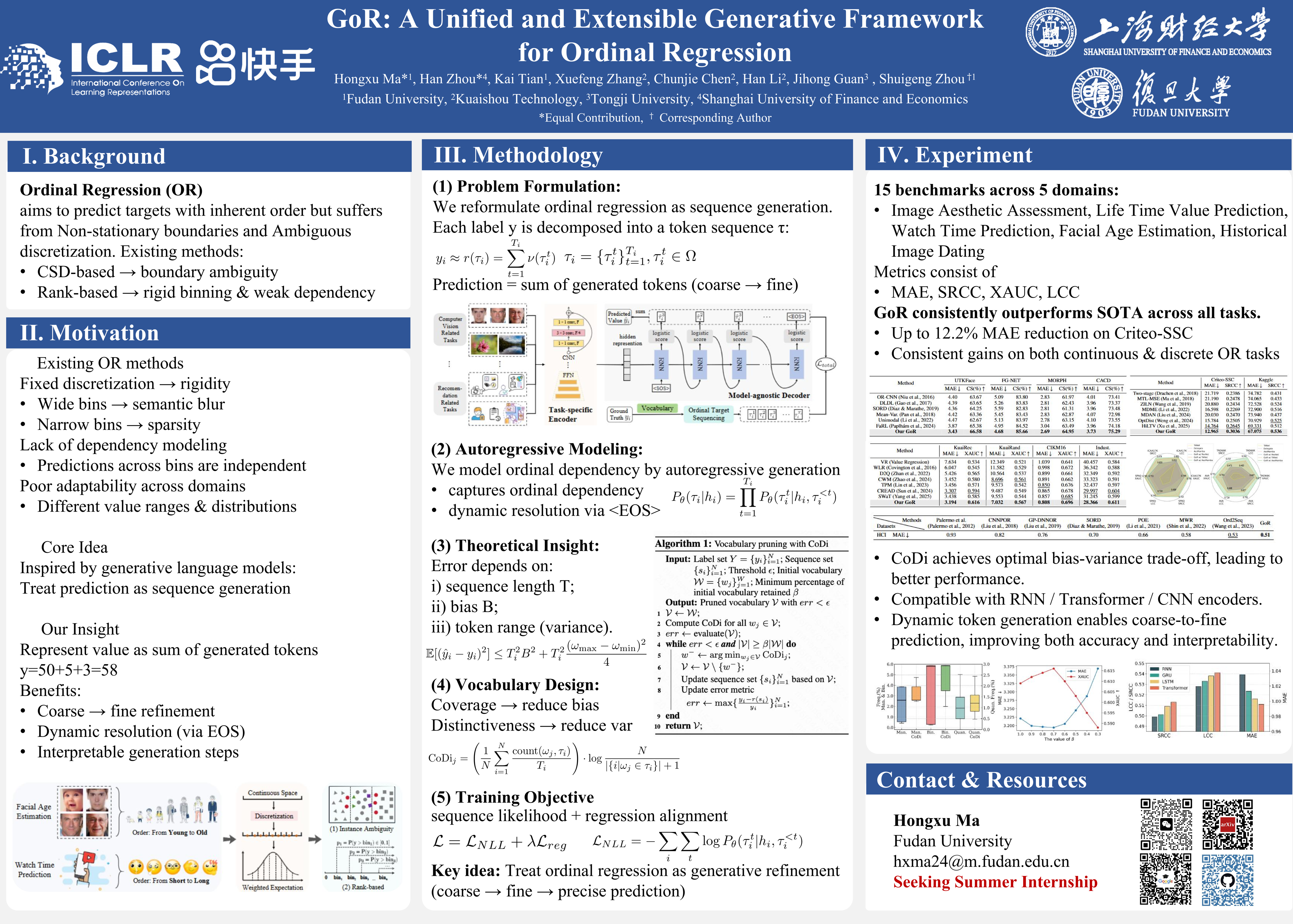
Ordinal Regression (OR), which predicts the target values with inherent order, underpins a wide spectrum of applications within diverse domains. The intrinsic ordinal structure and non-stationary inter-class boundaries make OR fundamentally more challenging than conventional classification or regression. Existing approaches, predominantly based on Continuous Space Discretization (CSD), struggle to model these ordinal relationships, but are hampered by boundary ambiguity. Alternative rank-based methods, while effective, rely on implicit order dependencies and suffer from the rigidity of fixed binning. Inspired by the advances of generative language models, we propose Generative Ordinal Regression (GoR), a novel generative paradigm that reframes OR as a sequential generation task. GoR autoregressively predicts ordinal segments until a dynamic ⟨EOS⟩, explicitly capturing ordinal dependencies while enabling adaptive resolution and interpretable step-wise refinement. To support this process, we theoretically establish a bias–variance decomposed error bound and propose the Coverage–Distinctiveness Index (CoDi), a principled metric for vocabulary construction that balances quantization bias against statistical variance. The GoR framework is model-agnostic, ensuring broad compatibility with arbitrary task-specific architectures. Moreover, it can be seamlessly integrated with established optimization strategies for generative models at a negligible adaptation cost. Extensive experiments on 17 diverse ordinal regression benchmarks across six major domains demonstrate GoR's powerful generalization and consistent superiority over state-of-the-art OR methods.