
Expertise Can Be Helpful for Reinforcement Learning-based Macro Placement
Abstract
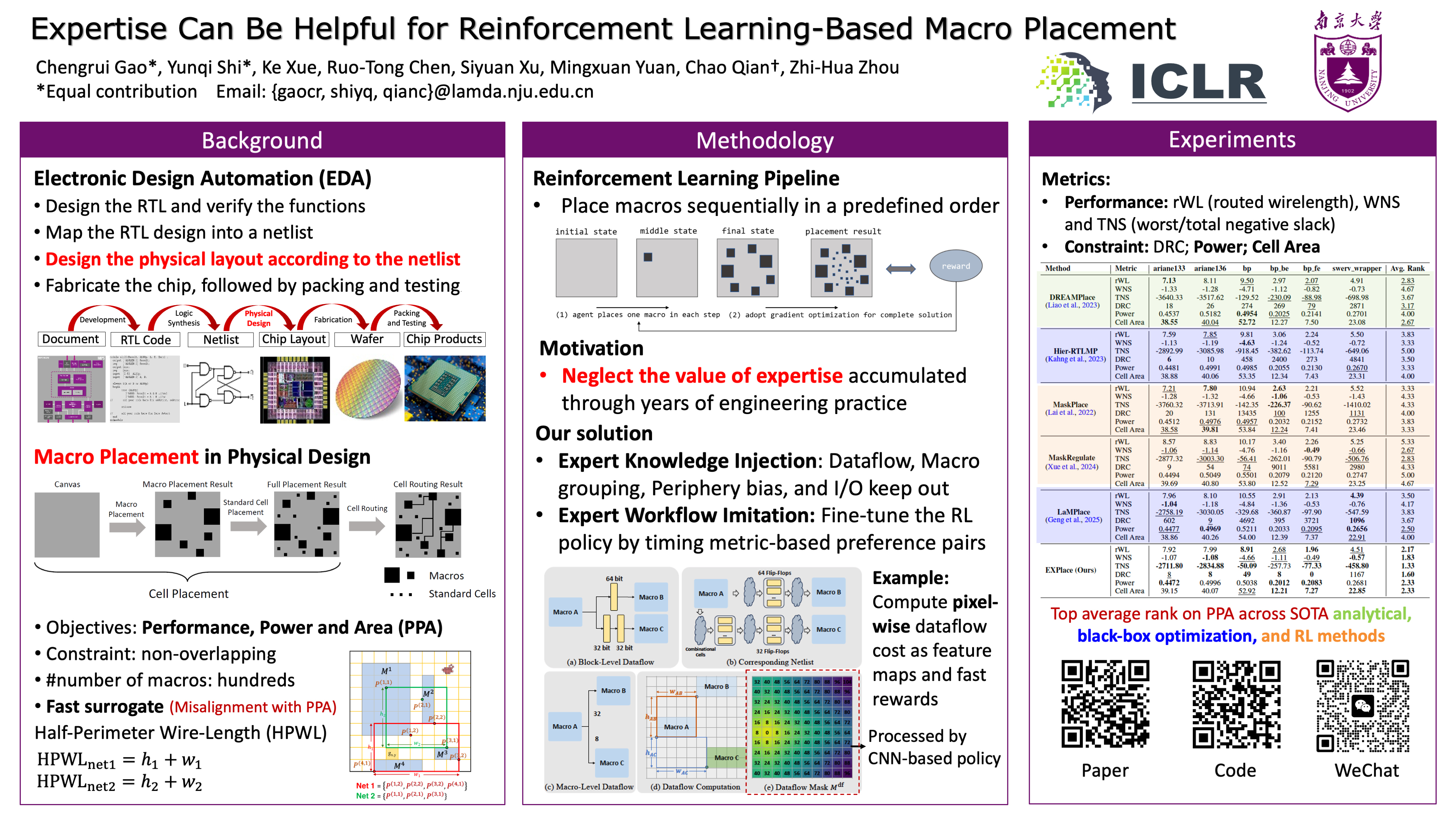
Chip placement determines the locations of electronic components on a chip layout, which directly impacts performance, power, and area (PPA) metrics, and thus is a critical step in electronic design automation (EDA). As modern chips scale to accommodate millions of components, manual placement by human experts becomes infeasible, necessitating the use of automated algorithms. Recently, reinforcement learning (RL) has emerged as a promising approach for automating macro placement, owing to its high optimization efficiency and potential for generalization. Despite their promise, existing RL-based methods often neglect the value of expert knowledge accumulated through years of engineering practice. They tend to optimize oversimplified proxy objectives, resulting in suboptimal placements that deviate significantly from expert-designed solutions. To bridge this gap, we propose a novel RL-based placement framework that integrates EDA domain expertise from two complementary perspectives: (1) Expert Knowledge Injection: Incorporating well-established placement knowledge, such as dataflow guidance, periphery bias, macro grouping, and I/O keepout constraints, to guide the learning process toward human-level solutions. (2) Expert Workflow Imitation: Emulating the post-refinement process of human experts (i.e., updating the design iteratively based on backend PPA feedback) to progressively optimize timing metrics by employing preference optimization. Experiments on the ICCAD 2015 and OpenROAD benchmarks demonstrate that our method achieves substantial improvements in PPA metrics (e.g., 32.53\% in total negative slack and 7.74\% in worst negative slack compared to the runner-up method on average), outperforming advanced analytical, black-box optimization, and RL-based methods.