
Dual-Branch Representations with Dynamic Gated Fusion and Triple-Granularity Alignment for Deep Multi-View Clustering
Abstract
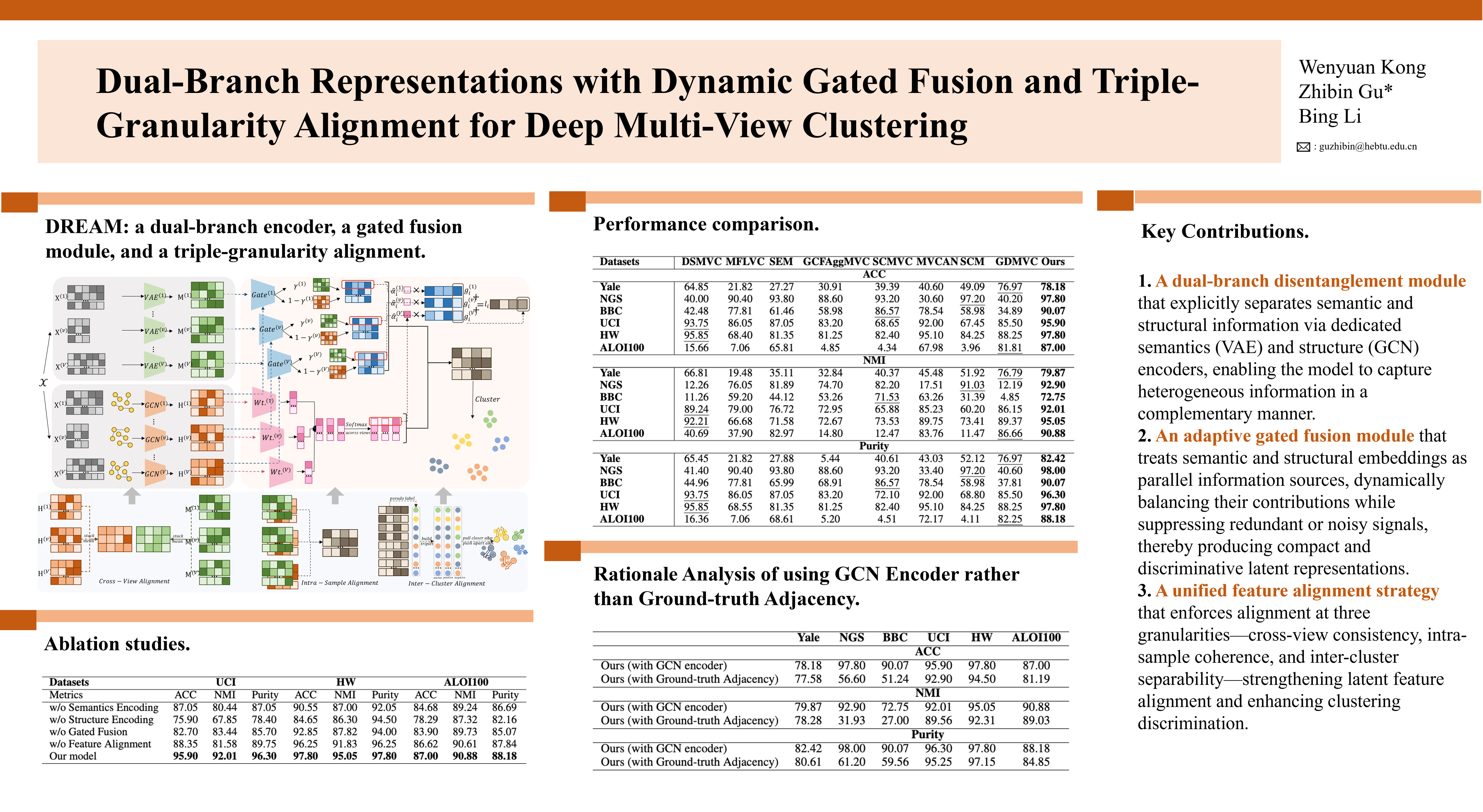
Multi-view clustering seeks to exploit complementary information across different views to enhance clustering performance, where both semantic and structural information are crucial. However, existing approaches often bias toward one type of information while treating the other as auxiliary, overlooking that the reliability of these signals may vary across datasets and that semantic and structural cues can provide complementary and parallel guidance. As a result, such methods may face limitations in generalization and suboptimal clustering performance. To address these issues, we propose a novel method, Dual-branch Representations with dynamic gatEd fusion and triple-grAnularity alignMent (DREAM), for deep multi-view clustering. Specifically, DREAM disentangles semantic information via a Variational Autoencoder (VAE) branch, while simultaneously captures structure-aware features through a Graph Convolutional Network (GCN) branch. The resulting representations are dynamically integrated using a gated fusion module that leverages structural cues as complementary guidance, adaptively balancing semantic and structural contributions to produce clustering-oriented latent embeddings. To further improve robustness and discriminability, we introduce a triple-granularity feature alignment mechanism that enforces consistency across views, within individual samples, and intra-cluster, thereby preserving semantic-structural coherence while enhancing inter-cluster separability. Extensive experiments on benchmark datasets demonstrate that DREAM significantly outperforms SOTA approaches, highlighting the effectiveness of disentangled dual-branch encoding, adaptive gated fusion, and triple-granularity feature alignment.