
Sparling: End-to-End Spatial Concept Learning via Extremely Sparse Activations
Kavi Gupta ⋅ Osbert Bastani ⋅ Armando Solar-Lezama
Abstract
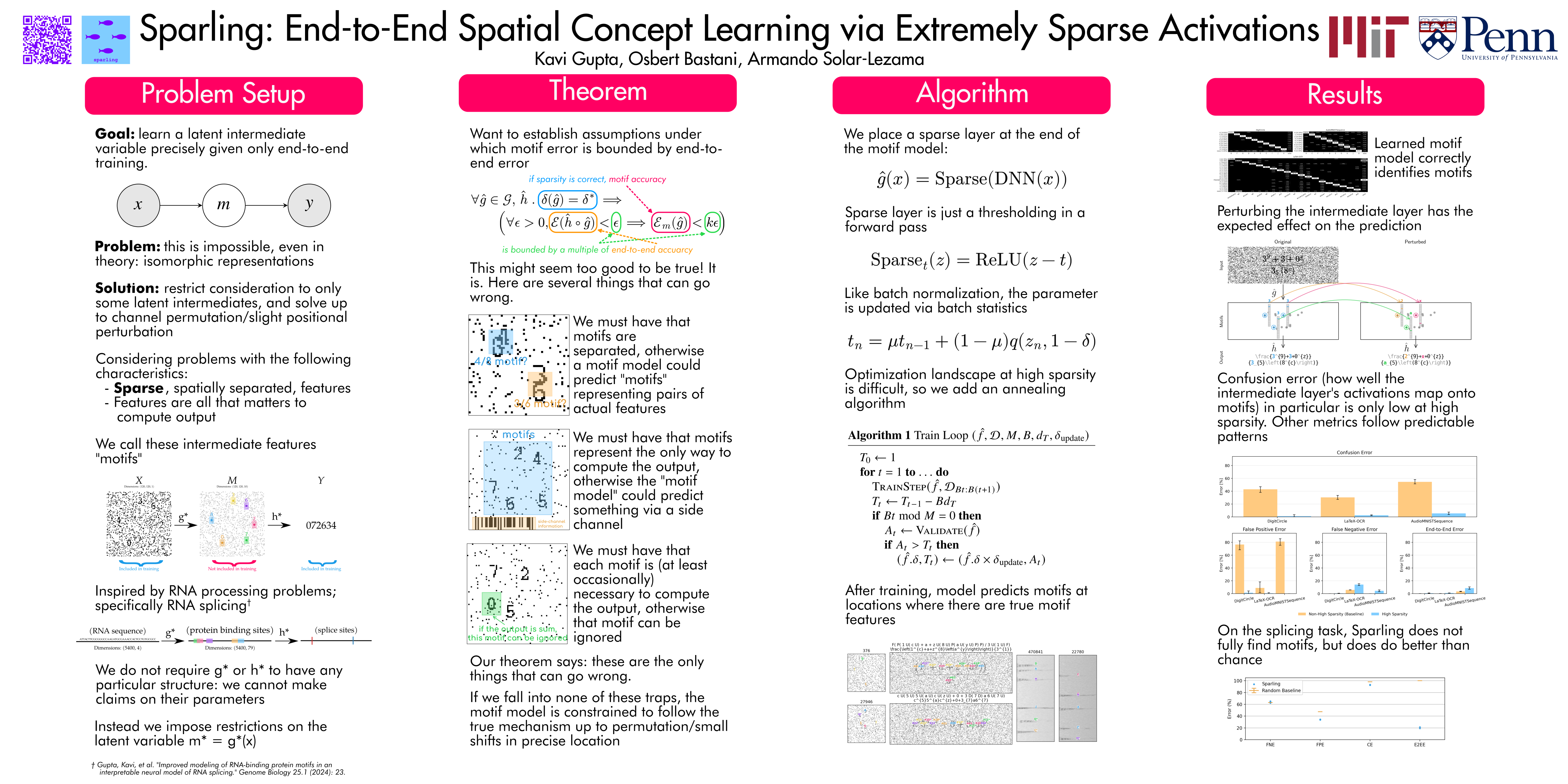
Real-world processes often contain intermediate state that can be modeled as an extremely sparse activation tensor. In this work, we analyze the identifiability of such sparse and local latent intermediate variables, which we call motifs. We prove our Motif Identifiability Theorem, stating that under certain assumptions it is possible to precisely identify these motifs exclusively by reducing end-to-end error. Notably, we do not assume identifiability of parameters, but rather of a latent intermediate representation output by a local model, thus allowing these representations to be arbitrarily complex functions of the input. Additionally, we provide the Sparling algorithm, which uses a new kind of informational bottleneck that enforces levels of activation sparsity unachievable using other techniques. We confirm empirically that extreme sparsity is necessary to achieve good intermediate state modeling. On synthetic domains, we are able to precisely localize the intermediate states up to feature permutation with $>90\%$ accuracy, even though we only train end-to-end.
Video
Chat is not available.
Successful Page Load