
Constant Degree Matrix-Driven Incomplete Multi-View Clustering via Connectivity-Structure and Embedding Tensor Learning
Zhibin Gu ⋅ Zhenhao Zhong ⋅ Xi Zhang ⋅ Bing Li
Abstract
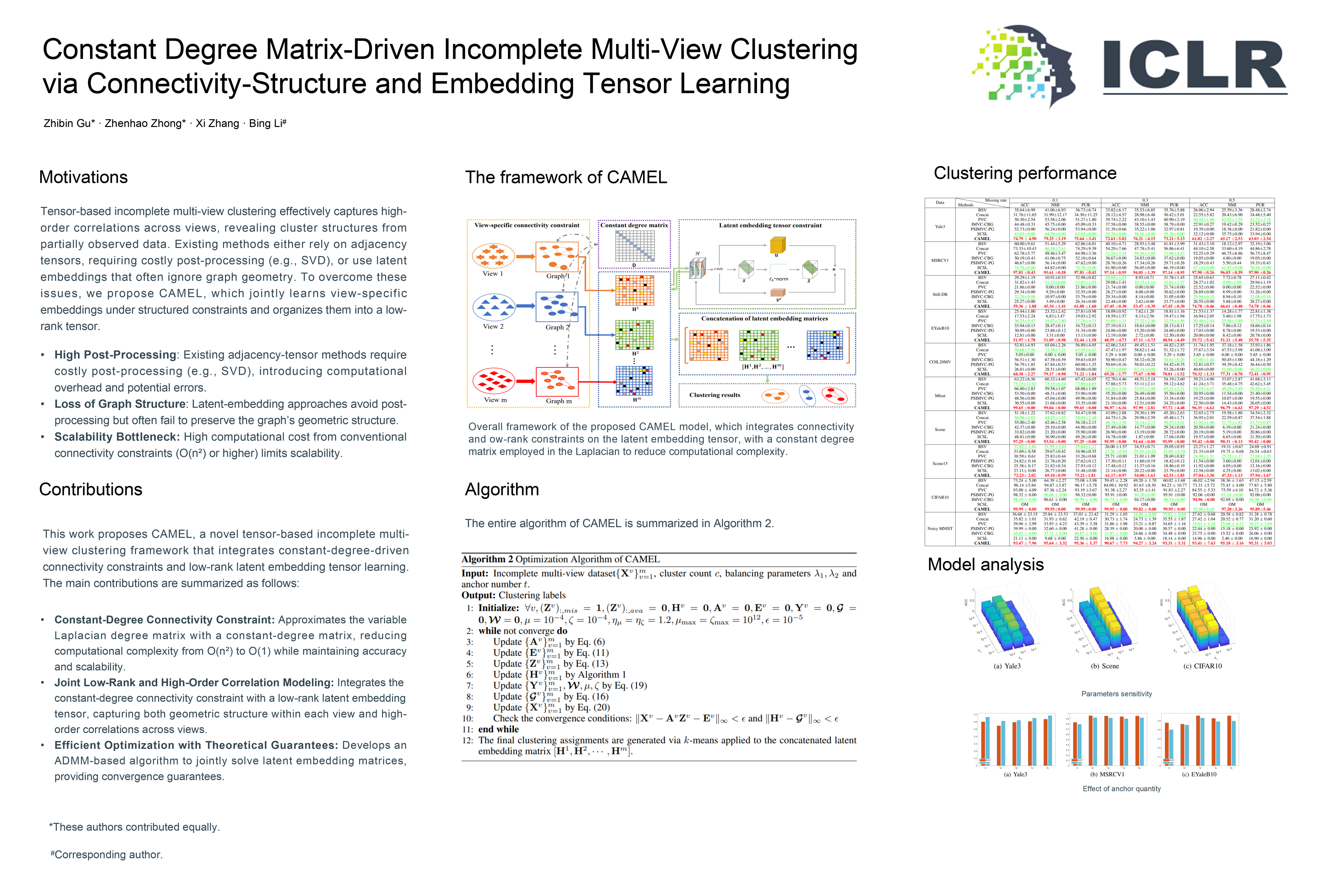
Tensor-based incomplete multi-view clustering has attracted significant research attention due to its capability to exploit high-order correlations across different views for revealing underlying cluster structures from partially observed multi-view data. However, most existing approaches construct tensors from adjacency matrices, which necessitate post-processing operations (e.g., singular value decomposition, SVD) and thereby introduce additional computational overhead and potential errors. Some approaches instead employ latent embedding tensors to avoid post-processing, but they often fail to capture the geometric structure of the underlying graph. To address these limitations, we propose **C**onst**A**nt degree **M**trix-driv**E**n incomp**L**ete multi-view clustering via connectivity-structure and embedding tensor learning (**CAMEL**). Specifically, CAMEL jointly learns view-specific latent embeddings under structured constraints and organizes them into a tensor with an ${\ell_{\delta}}$ low-rank constraint, thereby enabling coordinated optimization of graph connectivity and high-order correlations. To further mitigate the $\mathcal{O}(n^2)$ or ever higher complexity complexity associated with conventional connectivity constraints, CAMEL approximates the variable Laplacian degree matrix with a constant-degree matrix, reducing the computational cost to $\mathcal{O}(1)$. Clustering assignments are subsequently derived via $k$-means on the concatenated embeddings, eliminating the need for post-processing operations on adjacency matrices such as SVD. Extensive experiments on nine benchmark datasets demonstrate the superior effectiveness and efficiency of CAMEL.
Video
Chat is not available.
Successful Page Load