
Local Success Does Not Compose: Benchmarking Large Language Models for Compositional Formal Verification
Abstract
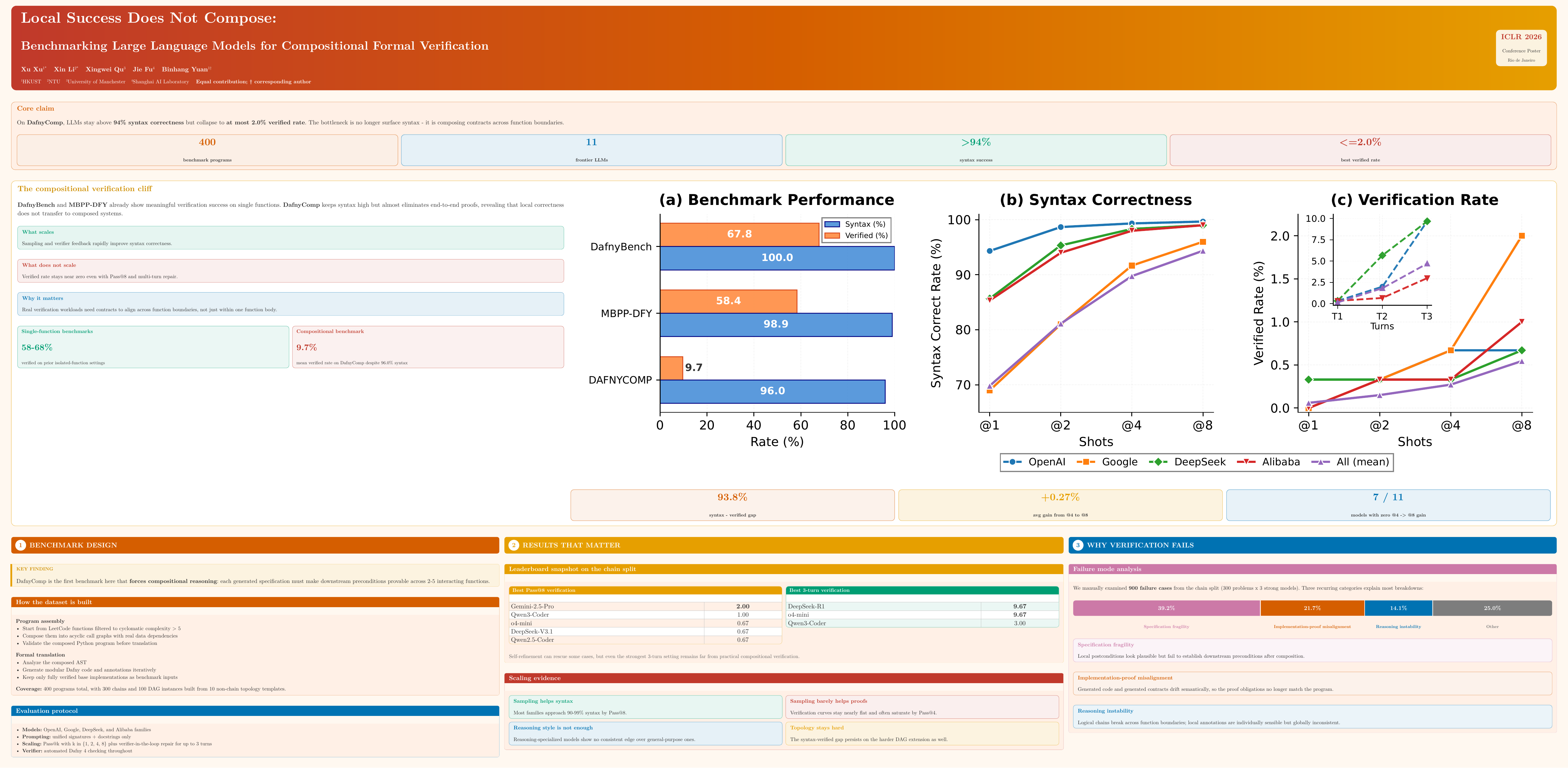
Despite rapid advances in code generation, current Large Language Models (LLMs) still struggle with reliable and verifiable code synthesis in the presence of compositional reasoning requirements across multi-function programs. To study this systematically, we introduce DafnyCOMP, a benchmark for generating compositional Dafny specifications for programs consisting of multiple interacting functions with non-trivial data dependencies. Unlike prior benchmarks that focus primarily on single-function annotation, DafnyCOMP targets programs composed of 2-5 functions arranged in acyclic call graphs, requiring specifications that establish correctness across component boundaries. DafnyCOMP contains 400 automatically synthesized programs: 300 chain-structured instances and 100 non-chain DAG instances generated from 10 topology templates. We evaluate frontier LLMs from major providers under a unified prompting and verification protocol. While these models achieve high syntactic well-formedness (>99%) and moderate end-to-end verification (>58%) on prior single-function Dafny verification benchmarks, they obtain near-zero end-to-end verification on DafnyCOMP. On the chain split, even the strongest evaluated model reaches only 2% verification at Pass@8, with most models below 1%; the difficulty persists under broader topologies and stronger test-time scaling. Our analysis identifies three recurring failure modes that hinder cross-functional reasoning: specification fragility, implementation--proof misalignment, and reasoning instability. DafnyCOMP provides a diagnostic benchmark for tracking progress in verifiable code generation, highlighting that bridging local correctness to compositional verification remains a key open challenge.