
Conformalized Decision Risk Assessment
Abstract
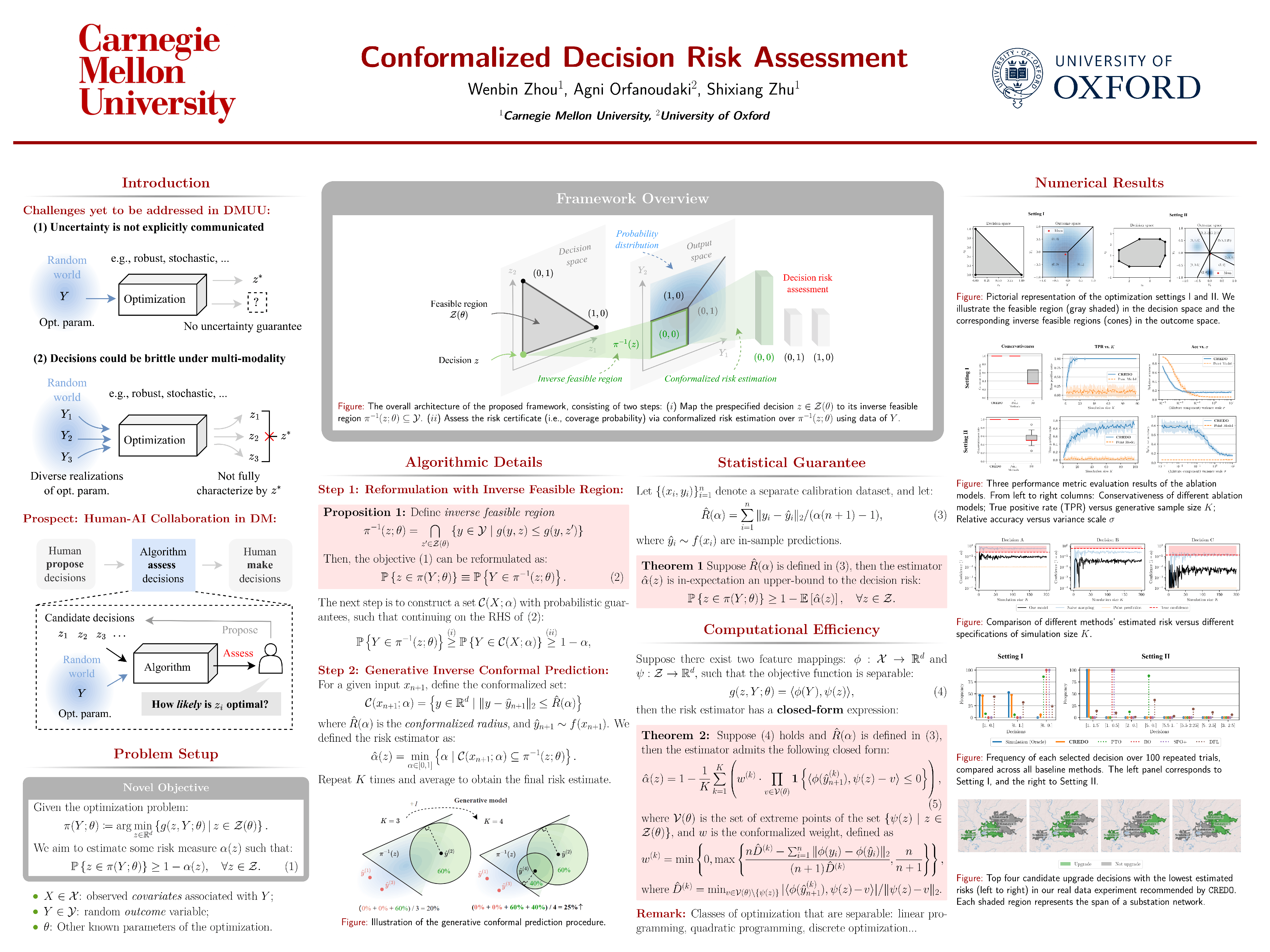
High-stakes decisions in healthcare, energy, and public policy have long depended on human expertise and heuristics, but are now increasingly supported by predictive and optimization-based tools. A prevailing paradigm in operations research is predict-then-optimize, where predictive models estimate uncertain inputs and optimization models recommend decisions. However, such approaches often sideline human judgment, creating a disconnect between algorithmic outputs and expert intuition that undermines trust and adoption in practice. To bridge this gap, we propose CREDO, a framework that, for any candidate decision proposed by human experts, provides a distribution-free upper bound on the probability of suboptimality---informed by both the optimization structure and the data distribution. By combining inverse optimization geometry with conformal generative prediction, CREDO delivers statistically rigorous yet practically interpretable risk certificates. This framework allows human decision-makers to audit and validate their decisions under uncertainty, strengthening the alignment between algorithmic tools and human intuition.