
Planned Diffusion
Abstract
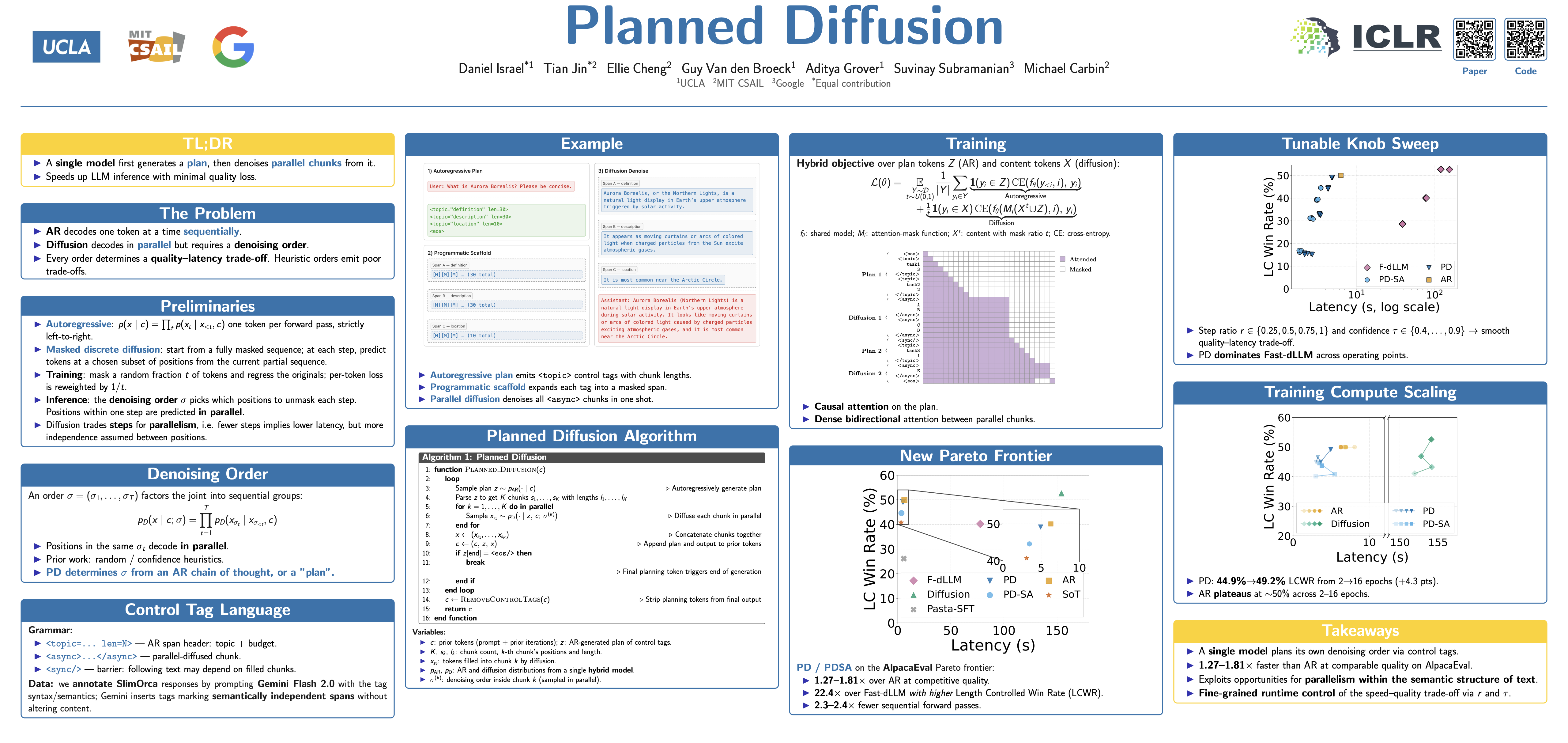
Most existing large language models are autoregressive: they generate text one token at a time, and cannot decode any new tokens until they have decoded every token before it. Discrete diffusion language models offer a promising alternative by generating multiple tokens in parallel, but sampling from them requires a denoising order, the strategy for deciding which tokens to decode at each step. Determining the right denoising order is difficult, and existing approaches use heuristics that create a steep trade-off between quality and latency. We propose planned diffusion, a system that trains the model to determine its own denoising order. Planned diffusion uses a single model that transitions between autoregressive and diffusion-based generation: first, the model autoregressively generates a plan that partitions the response into semantically independent chunks, defining a denoising order that parallelizes sampling across chunks; second, the model executes this plan via diffusion denoising. On AlpacaEval, a suite of 805 instruction-following prompts, planned diffusion achieves Pareto-optimal trade-off between quality and latency, achieving 1.27x to 1.81x speedup over autoregressive generation with only 0.87\% to 5.4\% drop in win rate. Our empirical results show that planned diffusion exhibits superior performance scaling on downstream tasks compared to autoregressive baselines while offering the runtime flexibility to precisely navigate the quality-latency trade-off.