
Repurposing Foundation Model for Generalizable Medical Time Series Classification
Abstract
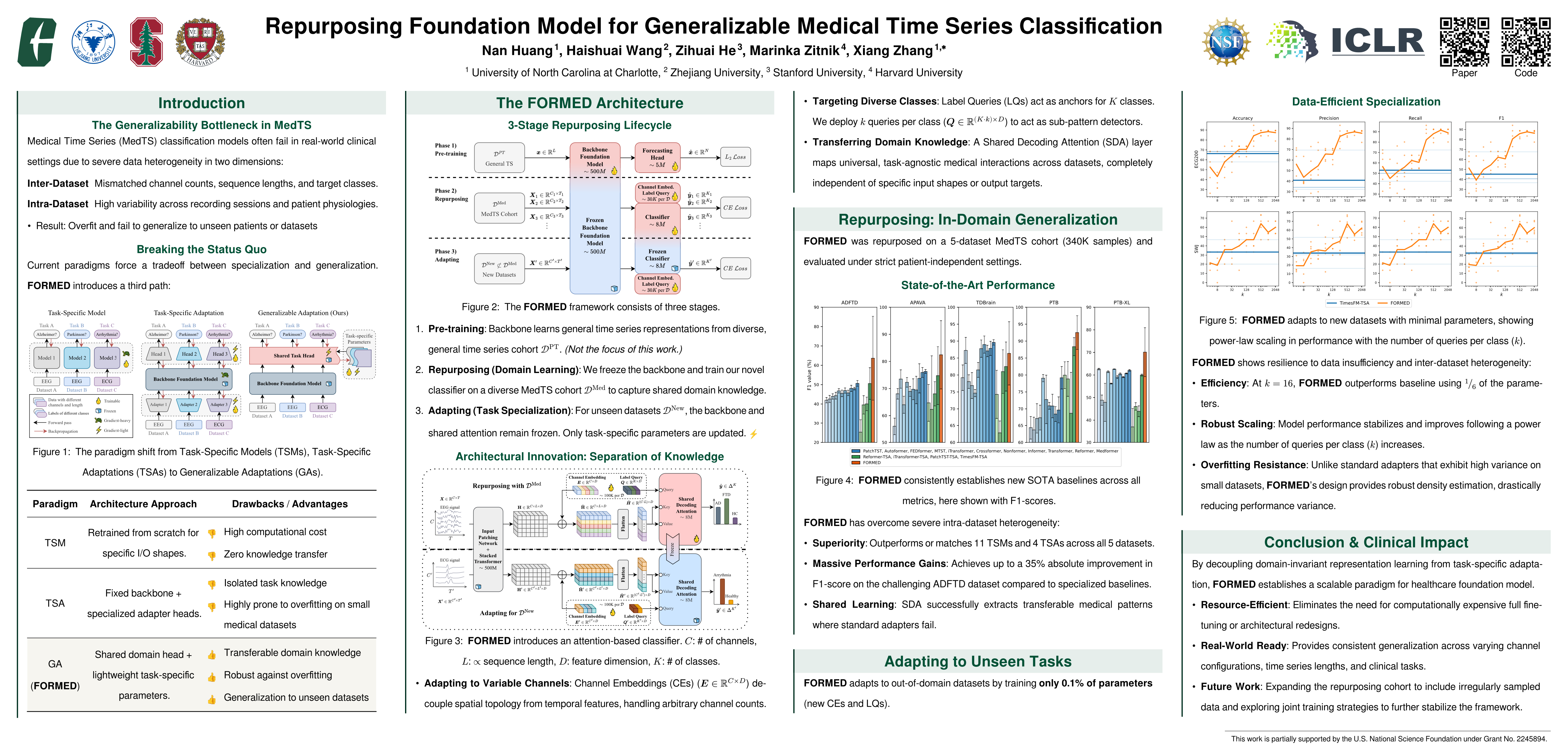
Medical time series (MedTS) classification suffers from poor generalizability in real-world deployment due to inter- and intra-dataset heterogeneity, such as varying numbers of channels, signal lengths, task definitions, and patient characteristics. % implicit patient characteristics, variable channel configurations, time series lengths, and diagnostic tasks. To address this, we propose FORMED, a novel framework for repurposing a backbone foundation model, pre-trained on generic time series, to enable highly generalizable MedTS classification on unseen datasets. FORMED combines the backbone with a novel classifier comprising two components: (1) task-specific channel embeddings and label queries, dynamically sized to match any number of channels and target classes, and (2) a shared decoding attention layer, jointly trained across datasets to capture medical domain knowledge through task-agnostic feature-query interactions. After repurposing, FORMED achieves seamless adaptation to unseen MedTS datasets through lightweight label query training (0.1\% of parameters), eliminating the need for full fine-tuning or architectural redesign. We evaluate FORMED on 5 diverse MedTS datasets, benchmarking against 11 Task-Specific Models (TSM) and 4 Task-Specific Adaptation (TSA) methods. Our results demonstrate FORMED's dominant performance, achieving up to 35\% absolute improvement in F1-score (on ADFTD dataset) over specialized baselines. By decoupling domain-invariant representation learning from task-specific adaptation, FORMED establishes a scalable and resource-efficient paradigm for foundation model repurposing in healthcare. This approach prioritizes clinical adaptability over rigid task-centric design, offering a practical pathway for real-world implementation.