
Multi-ReduNet: Interpretable Class-Wise Decomposition of ReduNet
Abstract
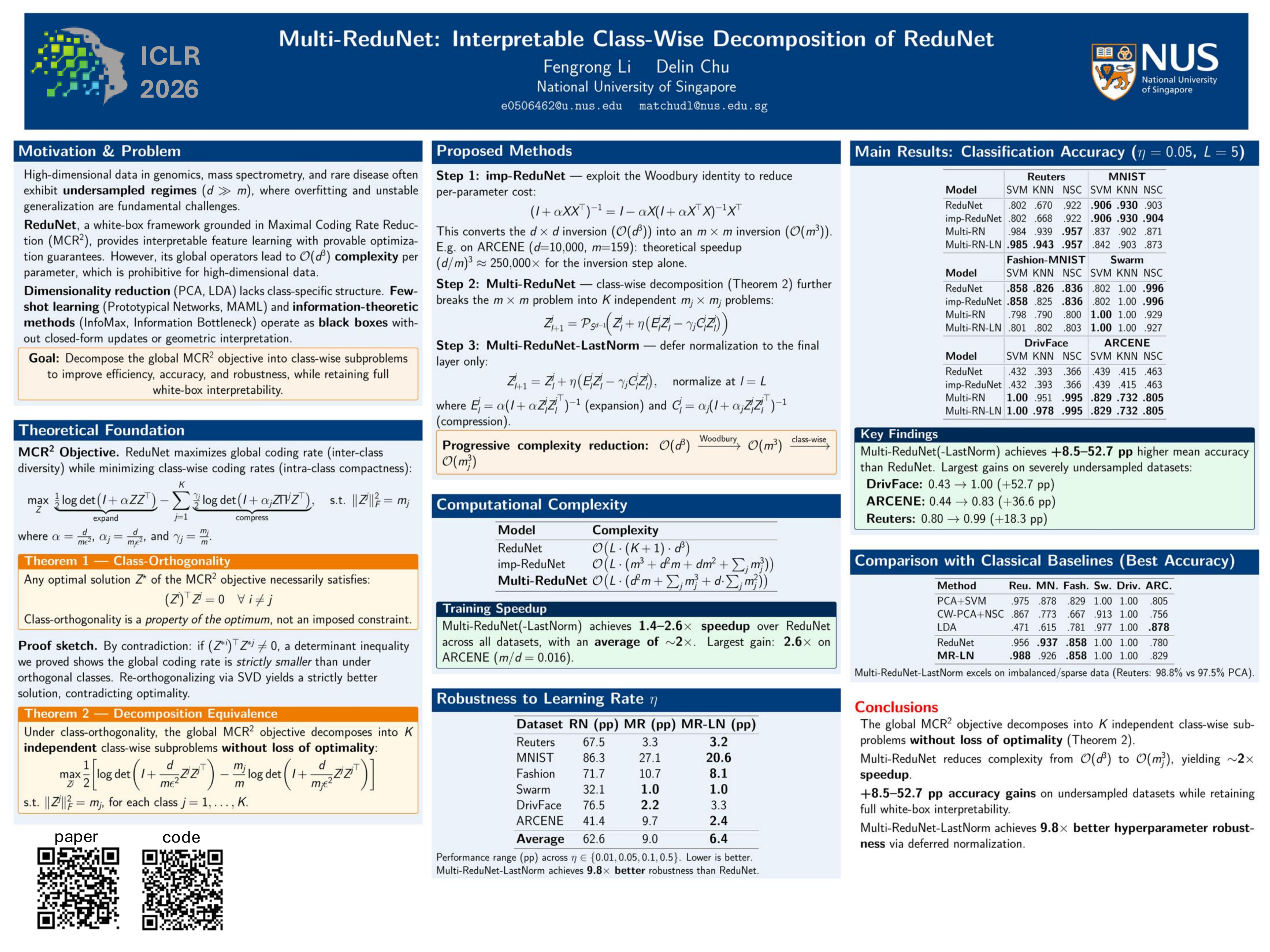
ReduNet has emerged as a promising white-box neural architecture grounded in the principle of maximal coding rate reduction, offering interpretability in deep feature learning. However, its practical applicability is hindered by computational complexity and limited ability to exploit class-specific structures, especially in undersampled regimes. In this work, we propose Multi-ReduNet and its variant Multi-ReduNet-LastNorm, which decompose the global learning objective into class-wise subproblems. These extensions preserve the theoretical foundation of ReduNet while improving training efficiency by reducing matrix inversion costs and enhancing feature separability. We provide a concise theoretical justification for the class-wise decomposition and show through experiments on diverse datasets that our models retain interpretability while achieving superior efficiency and discriminative power under limited supervision. Our findings suggest that class-wise extensions of ReduNet broaden its applicability, bridging the gap between interpretability and practical scalability in deep learning.