
SAIL: Self-Amplified Iterative Learning for Diffusion Model Alignment with Minimal Human Feedback
Abstract
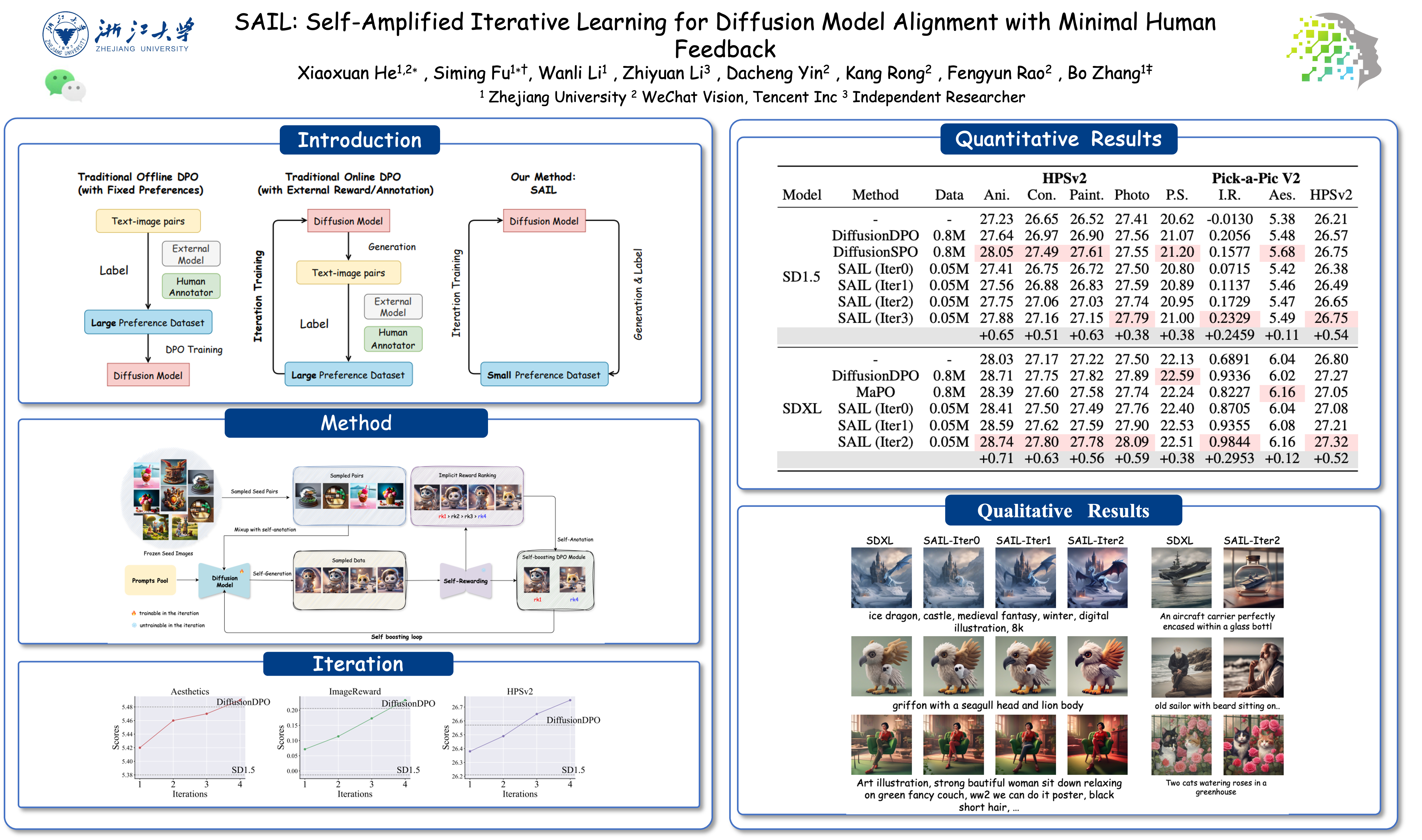
Aligning diffusion models with human preferences remains challenging, particularly when reward models are unavailable or impractical to obtain, and collecting large-scale preference datasets is prohibitively expensive. This raises a fundamental question: can we achieve effective alignment using only minimal human feedback, without auxiliary reward models, by unlocking the latent capabilities within diffusion models themselves? In this paper, we propose SAIL (Self-Amplified Iterative Learning), a novel framework that enables diffusion models to act as their own teachers through iterative self-improvement. Starting from a minimal seed set of human-annotated preference pairs, SAIL operates in a closed-loop manner where the model progressively generates diverse samples, self-annotates preferences based on its evolving understanding, and refines itself using this self-augmented dataset. To ensure robust learning and prevent catastrophic forgetting, we introduce a ranked preference mixup strategy that carefully balances exploration with adherence to initial human priors. Extensive experiments demonstrate that SAIL consistently outperforms state-of-the-art methods across multiple benchmarks while using merely 6\% of the preference data required by existing approaches, revealing that diffusion models possess remarkable self-improvement capabilities that, when properly harnessed, can effectively replace both large-scale human annotation and external reward models.