
KBVQ-MoE: KLT-guided SVD with Bias-Corrected Vector Quantization for MoE Large Language Models
Abstract
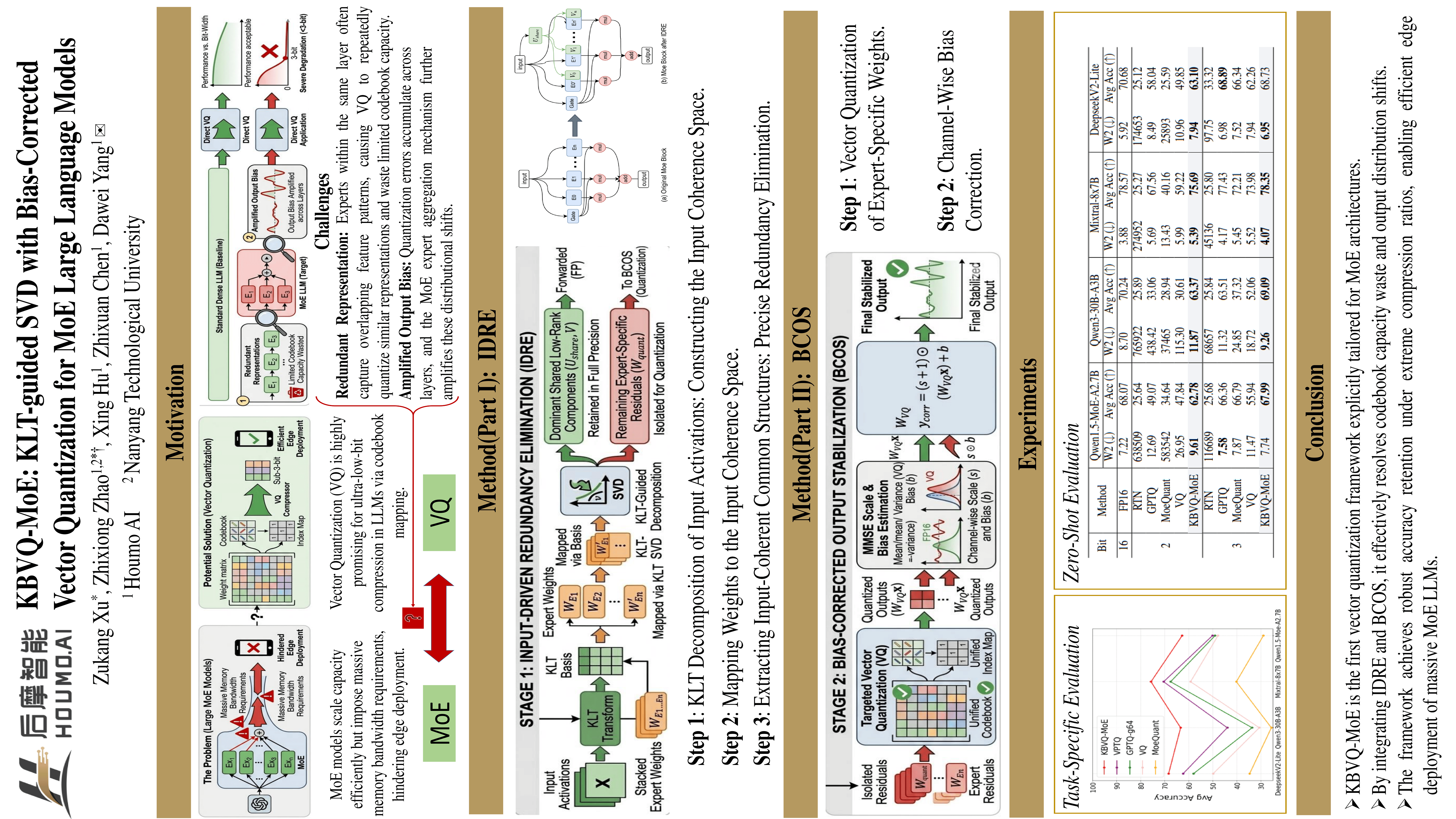
Mixture of Experts (MoE) models have achieved great success by significantly improving performance while maintaining computational efficiency through sparse expert activation. However, their enormous parameter sizes and memory demands pose significant challenges for deployment in resource-constrained environments. Vector Quantization (VQ) offers a promising approach for ultra-low-bit compression in Large Language Models (LLMs) by constructing and leveraging a codebook—where weight vectors are mapped to the most similar discrete codewords within the codebook. However, its direct application to MoEs suffers from significant performance degradation caused by two critical obstacles: (1) redundant representation among experts leads to VQ repeatedly quantizing similar representations for each expert, resulting in inefficient utilization of the limited codebook capacity; and (2) cumulative outputs bias, amplified by expert aggregation, leads to distributional shifts in the quantized outputs, resulting in degraded model accuracy. To this end, we propose KBVQ-MoE, a novel VQ framework to enhance extremely low-bit quantization for MoE-based LLMs. KBVQ-MoE introduces two lightweight and offline techniques that introduce negligible runtime computational and memory overhead: (1) Input-driven redundancy elimination, where a Karhunen–Loève Transform (KLT) guided singular value decomposition (SVD) extracts and shares dominant weight components across experts. (2) Bias-corrected output stabilization, where vector quantization is applied to expert-specific (i.e., non-redundant) representations and the quantized outputs are corrected with channel-wise affine compensation. Experiments on various MoE LLMs demonstrate that KBVQ-MoE preserves accuracy substantially better than existing quantization methods. For instance, 3-bit quantization of Qwen1.5-MoE-A2.7B achieves an average accuracy of 67.99, nearly identical to the FP16 baseline of 68.07, underscoring the potential of KBVQ-MoE for efficient deployment on edge devices and other resource-constrained platforms.