
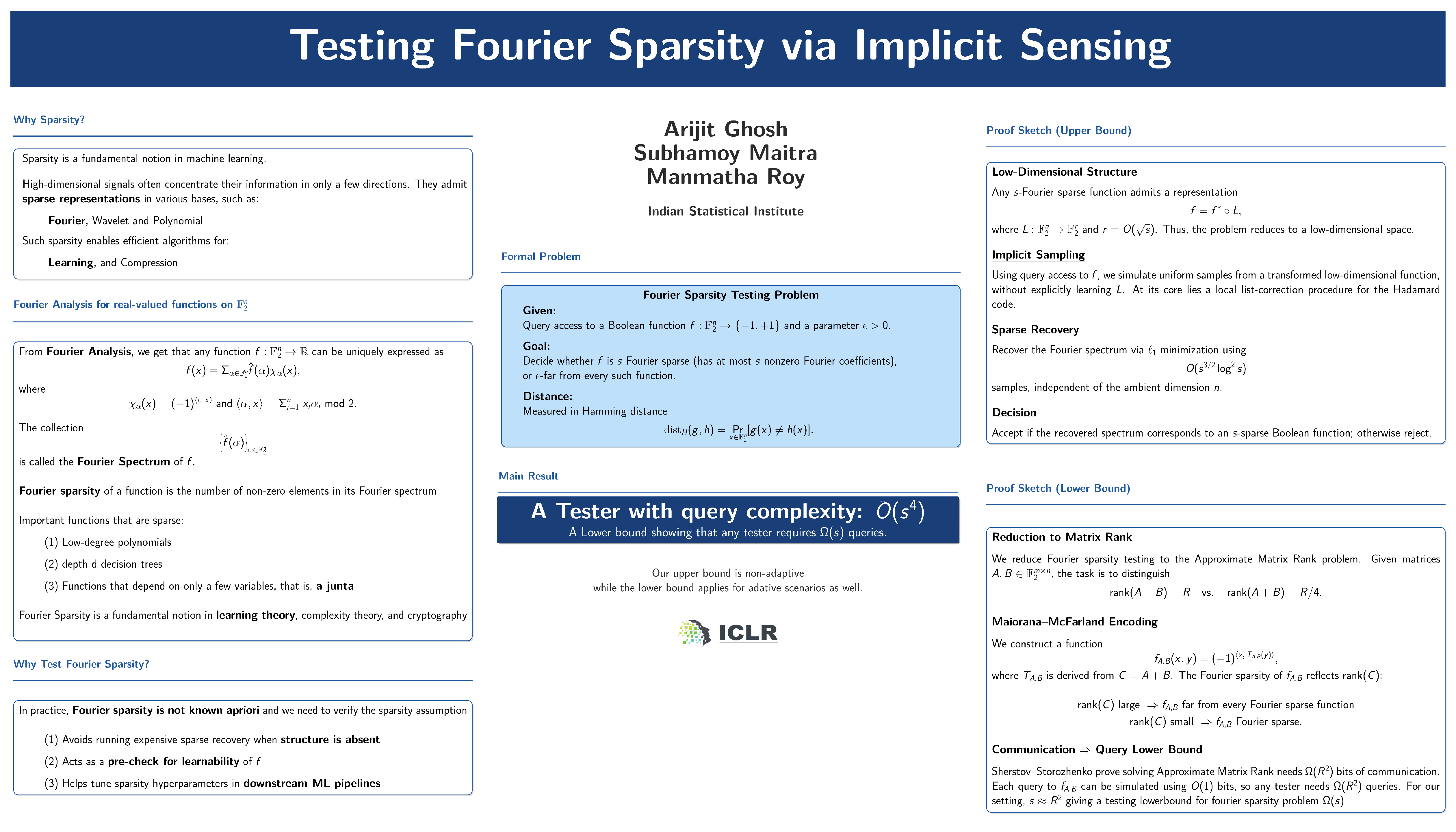
Testing Fourier Sparsity via Implicit Sensing
Arijit Ghosh ⋅ Subhamoy Maitra ⋅ Manmatha Roy
Abstract
Boolean functions constitute a fundamental object of study in machine learning and theoretical computer science. Among their various complexity measures, Fourier sparsity, the number of nonzero coefficients in a function’s Fourier expansion, serves as a natural indicator of structural simplicity. For more than three decades, the problem of learning Boolean functions with sparse Fourier representations has occupied a central place in computational learning theory. A major line of progress has produced algorithms whose complexities depend primarily on the sparsity parameter itself. However, these methods typically assume that this parameter is known in advance. In this work, we explore the problem of Fourier sparsity testing, which naturally relates to this question. Given query access to a Boolean function $f : \mathbb{F}_2^n \to \{ -1, +1 \}$, we seek to determine whether it is $s$-Fourier sparse or far (under Hamming distance) from every such function. Our contributions are twofold. On the algorithmic side, we design a new tester with query complexity $\widetilde{O}(s^4)$, independent of the ambient dimension. On the lower bound side, we prove that any tester requires at least $\Omega(s)$ queries. Both bounds improve upon the best known results of Gopalan et al. (SICOMP 2011), who obtained a tester with query complexity $\widetilde{O}(s^{14})$ and a lower bound of $\Omega(\sqrt{s})$. For the upper bound, we introduce a refined notion of a sampler inspired by the junta testing framework and combine it with $\ell_1$-minimization-based compressed sensing techniques. In doing so, we develop a novel method for sampling leaves of parity decision trees associated with Fourier-sparse Boolean functions. The lower bound is obtained via a reduction from communication complexity, leveraging structural properties of Fourier coefficients of a specific class of cryptographically hard functions.
Video
Chat is not available.
Successful Page Load