
OmniEVA: Embodied Versatile Planner via Task-Adaptive 3D-Grounded and Embodiment-aware Reasoning
Abstract
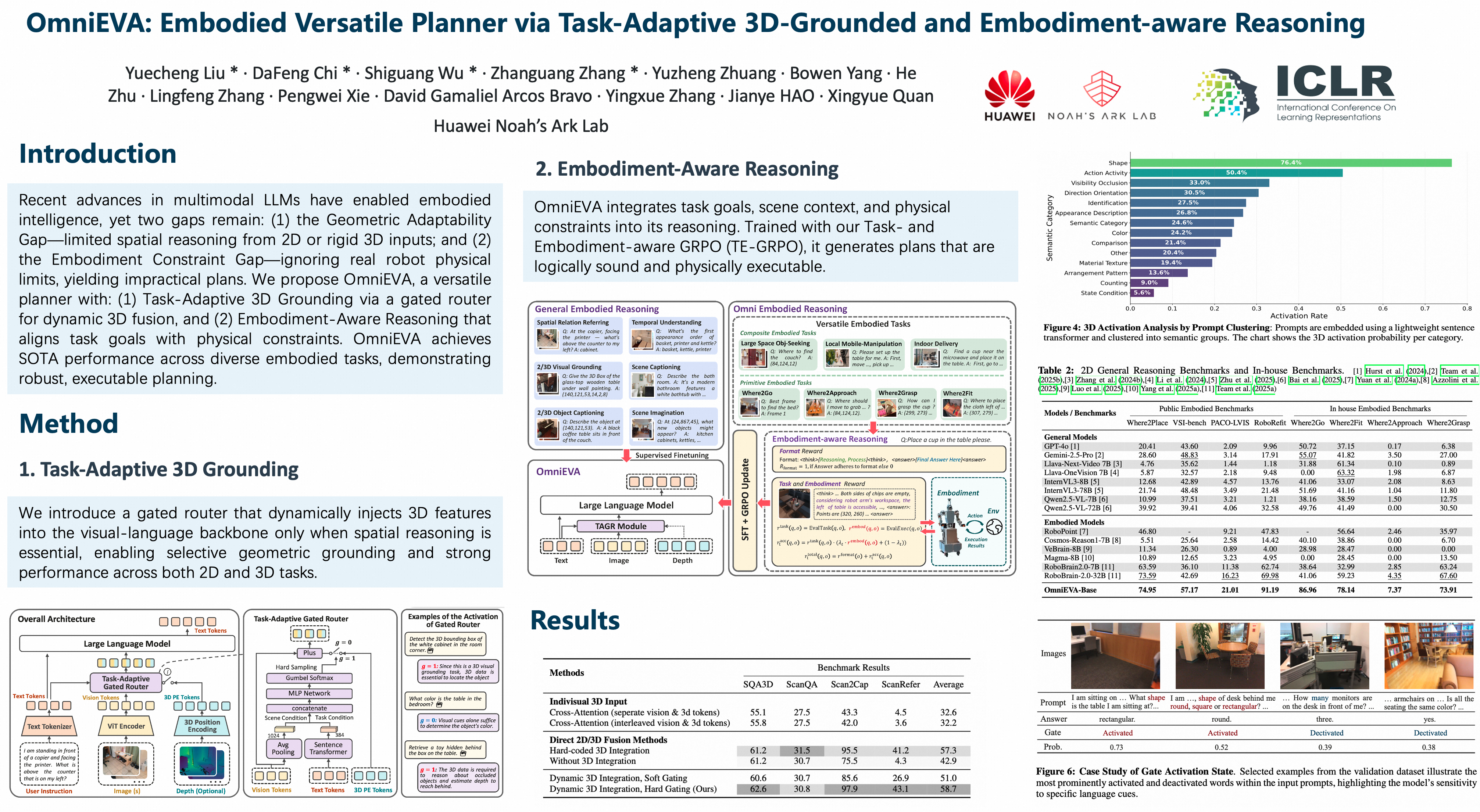
Recent advances in multimodal large language models (MLLMs) have opened new opportunities for embodied intelligence, enabling multimodal understanding, reasoning, and interaction, as well as continuous spatial decision-making. Nevertheless, current MLLM-based embodied systems face two critical limitations. First, Geometric Adaptability Gap: models trained solely on 2D inputs or with hard-coded 3D geometry injection suffer from either insufficient spatial information or restricted 2D generalization, leading to poor adaptability across tasks with diverse spatial demands. Second, Embodiment Constraint Gap: prior work often neglects the physical constraints of real robots, resulting in task plans that are theoretically valid but practically infeasible.To address these gaps, we introduce OmniEVA -- an embodied versatile planner that enables advanced embodied reasoning and task planning through two pivotal innovations: (1) a Task-Adaptive 3D Grounding mechanism, which uses a gated router to dynamically inject 3D features based on task context, enabling selective geometric reasoning. (2) an Embodiment-Aware Reasoning framework that incorporates task goals and physical constraints into the reasoning loop, ensuring executable plans. Extensive experiments show that OmniEVA achieves state-of-the-art performance on 7 of 8 embodied reasoning benchmarks and excels in downstream tasks such as object navigation and mobile manipulation. Evaluations on proposed primitive and composite benchmarks confirm its robust and versatile planning capabilities.