
Temporal Slowness in Central Vision Drives Semantic Object Learning
Abstract
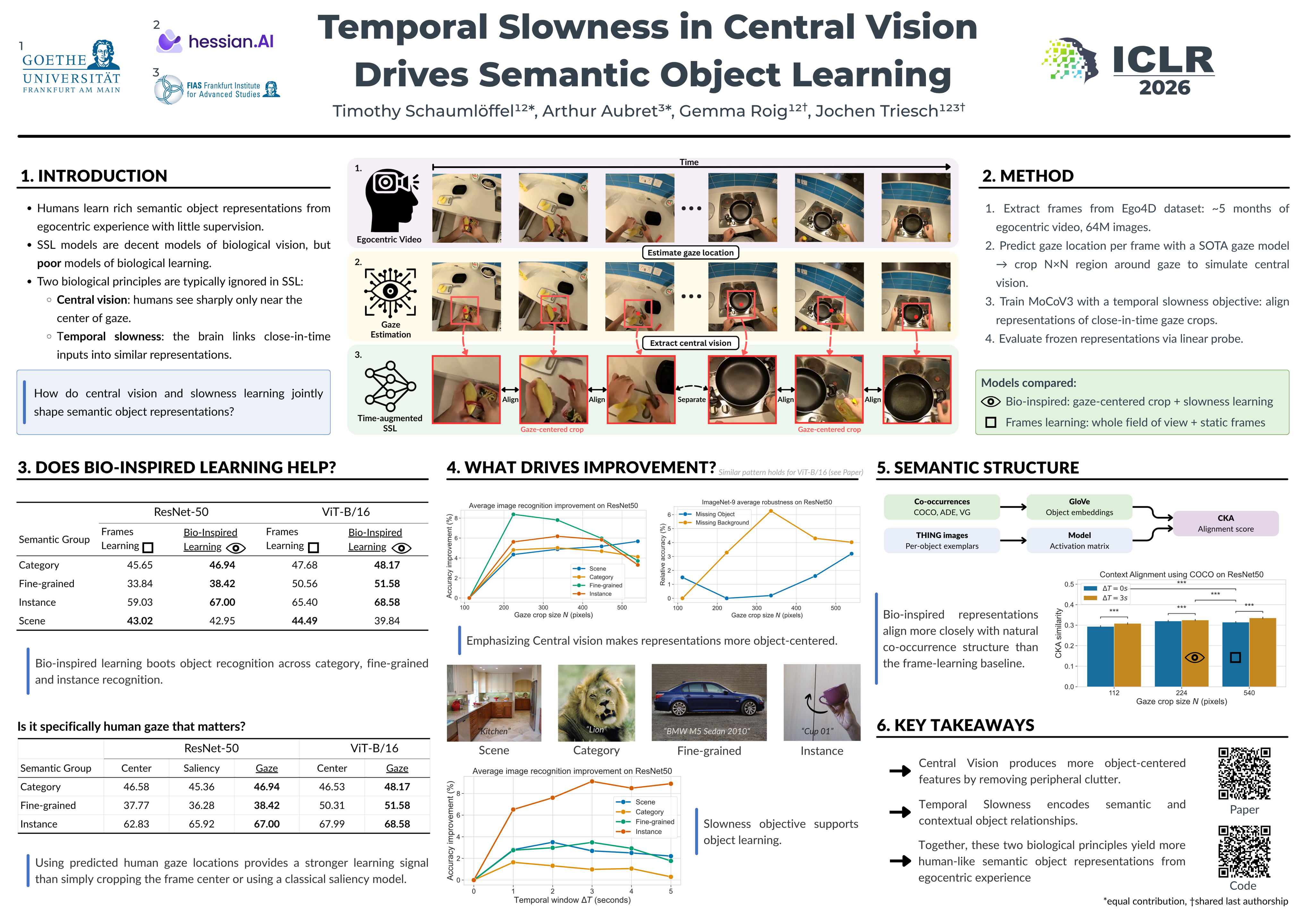
Humans acquire semantic object representations from egocentric visual streams with minimal supervision, but the underlying mechanisms remain unclear. Importantly, the visual system only processes the center of its field of view with high resolution and it learns similar representations for visual inputs occurring close in time. This emphasizes slowly changing information around gaze locations. This study investigates the role of central vision and slowness learning in the formation of semantic object representations from human-like visual experience. We simulate five months of human-like visual experience using the Ego4D dataset and a state-of-the-art gaze prediction model. We extract image crops around predicted gaze locations to train a time-contrastive Self-Supervised Learning model. Our results show that exploiting temporal slowness when learning from central visual field experience improves the encoding of different facets of object semantics. Specifically, focusing on central vision strengthens the extraction of foreground object features, while considering temporal slowness, especially in conjunction with eye movements, allows the model to encode broader semantic information about objects. These findings provide new insights into the mechanisms by which humans may develop semantic object representations from natural visual experience. Our code will be made public upon acceptance. Code is available at https://github.com/t9s9/central-vision-ssl.