
Doloris: Dual Conditional Diffusion Implicit Bridges with Sparsity Masking Strategy for Unpaired Single-Cell Perturbation Estimation
Abstract
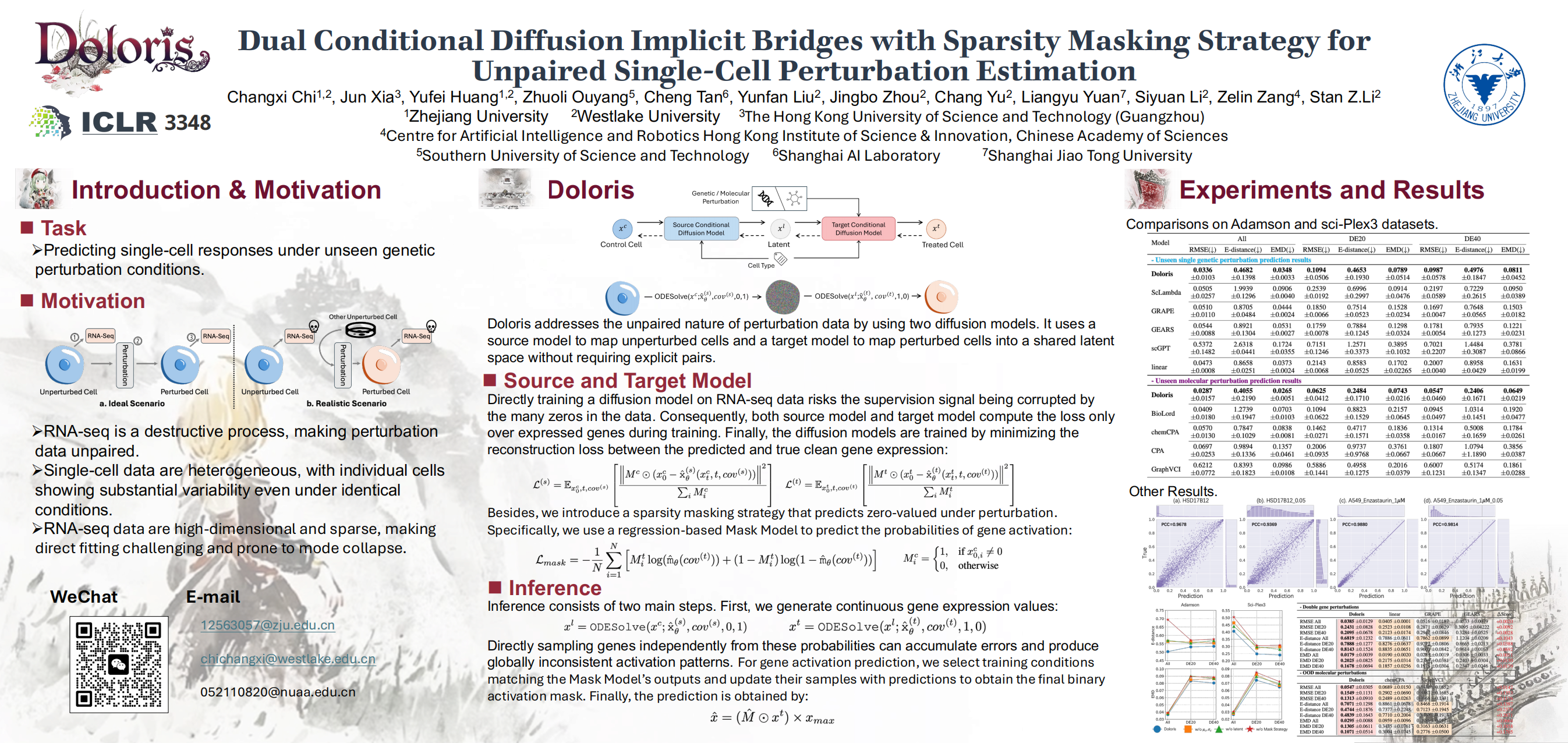
Estimating single-cell responses across various perturbations facilitates the identification of key genes and enhances drug screening, significantly boosting experimental efficiency. However, single-cell sequencing is a destructive process, making it impossible to capture the same cell's phenotype before and after perturbation. Consequently, data collected under perturbed and unperturbed conditions are inherently unpaired, creating a critical yet unresolved problem in single-cell perturbation modeling. Moreover, the high dimensionality and sparsity of single-cell expression make direct modeling prone to focusing on zeros and neglecting meaningful patterns. To address these problems, we propose a new paradigm for single-cell perturbation modeling. Specifically, we leverage dual diffusion models to learn the control and perturbed distributions separately, and implicitly align them through a shared Gaussian latent space, without requiring explicit cell pairing. Furthermore, we introduce a sparsity masking strategy in which the mask model learns to predict zero-expressed genes, allowing the diffusion model to focus on capturing meaningful patterns among expressed genes and thereby preserving diversity in high-dimensional sparse data. We introduce \textbf{Doloris}, a generative framework that defines a new paradigm for modeling unpaired, high-dimensional, and sparse single-cell perturbation data. It leverages dual conditional diffusion models for separate learning of control and perturbed distributions, complemented by a sparsity masking strategy to enhance prediction of zero-valued genes. The results on publicly available datasets show that our model effectively captures the diversity of single-cell perturbations and achieves state-of-the-art performance. To facilitate reproducibility, we include the code in the supplementary materials. Code available at \url{https://github.com/ChangxiChi/Doloris}.