
Expert Heads: Robust Evidence Identification for Large Language Models
Abstract
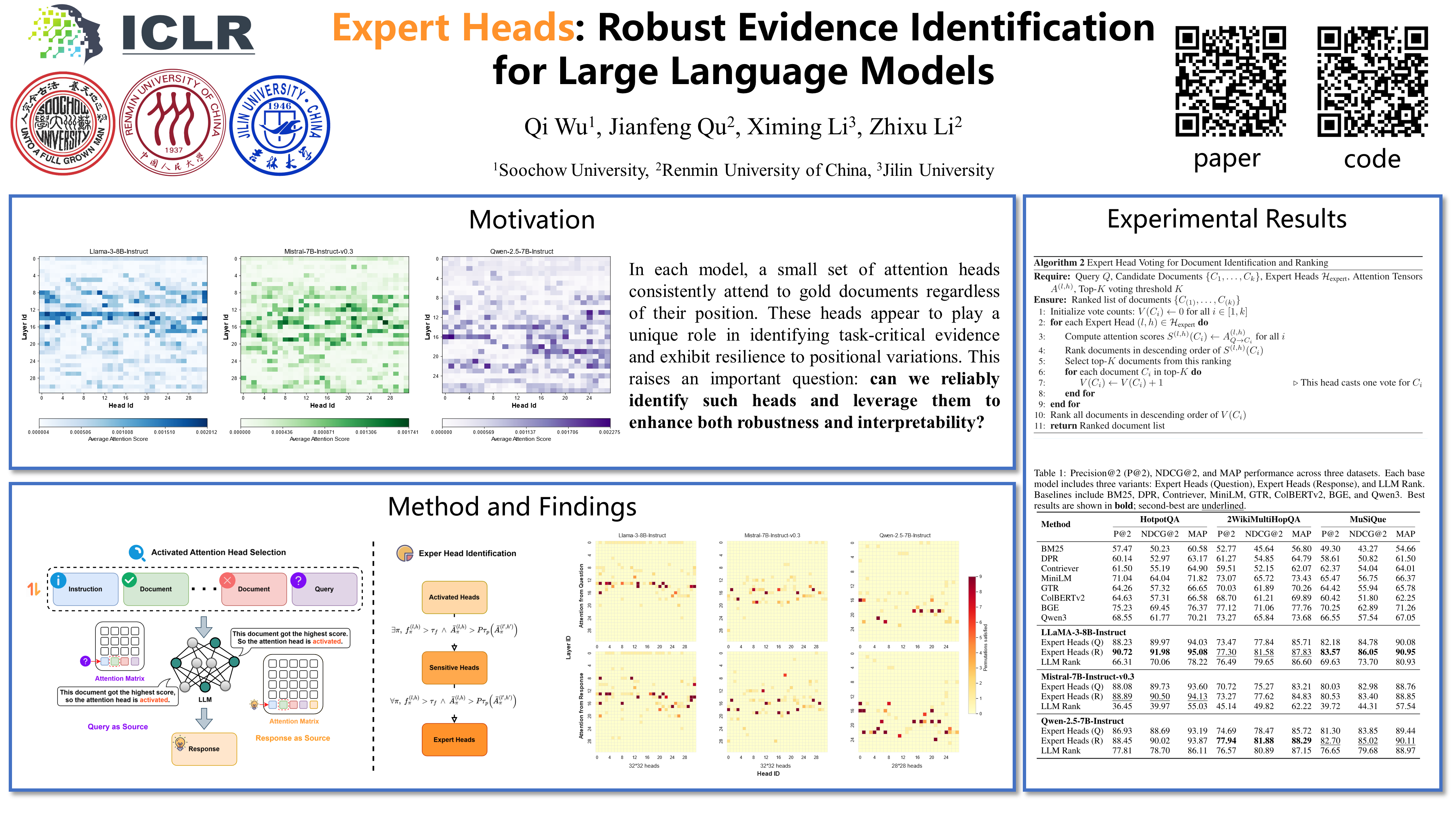
Large language models (LLMs) exhibit strong abilities in multi-document reasoning, yet their evidence identification is highly sensitive to input order. We trace this limitation to attention mechanisms, where many heads overemphasize sequence boundaries and neglect central content. We systematically analyze attention distributions under document permutations and discover a small subset of heads that consistently prioritize task-relevant documents regardless of position. We formalize these as Expert Heads, identified via activation frequency and stability across permutations. Experiments on LLaMA, Mistral, and Qwen reveal architecture-specific patterns: mid-layer heads in LLaMA and Mistral dominate semantic integration, while deeper-layer heads in Qwen specialize in evidence selection. Moreover, Expert Heads exhibit concentrated focus during understanding and more distributed engagement during generation. Their activation strongly correlates with answer correctness, providing diagnostic signals for hallucination detection. Leveraging Expert Heads for document voting significantly improves retrieval and ranking on HotpotQA, 2WikiMultiHopQA, and MuSiQue, outperforming dense retrievers and LLM-based ranking with minimal overhead. Ablations confirm that even a small subset achieves robust gains. Our findings establish Expert Heads as a stable and interpretable mechanism for evidence integration, offering new directions for context pruning, hallucination mitigation, and head-guided training of LLMs.