
PRISM: Enhancing PRotein Inverse Folding through Fine- Grained Retrieval on Structure-Sequence Multimodal Representations
Abstract
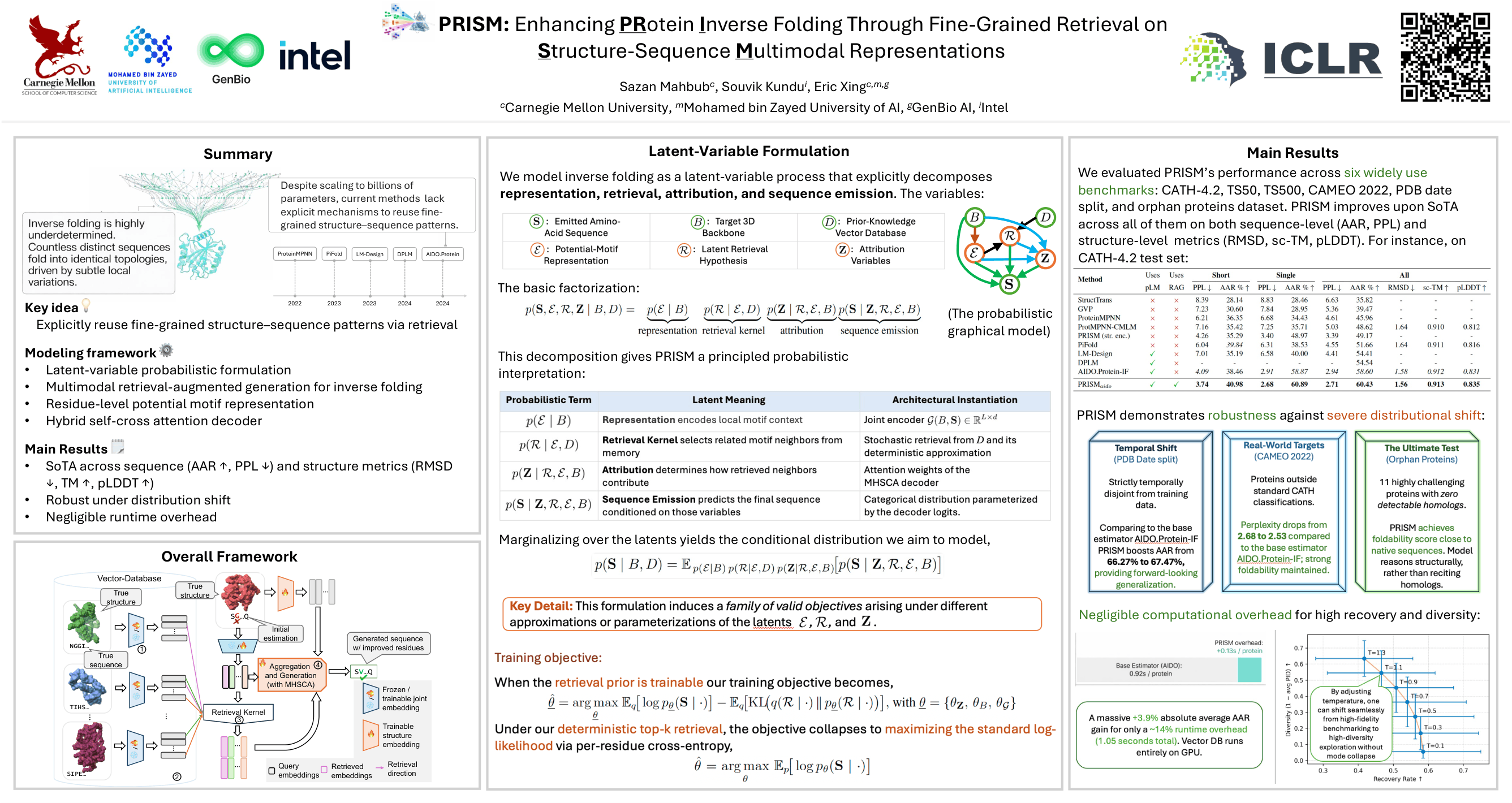
Designing protein sequences that fold into a target 3-D structure, termed as the inverse folding problem, is central to protein engineering. However, it remains challenging due to the vast sequence space and the importance of local structural constraints. Existing deep learning approaches achieve strong recovery rates, however, lack explicit mechanisms to reuse fine-grained structure-sequence patterns conserved across natural proteins. To mitigate this, we present PRISM a multimodal retrieval-augmented generation framework for inverse folding. PRISM retrieves fine-grained representations of potential motifs from known proteins and integrates them with a hybrid self-cross attention decoder. PRISM is formulated as a latent-variable probabilistic model and implemented with an efficient approximation, combining theoretical grounding with practical scalability. Experiments across multiple benchmarks, including CATH-4.2, TS50, TS500, CAMEO 2022, and the PDB date split, demonstrate the fine-grained multimodal retrieval efficacy of PRISM in yielding SoTA perplexity and amino acid recovery, while also improving the foldability metrics (RMSD, TM-score, pLDDT).