
BA-LoRA: Bias-Alleviating Low-Rank Adaptation to Mitigate Catastrophic Inheritance in Large Language Models
Abstract
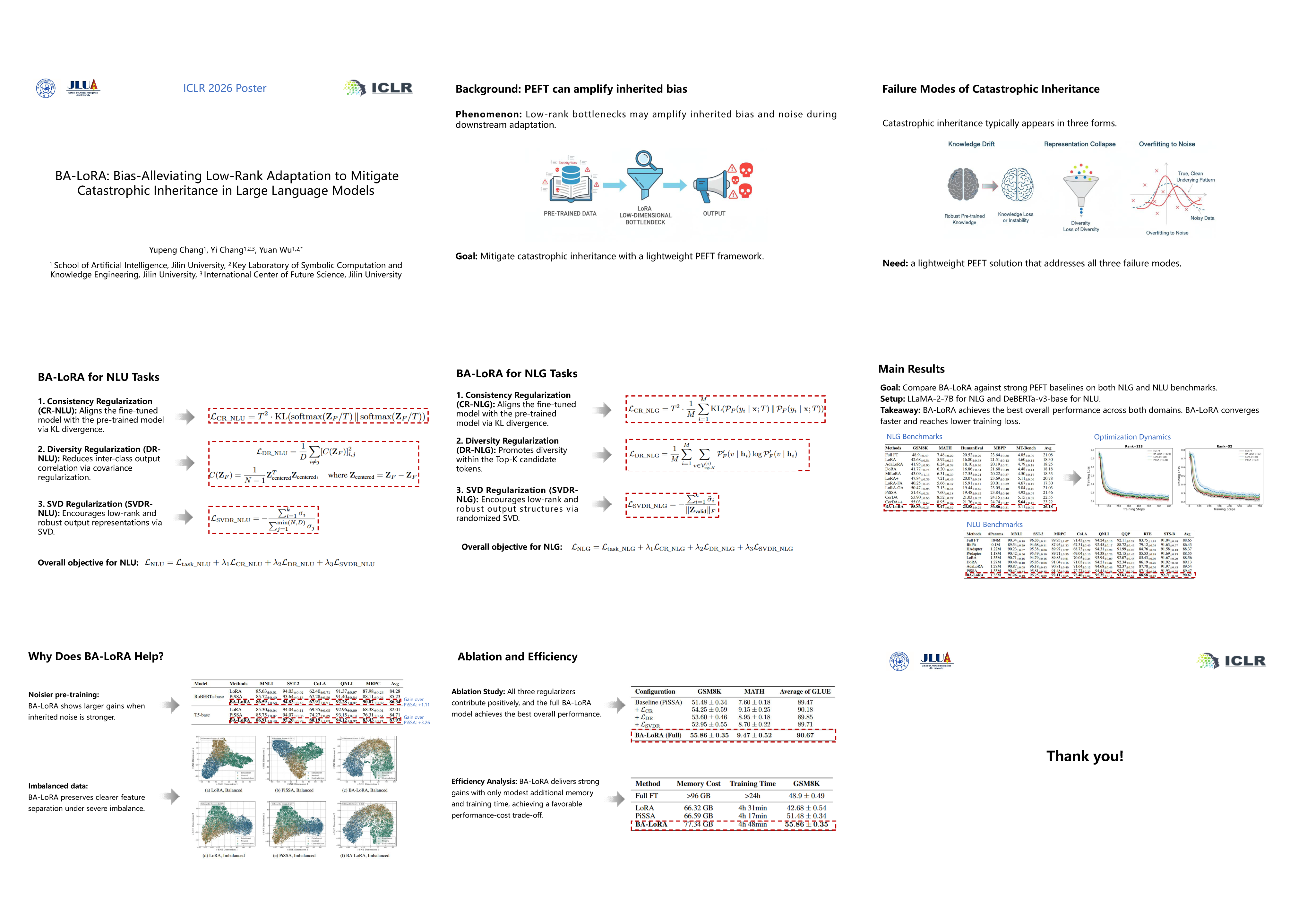
Parameter-efficient fine-tuning (PEFT) has become a de facto standard for adapting Large Language Models (LLMs). However, we identify a critical vulnerability within popular low-rank adaptation methods such as LoRA: they can exacerbate ``Catastrophic Inheritance''---the unchecked propagation of biases, noise, and data imbalances from pre-training. This phenomenon can degrade model robustness and fairness, undermining the benefits of efficient adaptation. To address this, we introduce Bias-Alleviating Low-Rank Adaptation (BA-LoRA). Our approach is founded on a principled decomposition of Catastrophic Inheritance into three core challenges: Knowledge Drift, Representation Collapse, and Overfitting to Noise. BA-LoRA systematically mitigates these issues by incorporating a trio of targeted regularizers: consistency, diversity, and an SVD-based term, designed to preserve core knowledge, enforce representational richness, and promote robust, low-rank output representations, respectively. We conduct comprehensive evaluations on a suite of Natural Language Generation (NLG) and Understanding (NLU) tasks using diverse, prominent open-source language models (e.g., LLaMA-2-7B and DeBERTa-v3-base). Our results show that BA-LoRA not only outperforms state-of-the-art LoRA variants in terms of performance and stability, but also demonstrates superior robustness and bias mitigation on targeted evaluations. These results provide evidence that BA-LoRA can counteract the adverse effects of Catastrophic Inheritance. Code is available at https://github.com/llm172/BA-LoRA.