
Characterizing and Optimizing the Spatial Kernel of Multi Resolution Hash Encodings
Tianxiang Dai ⋅ Jonathan Fan
Abstract
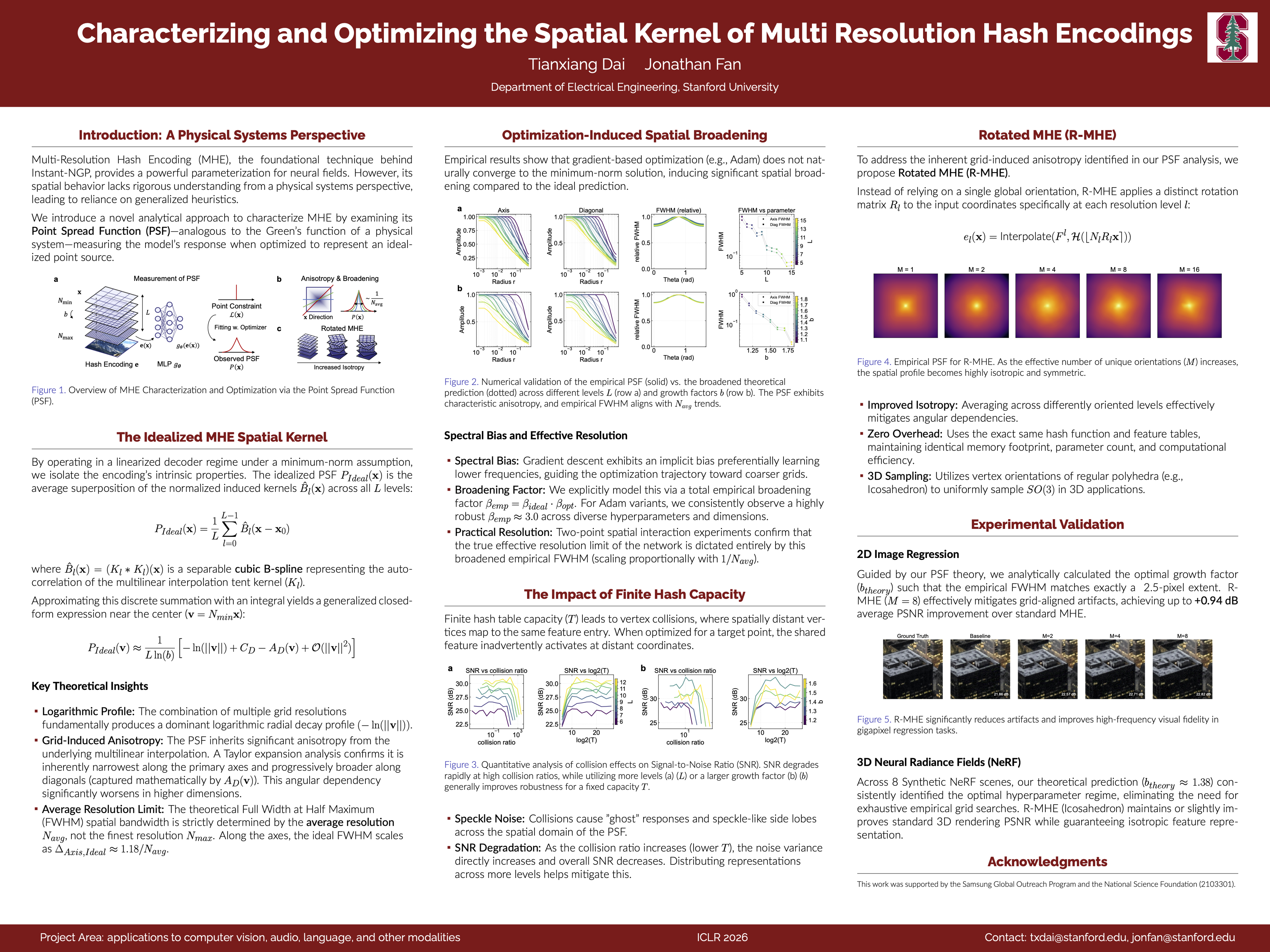
Multi-Resolution Hash Encoding (MHE), the foundational technique behind Instant Neural Graphics Primitives, provides a powerful parameterization for neural fields. However, its spatial behavior lacks rigorous understanding from a physical systems perspective, leading to reliance on heuristics for hyperparameter selection. This work introduces a novel analytical approach that characterizes MHE by examining its Point Spread Function (PSF), which is analogous to the Green's function of the system. This methodology enables a quantification of the encoding's spatial resolution and fidelity. We derive a closed-form approximation for the collision-free PSF, uncovering inherent grid-induced anisotropy and a logarithmic spatial profile. We establish that the idealized spatial bandwidth, specifically the Full Width at Half Maximum (FWHM), is determined by the average resolution, $N_{\text{avg}}$. This leads to a counterintuitive finding: the effective resolution of the model is governed by the broadened empirical FWHM (and therefore $N_{\text{avg}}$), rather than the finest resolution $N_{\max}$, a broadening effect we demonstrate arises from optimization dynamics. Furthermore, we analyze the impact of finite hash capacity, demonstrating how collisions introduce speckle noise and degrade the Signal-to-Noise Ratio (SNR). Leveraging these theoretical insights, we propose Rotated MHE (R-MHE), an architecture that applies distinct rotations to the input coordinates at each resolution level. R-MHE mitigates anisotropy while maintaining the efficiency and parameter count of the original MHE. This study establishes a methodology based on physical principles that moves beyond heuristics to characterize and optimize MHE.
Video
Chat is not available.
Successful Page Load