
CoLA: Co-Calibrated Logit Adjustment for Long-Tailed Semi-Supervised Learning
Qian Shao ⋅ Qiyuan Chen ⋅ Jiahe Chen ⋅ Zepeng Li ⋅ Qianqian Tang ⋅ Hongxia Xu ⋅ JIAN Wu
Abstract
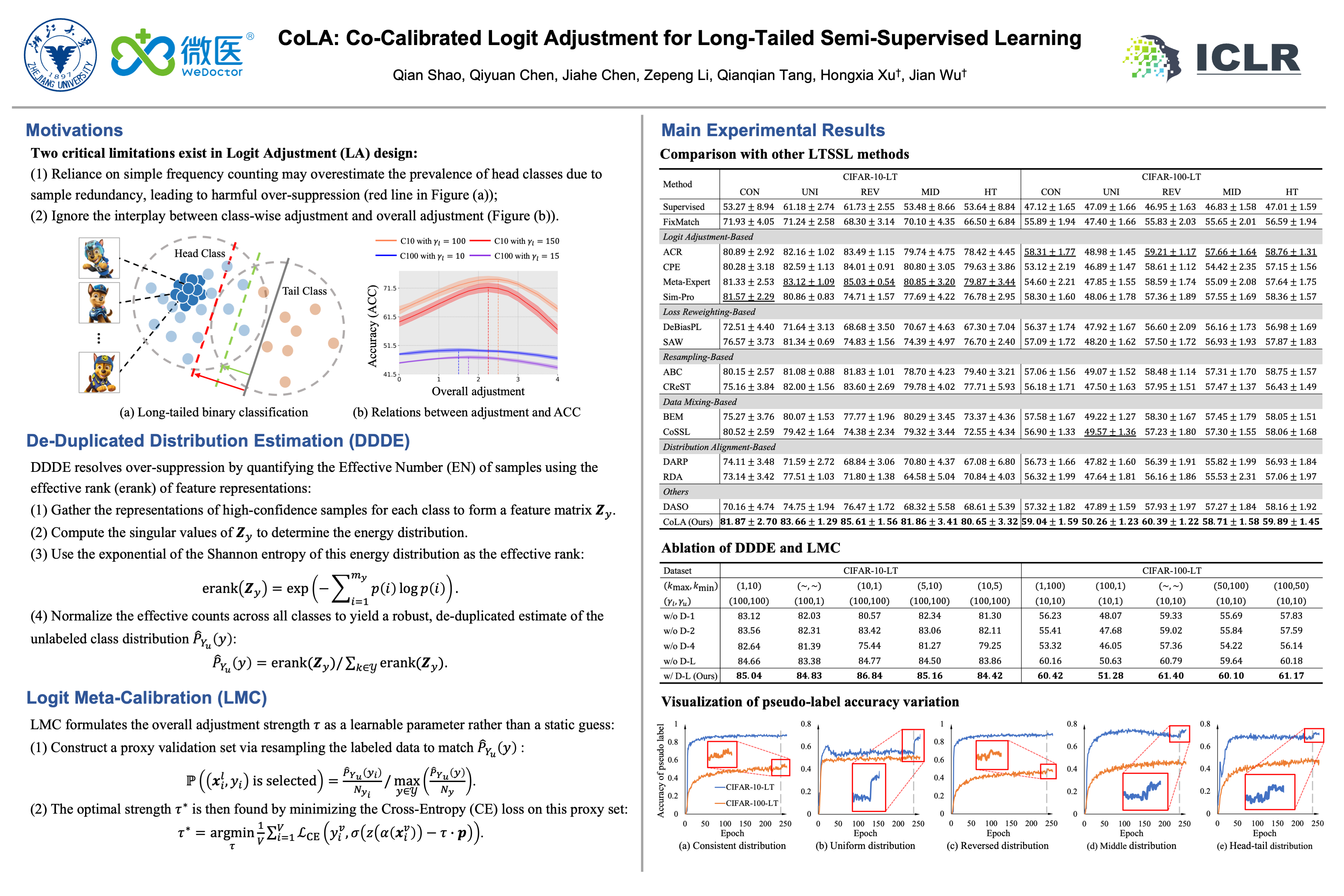
Long-tailed semi-supervised learning is hampered by a vicious cycle of confirmation bias, where skewed pseudo-labeling progressively marginalizes tail classes. This challenge is compounded in real-world scenarios by a class distribution mismatch between labeled and unlabeled data, rendering the bias unpredictable and difficult to mitigate. While existing methods adapt Logit Adjustment (LA) using dynamic estimates of the unlabeled distribution, we argue their effectiveness is undermined by two critical limitations stemming from LA's core design, *i.e.*, its class-wise and overall adjustment mechanisms. First, their reliance on simple frequency counting overestimates the prevalence of head classes due to sample redundancy, leading to harmful over-suppression. Second, and more critically, they overlook the interplay between the above two types of adjustment, treating the overall adjustment strength as a fixed hyperparameter. This is a significant oversight, as we empirically find that the optimal strength is highly sensitive to the estimated distribution. To address these limitations, we propose Co-Calibrated Logit Adjustment (CoLA), a framework that co-designs the class-wise and overall LA components. Specifically, CoLA refines the class-wise adjustment by estimating each class's effective sample size via the effective rank of its representations. Subsequently, it formulates the overall adjustment strength as a learnable parameter, which is optimized through a meta-learning procedure on a proxy validation set constructed to mirror the refined distribution. Supported by a theoretical generalization bound, our extensive experiments show that CoLA outperforms existing baselines on $4$ public benchmarks across standard long-tail setups.
Video
Chat is not available.
Successful Page Load