
Coarse-to-Fine Learning of Dynamic Causal Structures
Abstract
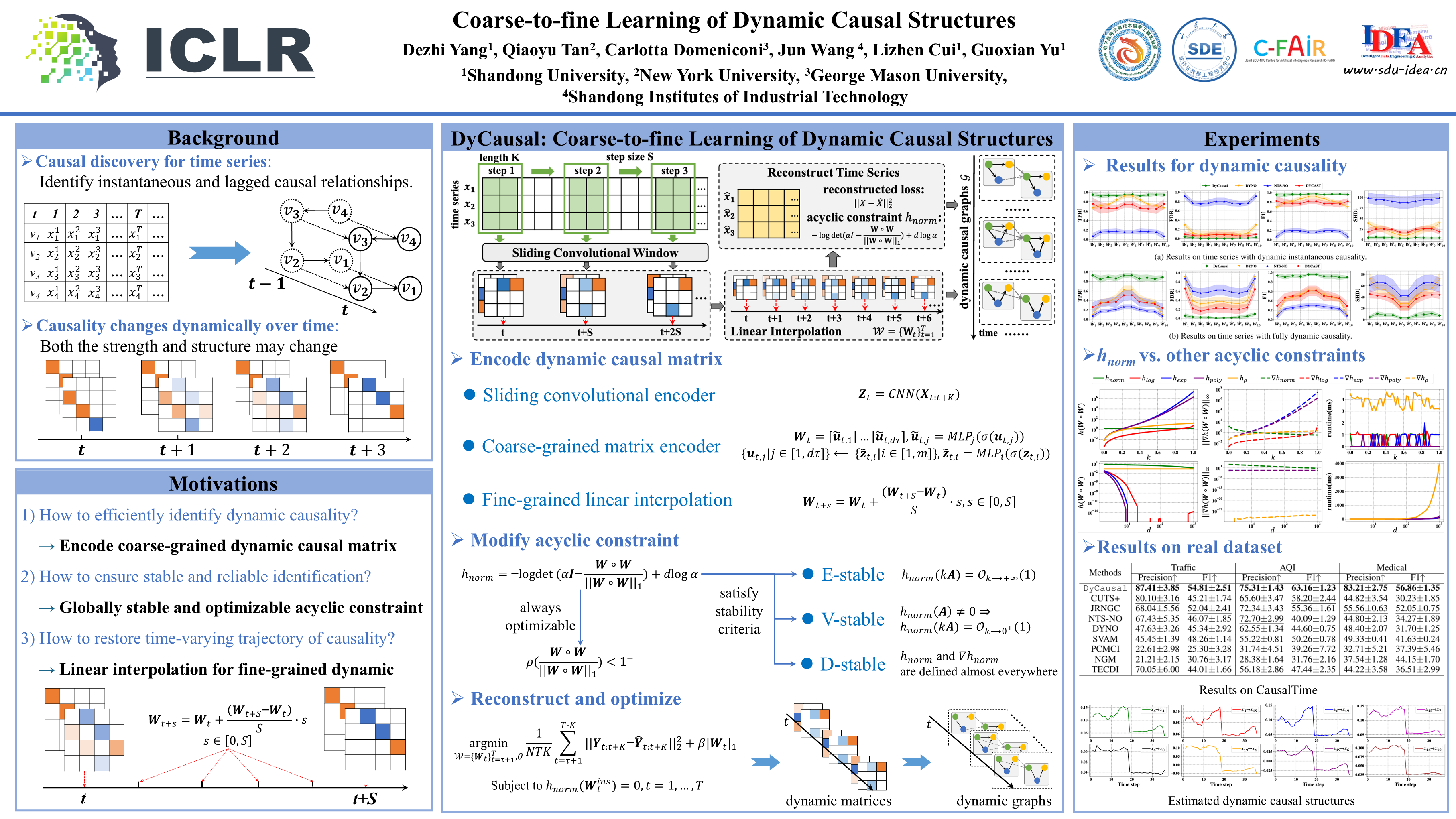
Learning the dynamic causal structure is a difficult challenge in discovering causality from time series. Most existing studies rely on distributional or structural invariance to uncover the underlying causal dynamics, assuming stationary or partially stationary causality, which frequently conflicts with complex causal relationships in the real world. This boosts temporal causal discovery to encompass fully dynamic causality, where both instantaneous and lagged causal dependencies may change over time, bringing significant challenges to the efficiency and stability of causal discovery. To tackle these challenges, we introduce DyCausal, a dynamic causal structure learning framework that leverages convolutional networks to effectively model causal structures within coarse-grained time windows, and introduces linear interpolation to refine causal structures to each time step and recover time-varying causal graphs. In addition, we propose an acyclic constraint based on matrix norm scaling. It is more stable both theoretically and empirically, and constrains loops in dynamic causal structures with improved efficiency. Evaluations on both synthetic and real-world datasets prove that DyCausal significantly outperforms existing methods and identifies fully dynamic causal structures from coarse to fine.