
Automatic Image-Level Morphological Trait Annotation for Organismal Images
Abstract
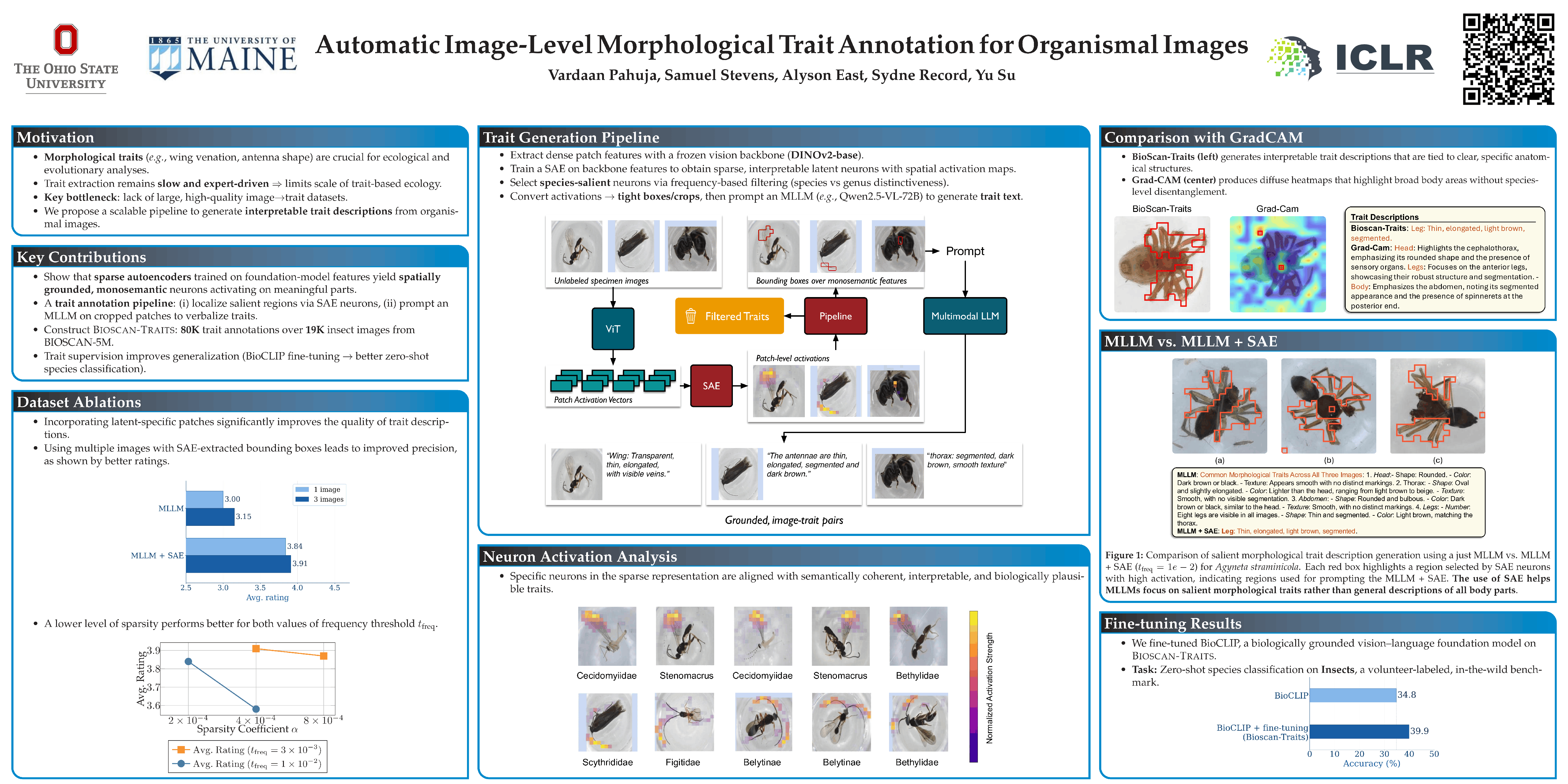
Morphological traits are physical characteristics of biological organisms that provide vital clues on how organisms interact with their environment. Yet extracting these traits remains a slow, expert-driven process, limiting their use in large-scale ecological studies. A major bottleneck is the absence of high-quality datasets linking biological images to trait-level annotations. In this work, we demonstrate that sparse autoencoders trained on foundation-model features yield monosemantic, spatially grounded neurons that consistently activate on meaningful morphological parts. Leveraging this property, we introduce a trait annotation pipeline that localizes salient regions and uses vision-language prompting to generate interpretable trait descriptions. Using this approach, we construct Bioscan-Traits, a dataset of 80K trait annotations spanning 19K insect images from BIOSCAN-5M. Human evaluation confirms the biological plausibility of the generated morphological descriptions. We assess design sensitivity through a comprehensive ablation study, systematically varying key design choices and measuring their impact on the quality of the resulting trait descriptions. By annotating traits with a modular pipeline rather than prohibitively expensive manual efforts, we offer a scalable way to inject biologically meaningful supervision into foundation models, enable large-scale morphological analyses, and bridge the gap between ecological relevance and machine-learning practicality.