
OmniCT: Towards a Unified Slice-Volume LVLM for Comprehensive CT Analysis
Abstract
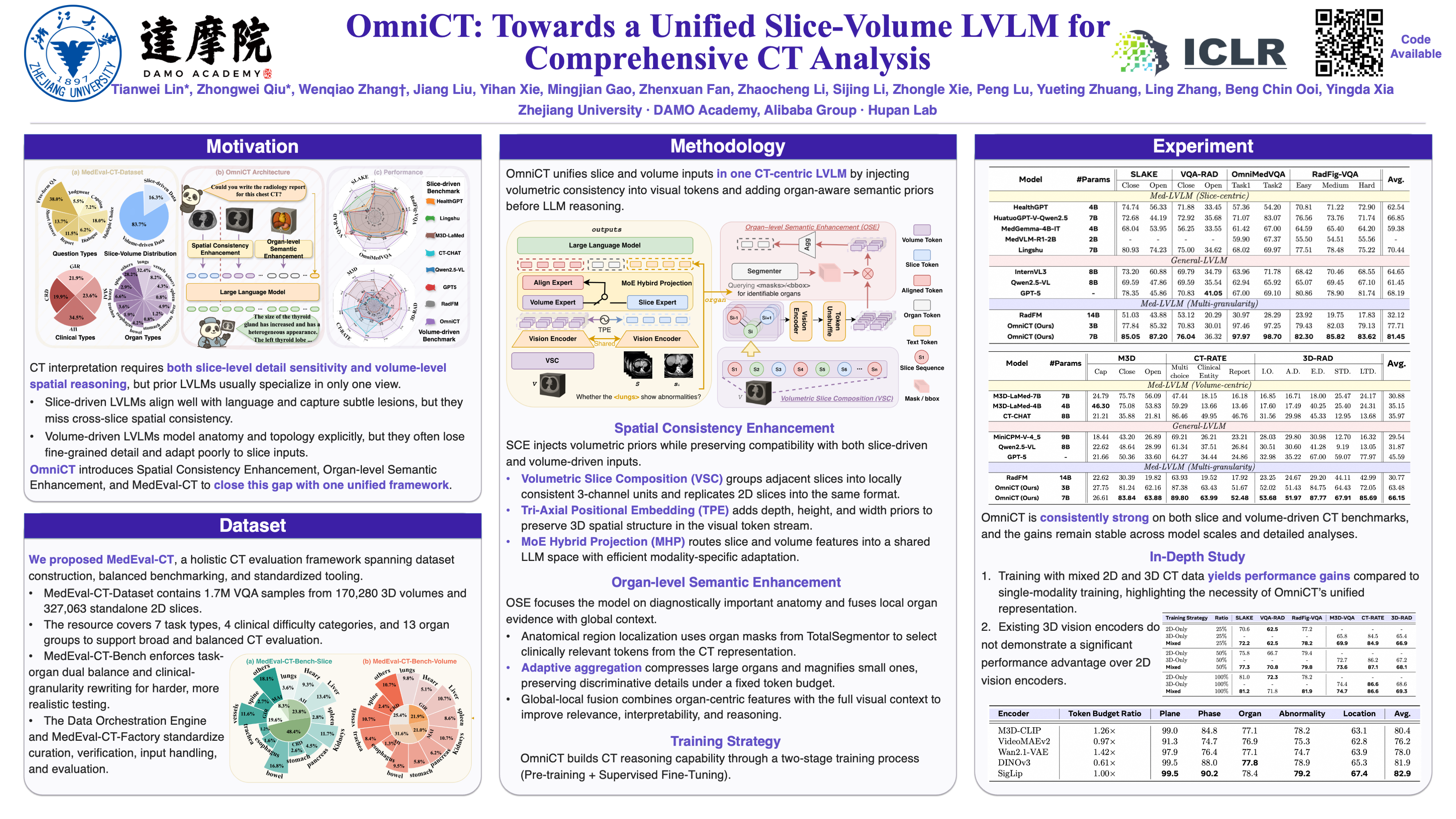
Computed Tomography (CT) is one of the most widely used and diagnostically information-dense imaging modalities, covering critical organs such as the heart, lungs, liver, and colon. Clinical interpretation relies on both slice-driven local features (e.g., sub-centimeter nodules, lesion boundaries) and volume-driven spatial representations (e.g., tumor infiltration, inter-organ anatomical relations). However, existing Large Vision–Language Models (LVLMs) remain fragmented in CT slice versus volumetric understanding: slice-driven LVLMs show strong generalization but lack cross-slice spatial consistency, while volume-driven LVLMs explicitly capture volumetric semantics but suffer from coarse granularity and poor compatibility with slice inputs. The absence of a unified modeling paradigm constitutes a major bottleneck for the clinical translation of medical LVLMs. We present OmniCT, a powerful unified slice–volume LVLM for CT scenarios, which makes three contributions: (i) Spatial Consistency Enhancement (SCE): volumetric slice composition combined with tri-axial positional embedding that introduces volumetric consistency, and an MoE hybrid projection enables efficient slice–volume adaptation; (ii) Organ-level Semantic Enhancement (OSE): segmentation and ROI localization explicitly align anatomical regions, emphasizing lesion- and organ-level semantics; (iii) MedEval-CT: the largest slice–volume CT dataset and hybrid benchmark integrates comprehensive metrics for unified evaluation. OmniCT consistently outperforms existing methods with a substantial margin across diverse clinical tasks and satisfies both micro-level detail sensitivity and macro-level spatial reasoning. More importantly, it establishes a new paradigm for cross-modal medical imaging understanding. Our project is available at https://github.com/ZJU4HealthCare/OmniCT.