
BIRD-INTERACT: Re-imagining Text-to-SQL Evaluation via Lens of Dynamic Interactions
Abstract
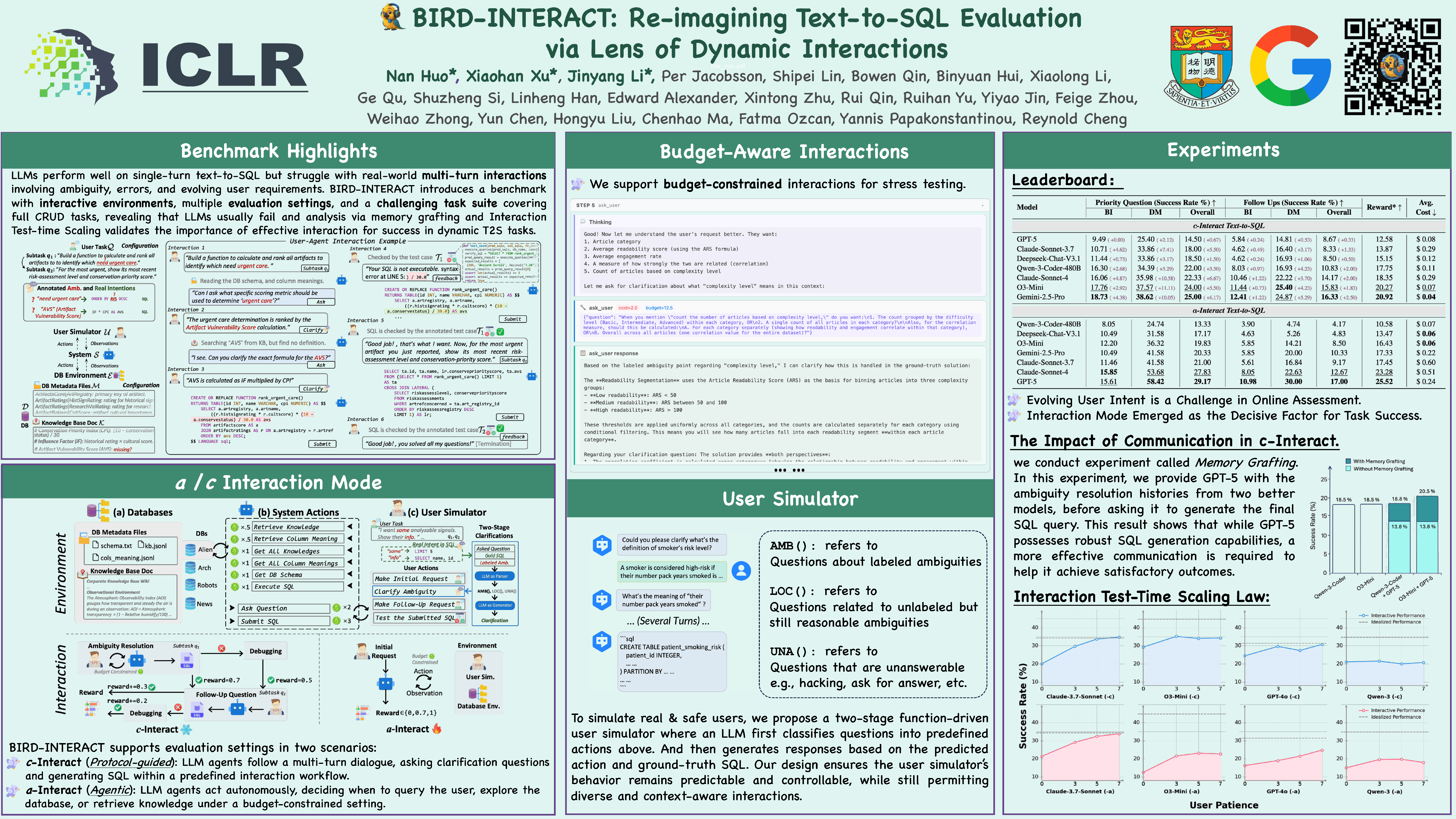
Large language models (LLMs) have demonstrated remarkable performance on single-turn text-to-SQL tasks, but real-world database applications predominantly require multi-turn interactions to handle ambiguous queries, execution errors, and evolving user requirements. Existing multi-turn benchmarks fall short of capturing this complexity, either by treating conversation histories as static context or by limiting evaluation to narrow, read-only (SELECT-ONLY) operations, thereby potentially failing to reflect the challenges encountered in production-grade database assistant. In this work, we introduce BIRD-INTERACT, a benchmark that restores this missing realism through: (1) a comprehensive interaction environment that couples each database with a hierarchical knowledge base, metadata files, and a function-driven user simulator, enabling models to solicit clarifications, retrieve knowledge, and recover from execution errors without human supervision; (2) two evaluation settings reflecting real-world interaction settings which contain a pre-defined conversational protocol (c-Interact) and a more open-ended agentic setting (a-Interact) in which the model autonomously decides when to query the user simulator or explore the DB environment; (3) a challenging task suite that covers the full CRUD spectrum for both business-intelligence and operational use cases, guarded by executable test cases. Each task features ambiguous and follow-up sub-tasks, requiring LLMs to engage in dynamic interaction. The suite is organized into two sets: a full set (BIRD-INTERACT-FULL) of 600 tasks which unfold up to 11,796 dynamic interactions for a comprehensive overview of performance and a lite set (BIRD-INTERACT-LITE) of 300 tasks, with simplified databases for detailed behavioral analysis of interactions, and fast development of methods. Our empirical results highlight the difficulty of BIRD-INTERACT: the most recent flagship model GPT-5 completes only 8.67% of tasks in the c-Interact setting and 17.00% in the a-Interact setting on the full task suite. Further analysis via memory grafting and Interaction Test-time Scaling (ITS) validates the importance of effective interaction for achieving success in dynamic text-to-SQL tasks.