
Polynomial Convergence of Riemannian Diffusion Models
Abstract
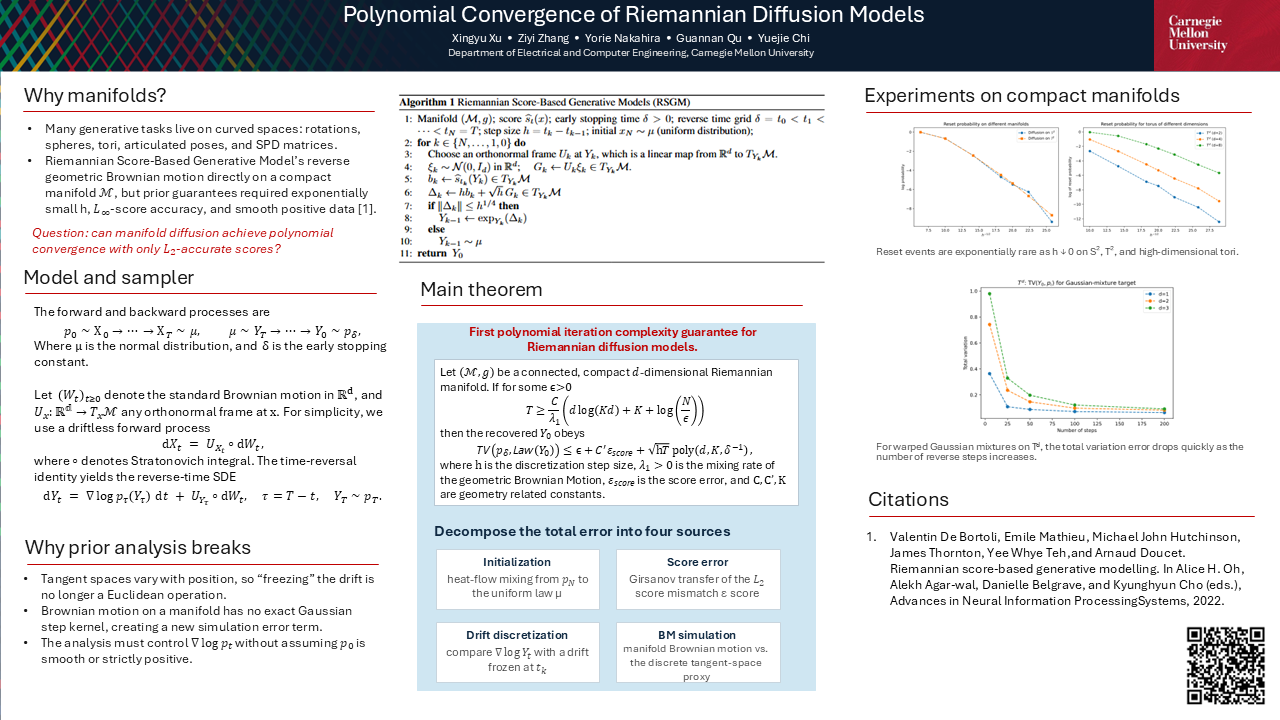
Diffusion generative models have demonstrated remarkable empirical success in the recent years and are now considered the state-of-the-art generative models in modern AI. These models consist of a forward process, which gradually diffuses the data distribution to a noise distribution spanning the whole space, and a backward process, which inverts this transformation to recover the data distribution from noise. Most of the existing literature assumes that the underlying space is Euclidean. However, in many practical applications, the data are constrained to lie on a submanifold of Euclidean space. Addressing this setting, de Bortoli et al. (2022) introduced Riemannian diffusion models and proved that using an exponentially small step size yields small sampling error in Wasserstein distance, provided the data distribution is smooth and strictly positive. In this paper, we prove that a polynomially small stepsize suffices to guarantee small sampling error in total variation distance, without any assumption on the smoothness or positivity of the data distribution. Our analysis only requires mild and standard curvature assumptions on the underlying manifold. The main ingredients in our proof are Li-Yau estimate for log-gradient of heat kernel, and Minakshisundaram-Pleijel parametrix expansion for perturbed heat equation. Our approach opens the door to a sharper analysis of diffusion models on non-Euclidean spaces.