
Planner Aware Path Learning in Diffusion Language Models Training
Zhangzhi Peng ⋅ Zachary Bezemek ⋅ Jarrid Rector-Brooks ⋅ Shuibai Zhang ⋅ Michael Bronstein ⋅ Anru Zhang ⋅ Joey Bose ⋅ Alexander Tong
Abstract
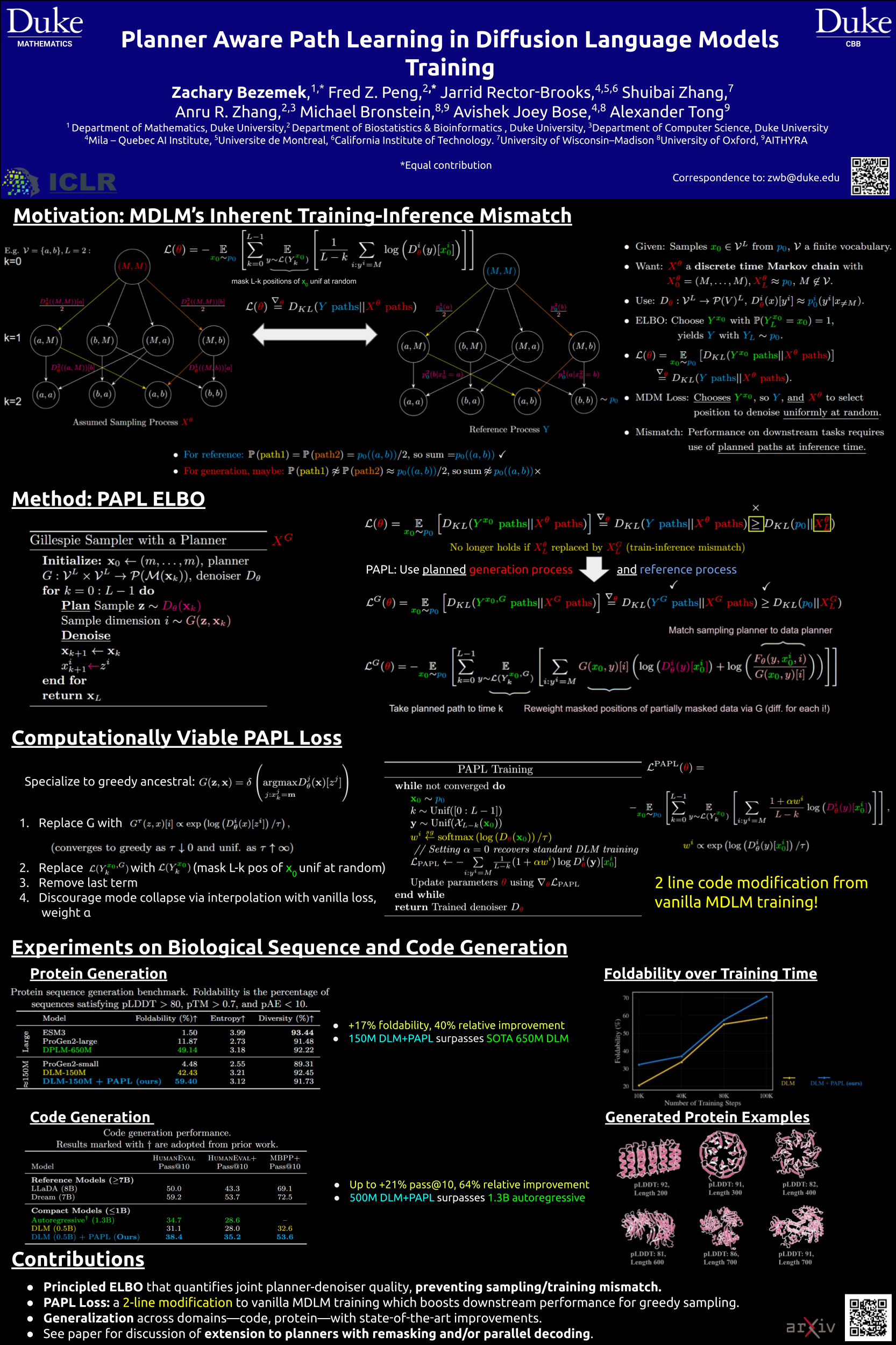
Diffusion language models have emerged as a powerful alternative to autoregressive models, enabling fast inference through more flexible and parallel generation paths. This flexibility of sampling is unlocked by new engineered sampling strategies, or *planners*, that select more favorable generation paths by iteratively planning---versus uniformly at random---where to denoise along the sequence. However, by modifying the reverse paths via planning, planners create an irrevocable mismatch between the uniformly random denoising paths during training and planning-based inference. In this paper, we systematically investigate the mismatch of discrete diffusion training and inference under planning and theoretically prove that the standard discrete diffusion training evidence lower bound (ELBO) does not accurately describe a denoiser that uses a non-uniform planner. To address this gap, we derive a new planned evidence lower bound (P-ELBO) that incorporates planner-based reverse dynamics directly into the training objective. Using the P-ELBO, we introduce *Planner Aware Path Learning* (PAPL), a novel training scheme that aligns training and inference under a planned denoiser. PAPL is implemented as a simple yet effective modification to the standard masked discrete diffusion loss, making it widely applicable and easy to adopt. Empirically, we show PAPL delivers consistent gains across domains, including a 40\% relative improvement in protein sequences, improved text generation with up to a $4\times$ relative MAUVE gain, and 23\% relative improvement in code generation HumanEval pass@10.
Video
Chat is not available.
Successful Page Load