
Tversky Neural Networks: Psychologically Plausible Deep Learning with Differentiable Tversky Similarity
Abstract
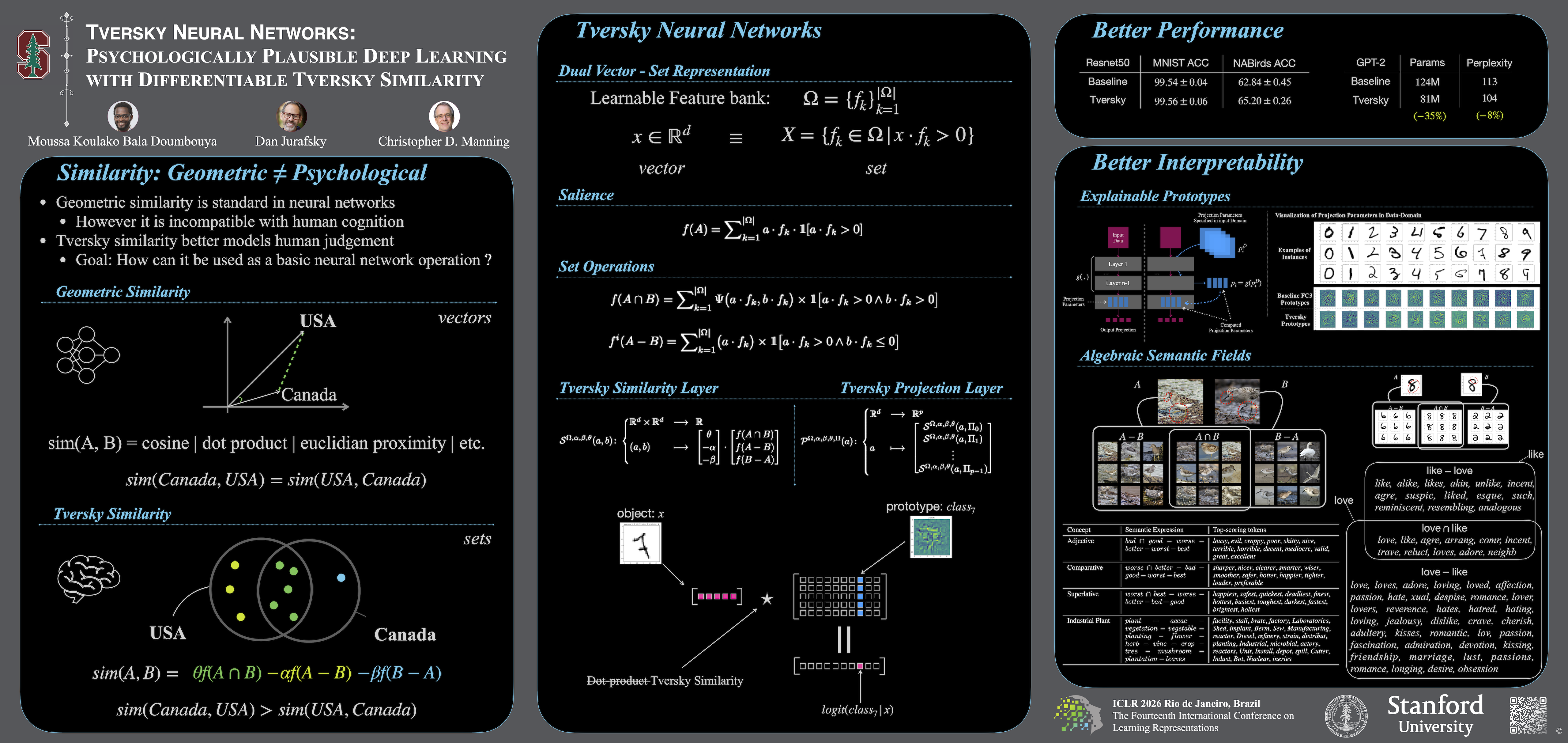
Work in psychology has highlighted that the geometric model of similarity standard in deep learning is not psychologically plausible because its metric properties such as symmetry do not align with human perception of similarity. In contrast, Tversky (1977) proposed an axiomatic theory of similarity with psychological plausibility based on a representation of objects as sets of features, and their similarity as a function of their common and distinctive features. This model of similarity has not been incorporated as a general-purpose building block in deep learning, in part because of the challenge of incorporating discrete set operations. In this paper, we develop a differentiable parameterization of Tversky's similarity that is learnable through gradient descent, and derive basic neural network building blocks such as the Tversky projection layer, which unlike the linear projection layer can model non-linear functions such as XOR. Through experiments with image recognition and language modeling neural networks, we show that the Tversky projection layer is a beneficial replacement for the linear projection layer. For instance, on the NABirds image classification task, a ResNet-50 with a Tversky projection layer trained from scratch achieves a 2.36 percentage point accuracy improvement over the linear layer baseline. With Tversky projection layers, GPT-2's perplexity on PTB decreases by 7.8%, and its parameter count by 34.8%. Finally, we propose a unified interpretation of both projection layer types as computing similarities of inputs to learned prototypes, along with a novel visualization technique. Crucially, Tversky's set-based representation enables the algebraic specification of semantic fields, which we illustrate with lexical and visual stimuli. Our work offers a new paradigm for neural networks that are not only more accurate and efficient, but also interpretable under an established theory of psychological similarity.