
Reward Is Enough: LLMs Are In-Context Reinforcement Learners
Abstract
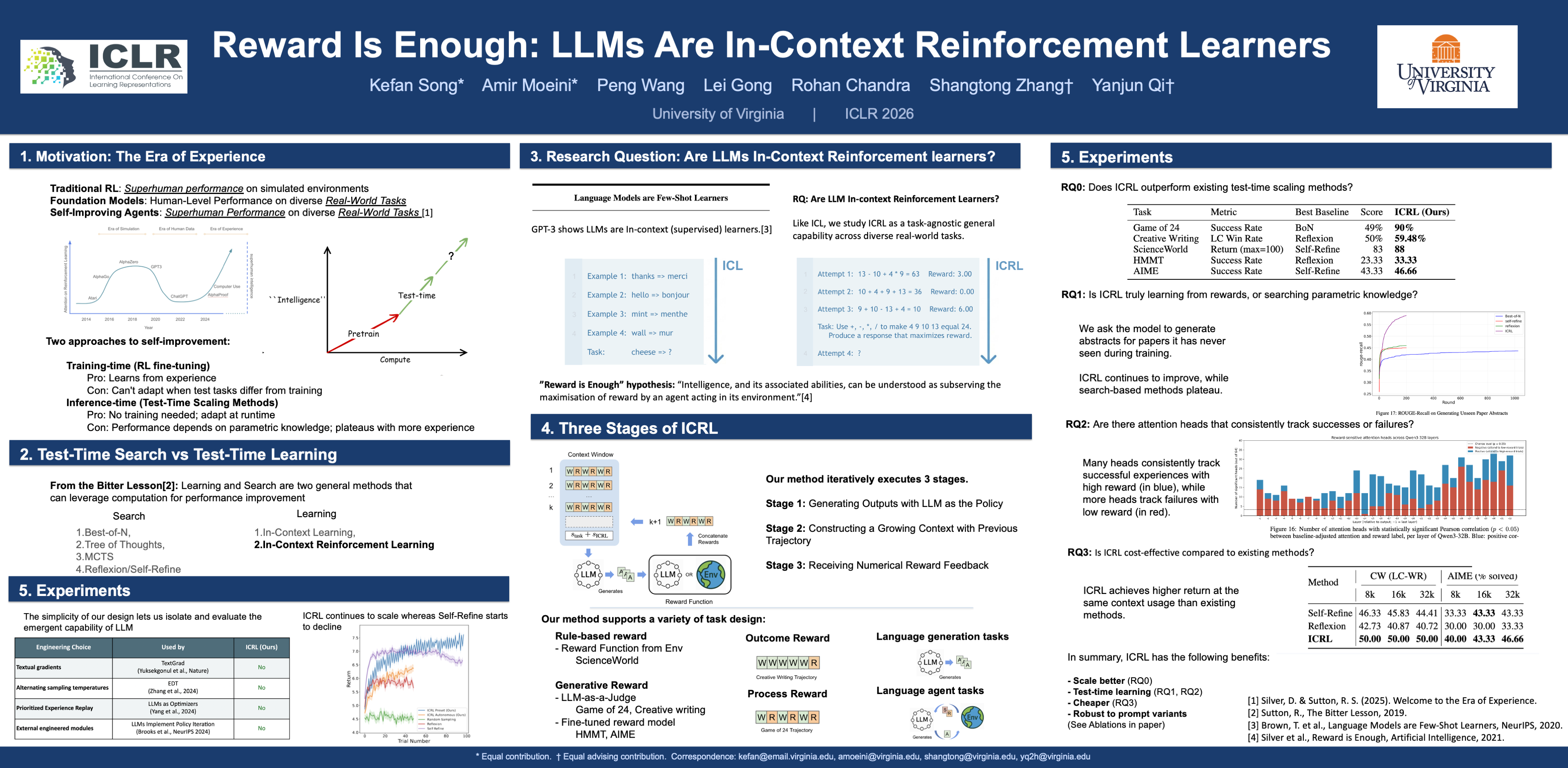
Reinforcement learning (RL) is a framework for solving sequential decision-making problems. In this work, we demonstrate that, surprisingly, RL emerges during the inference time of large language models (LLMs), a phenomenon we term in-context RL (ICRL). To reveal this capability, we introduce a simple multi-round prompting framework, we call ICRL prompting, for inference-time self-improvement. The goal of ICRL prompting is to guide LLMs to perform reinforcement learning during inference for self-improvement on a given task. After each response, the model receives numerical scalar feedback, denoted as a reward. In the next round, we prompt the LLM again together with a context that concatenates all prior responses and their associated rewards. We consistently observe that response quality improves as the context grows. In other words, the LLM can optimize scalar reward signals during inference, exhibiting behavior analogous to reinforcement learning. We evaluate ICRL prompting on Game of 24, creative writing, ScienceWorld, and Olympiad-level math competitions (AIME and HMMT), demonstrating significant improvements over baselines such as Self-Refine and Reflexion. Notably, even when the reward signals are generated by the same LLM, ICRL prompting still improves performance, highlighting a promising new paradigm for test-time scaling.