
Long-Text-to-Image Generation via Compositional Prompt Decomposition
Abstract
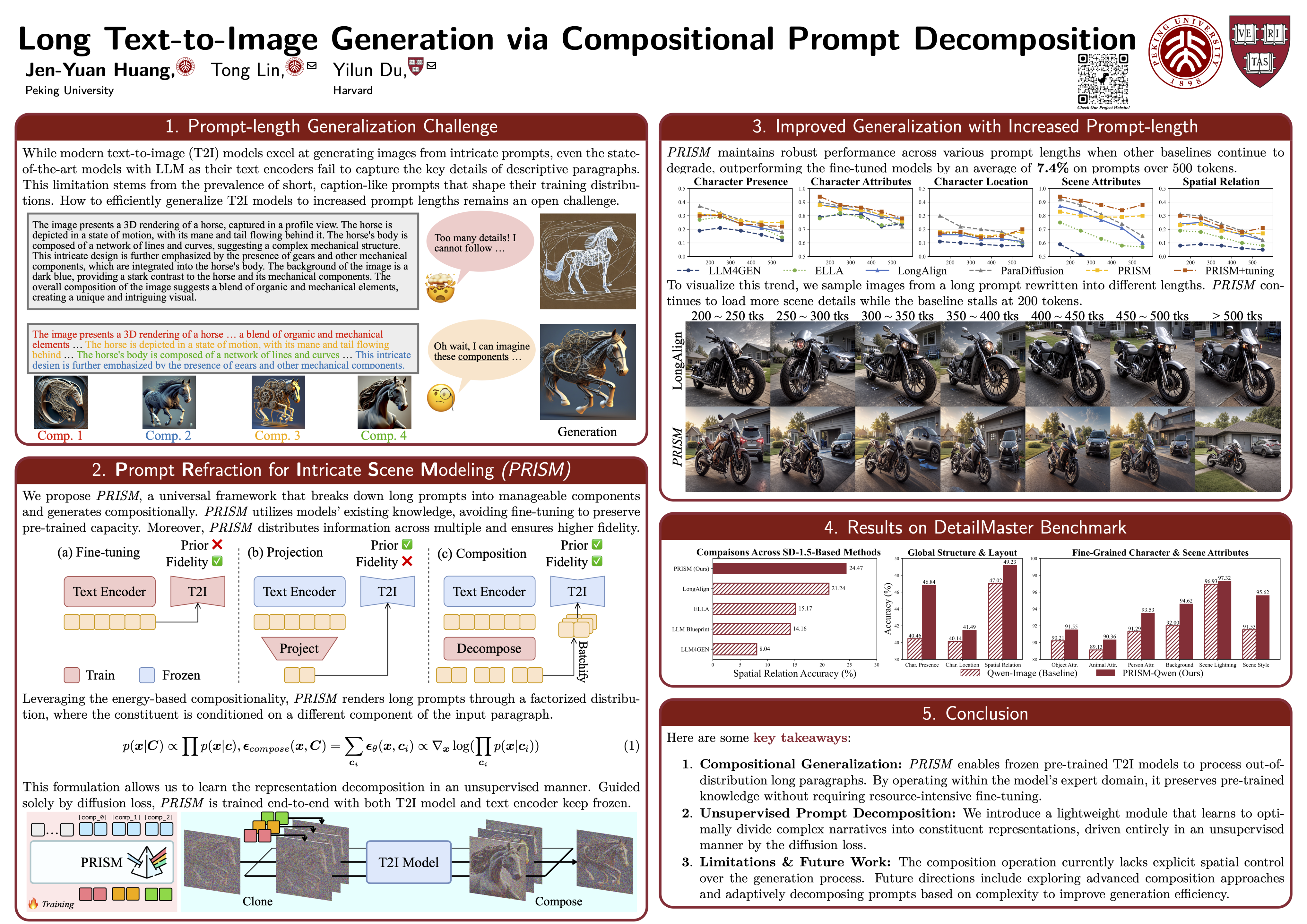
While modern text-to-image (T2I) models excel at generating images from intricate prompts, they struggle to capture the key details when the inputs are descriptive paragraphs. This limitation stems from the prevalence of concise captions that shape their training distributions. Existing methods attempt to bridge this gap by either fine-tuning T2I models on long prompts, which generalizes poorly to longer lengths; or by projecting the oversize inputs into normal-prompt space and compromising fidelity. We propose \textbf{P}rompt \textbf{R}efraction for \textbf{I}ntricate \textbf{S}cene \textbf{M}odeling (\textit{PRISM}), a compositional approach that enables pre-trained T2I models to process long sequence inputs. PRISM uses a lightweight module to extract constituent representations from the long prompts. The T2I model makes independent noise predictions for each component, and their outputs are merged into a single denoising step using energy-based conjunction. We evaluate PRISM across a wide range of model architectures, showing comparable performances to models fine-tuned on the same training data. Furthermore, PRISM demonstrates superior generalization, outperforming baseline models by \textbf{7.4\%} on prompts over 500 tokens in a challenging public benchmark.