
Verification and Co-Alignment via Heterogeneous Consistency for Preference-Aligned LLM Annotations
Abstract
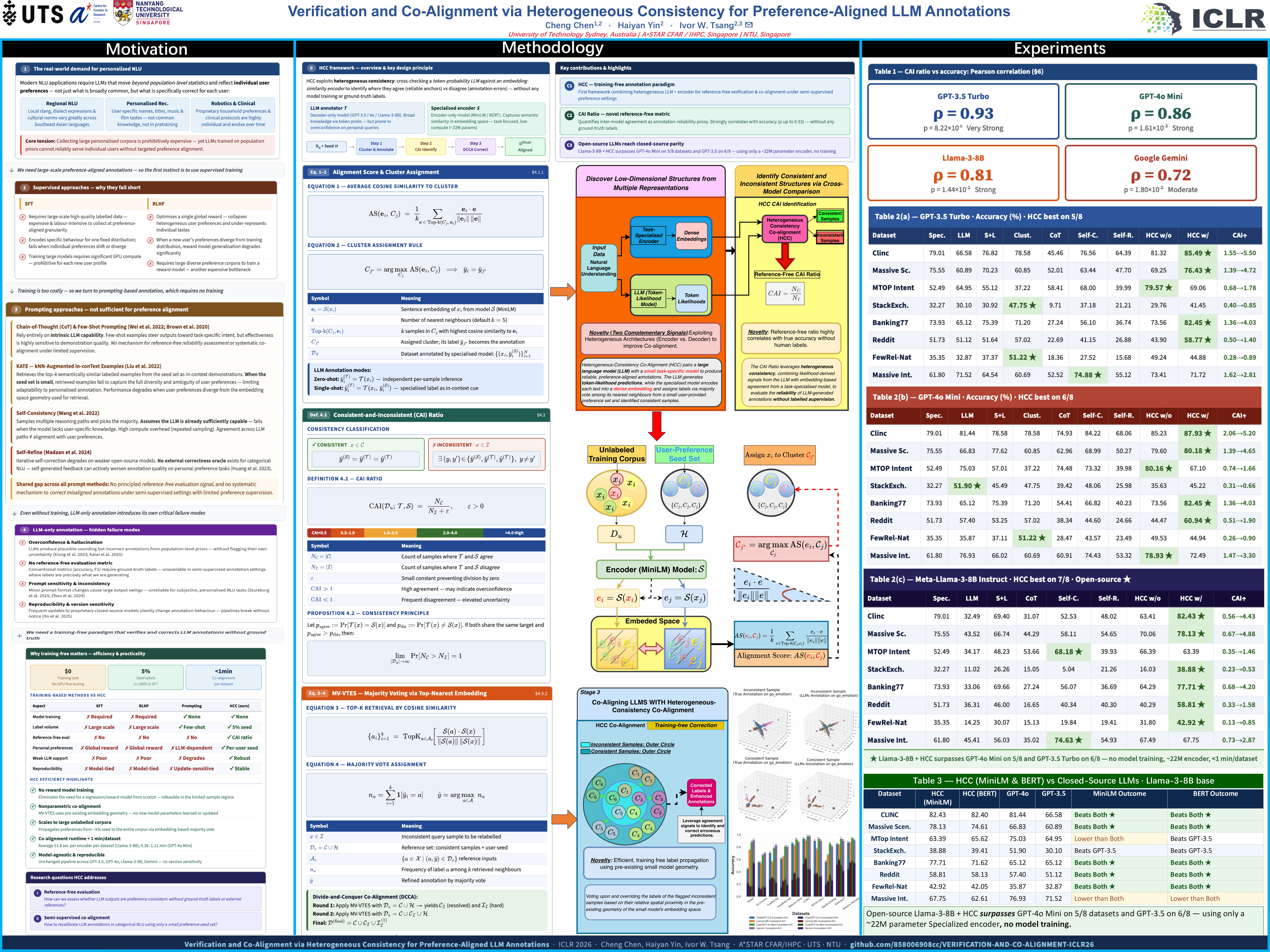
Large Language Models (LLMs) are increasingly expected to be culturally customisable and personally aligned for natural language understanding (NLU). However, existing methods, from supervised fine-tuning (SFT) to personalised RLHF and prompting, either require costly large-scale annotations or remain constrained by their pretraining distributions. Moreover, acquiring annotations that reflect subjective, diverse, and evolving user preferences is both expensive and labour-intensive. To address these limitations, we propose \textit{\textbf{H}eterogeneous-\textbf{C}onsistency \textbf{C}o-Alignment} (HCC), a training-free annotation paradigm that leverages two heterogeneous models: a knowledge-rich yet potentially overconfident LLM and a task-specialised lightweight model guided by a small user preference set. Together, they verify and co-align misaligned outputs over unlabelled corpora. For verification, HCC introduces the reference-free \textit{\textbf{C}onsistent}-\textit{\textbf{A}nd}-\textit{\textbf{I}nconsistent} (\textbf{CAI}) Ratio, an uncertainty signal derived from inter-model agreements (consistent samples) and disagreements (inconsistent samples) to determine whether refinement is necessary. For co-alignment, HCC employs a non-parametric, embedding-based preference assignment scheme to recalibrate inconsistent samples according to user preferences. Across eight NLU datasets and both open- and closed-source LLMs, HCC consistently improves annotation alignment and, in several tasks, enables \textit{Llama-3-8B} to surpass \textit{GPT-3.5/4o-mini} after co-alignment correction. Moreover, CAI strongly correlates with accuracy and tracks pre- and post-alignment gains, offering a reference-free signal for scaling preference-aligned annotation without ground-truth supervision.