
Neural Dynamics Self-Attention for Spiking Transformers
Abstract
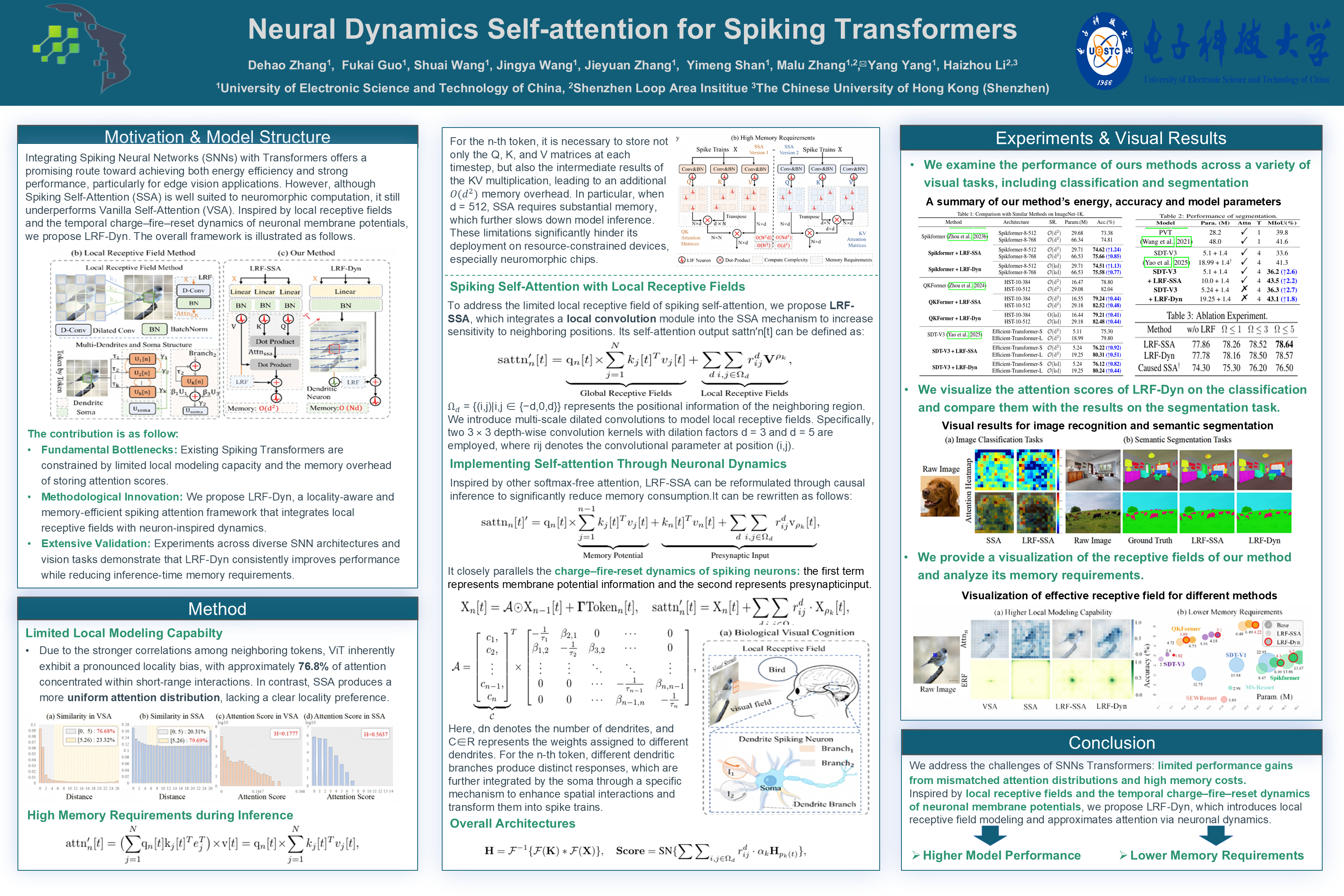
Integrating Spiking Neural Networks (SNNs) with Transformer architectures offers a promising pathway to balance energy efficiency and performance, particularly for edge vision applications. However, existing Spiking Transformers face two critical challenges: (i) a substantial performance gap compared to their Artificial Neural Networks (ANNs) counterparts and (ii) high memory overhead during inference. Through theoretical analysis, we attribute both limitations to the Spiking Self-Attention (SSA) mechanism: the lack of locality bias and the need to store large attention matrices. Inspired by the localized receptive fields (LRF) and membrane-potential dynamics of biological visual neurons, we propose LRF-Dyn, which uses spiking neurons with localized receptive fields to compute attention while reducing memory requirements. Specifically, we introduce a LRF method into SSA to assign higher weights to neighboring regions, strengthening local modeling and improving performance. Building on this, we approximate the resulting attention computation via charge–fire–reset dynamics, eliminating explicit attention-matrix storage and reducing inference-time memory. Extensive experiments on visual tasks confirm that our method reduces memory overhead while delivering significant performance improvements. These results establish it as a key unit for achieving energy-efficient Spiking Transformers.