
Efficient Degradation-agnostic Image Restoration via Channel-Wise Functional Decomposition and Manifold Regularization
Abstract
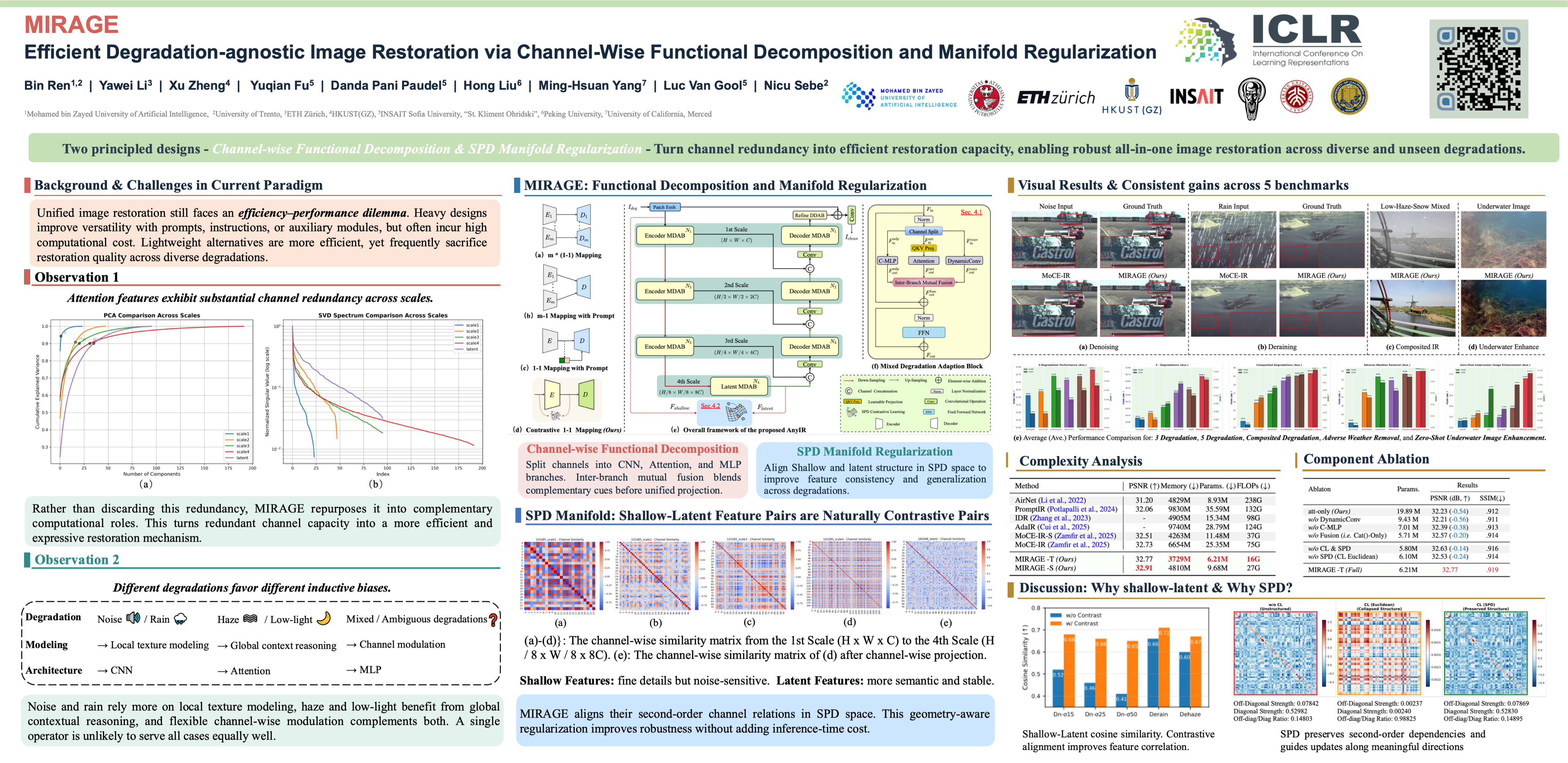
Degradation-agnostic image restoration aims to handle diverse corruptions with one unified model, but faces fundamental challenges in balancing efficiency and performance across different degradation types. Existing approaches either sacrifice efficiency for versatility or fail to capture the distinct representational requirements of various degradations. We present MIRAGE, an efficient framework that addresses these challenges through two key innovations. First, we propose a channel-wise functional decomposition that systematically repurposes channel redundancy in attention mechanisms by assigning CNN, attention, and MLP branches to handle local textures, global context, and channel statistics, respectively. This principled decomposition enables degradation-agnostic learning while achieving superior efficiency-performance trade-offs. Second, we introduce manifold regularization that performs cross-layer contrastive alignment in Symmetric Positive Definite (SPD) space, which empirically improves feature consistency and generalization across degradation types. Extensive experiments demonstrate that MIRAGE achieves state-of-the-art performance with remarkable efficiency, outperforming existing methods in various all-in-one IR settings while offering a scalable and generalizable solution for challenging unseen IR scenarios.