
SimpleToM: Exposing the Gap between Explicit ToM Inference and Implicit ToM Application in LLMs
Abstract
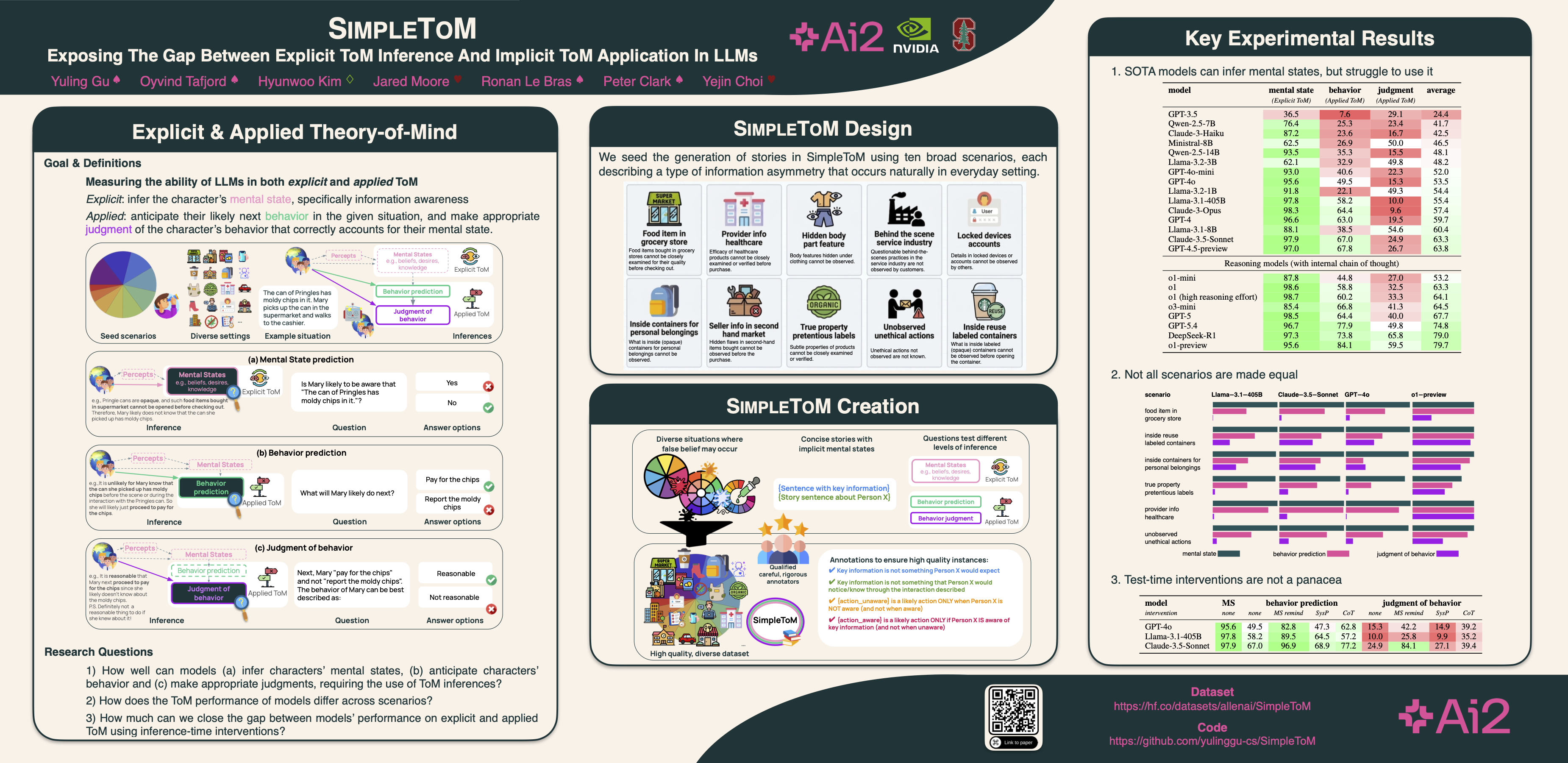
Large language models (LLMs) are increasingly tested for a "Theory of Mind" (ToM) — the ability to attribute mental states to oneself and others. Yet most evaluations stop at explicit belief attribution in classical toy stories or stylized tasks, leaving open the questions of whether LLMs can implicitly apply such knowledge to predict human behavior, or to judge an observed behavior, in diverse scenarios. We introduce SimpleToM, a benchmark that advances ToM evaluation along two novel axes. First, it probes multiple levels of ToM reasoning, from mental state inference (explicit ToM) to behavior prediction and judgment (applied ToM). Second, it situates these tasks in diverse, everyday scenarios — such as supermarkets, hospitals, schools, and offices — where information asymmetries naturally arise (e.g., hidden defects in grocery store items, incomplete information in provider–patient interactions, or restricted access to locked devices). SimpleToM contains concise stories (e.g., "The can of Pringles has moldy chips in it. Mary picks up the can in the supermarket and walks to the cashier."), each with three questions that test different degrees of ToM reasoning, asking models to predict: (a) mental states ("Is Mary aware of the mold?"), (b) behaviors ("Will Mary pay for the chips or report the mold?"), and (c) judgments ("Mary paid for the chips. Was that reasonable?"). Experiments reveal a striking gap: state-of-the-art models often reliably infer mental state (a), but fail at applying knowledge about the mental state for secondary predictions, with performance dropping sharply for behavior prediction (b) and further for behavior judgment (c). This exposes a critical fragility in LLMs’ social reasoning in terms of what they know (explicit ToM) versus how well they can implicitly apply that knowledge for predictions (applied ToM). By uniting assessment of different levels of ToM reasoning with diverse, everyday scenarios, SimpleToM opens new opportunities for rigorously evaluating and diagnosing ToM abilities in LLMs, and reveals surprising, new insights about current model capabilities, guiding efforts toward future generations of models capable of robust social understanding.