
Hippoformer: Integrating Hippocampus-inspired Spatial Memory with Transformers
Abstract
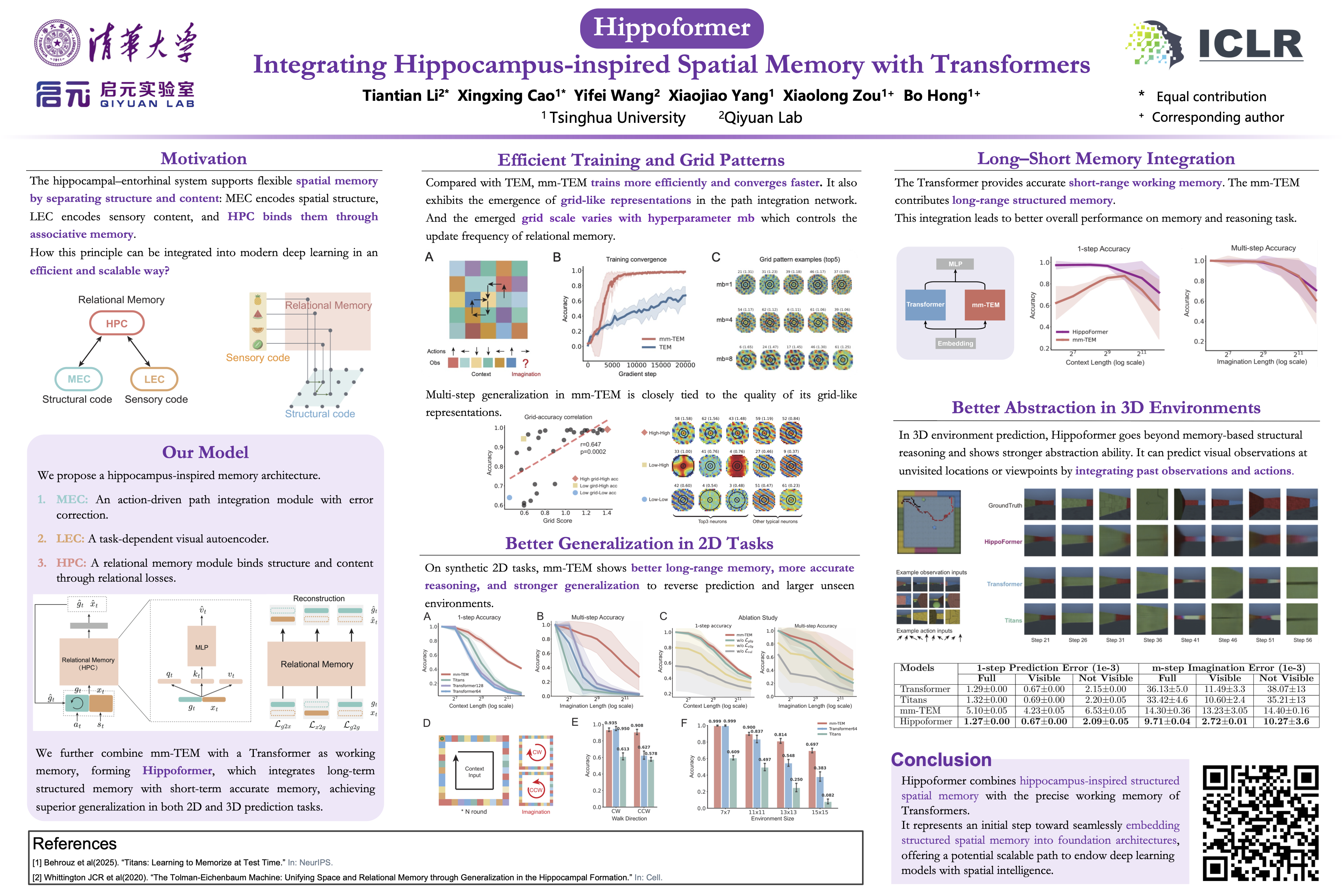
Transformers form the foundation of modern generative AI, yet their key–value memory lacks inherent spatial priors, constraining their capacity for spatial reasoning. In contrast, neuroscience points to the hippocampal–entorhinal system, where the medial entorhinal cortex provides structural codes and the hippocampus binds them with sensory codes to enable flexible spatial inference. However, existing hippocampus models such as the Tolman-Eichenbaum Machine (TEM) suffer from inefficiencies due to outer-product operations or context-length bottlenecks in self-attention, limiting their scalability and integration into modern deep learning frameworks. To bridge this gap, we propose mm-TEM, an efficient and scalable structural spatial memory model that leverages meta-MLP relational memory to improve training efficiency, form grid-like representations, and reveal an intriguing link between prediction horizon and grid scales. Extensive evaluation shows its good generalization on long sequences, large-scale environments, and multi-step prediction, with analyses confirming that its advantages stem from explicit understanding of spatial structures. Building on this, we introduce Hippoformer, which integrates mm-TEM with Transformer to combine structural spatial memory with precise working memory, achieving superior generalization in both 2D and 3D prediction tasks and highlighting the potential of hippocampal-inspired architectures for complex domains. Overall, Hippoformer represents a initial step toward seamlessly embedding structured spatial memory into foundation architectures, offering a potential scalable path to endow deep learning models with spatial intelligence.