
Self-Consistency Improves the Trustworthiness of Self-Interpretable GNNs
Abstract
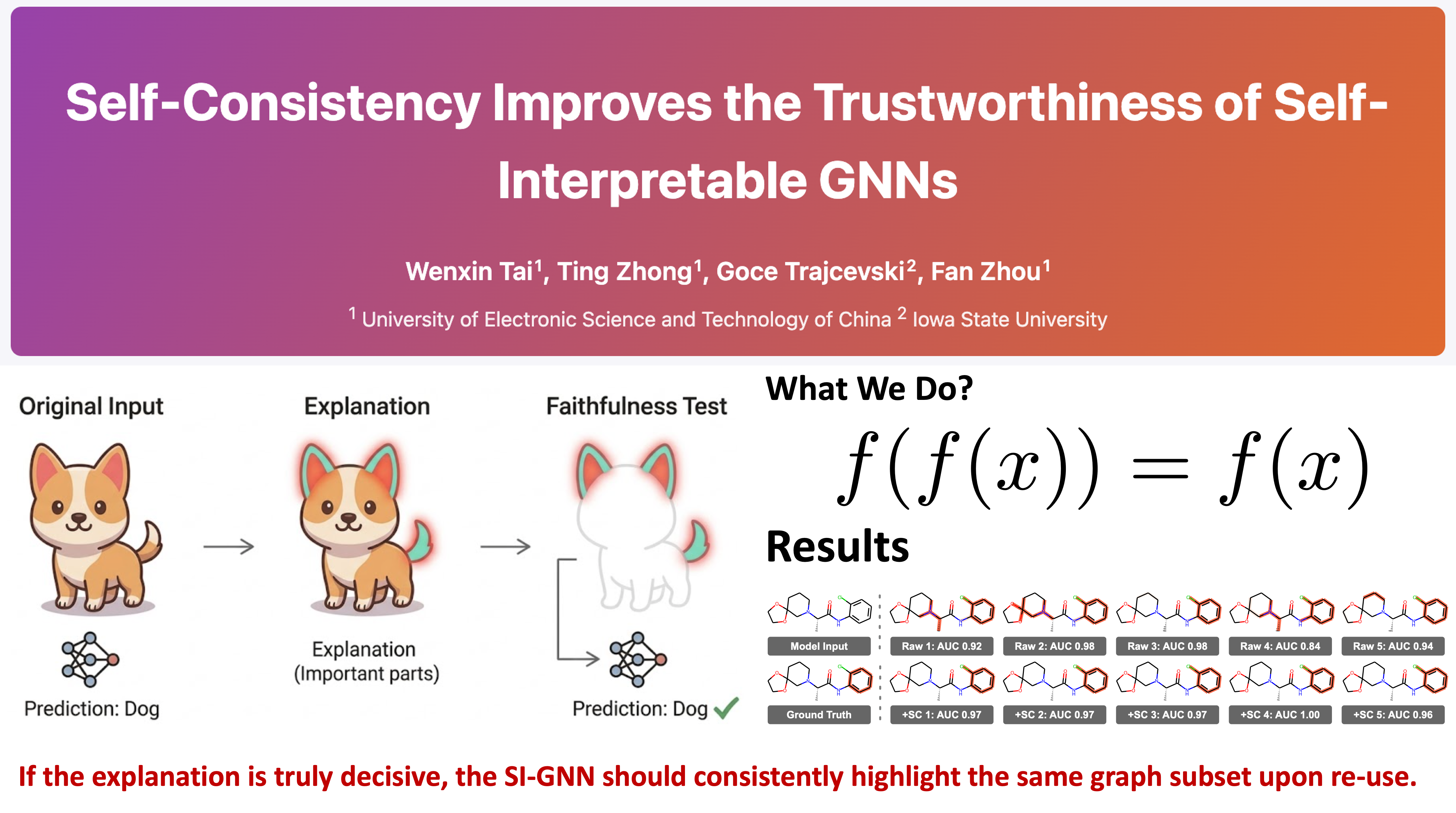
Graph Neural Networks (GNNs) achieve strong predictive performance but offer limited transparency in their decision-making. Self-Interpretable GNNs (SI-GNNs) address this by generating built-in explanations, yet their training objectives are misaligned with evaluation criteria such as faithfulness. This raises two key questions: (i) can faithfulness be explicitly optimized during training, and (ii) does such optimization truly improve explanation quality? We show that faithfulness is intrinsically tied to explanation self-consistency and can therefore be optimized directly. Empirical analysis further reveals that self-inconsistency predominantly occurs on unimportant features, linking it to redundancy-driven explanation inconsistency observed in recent work and suggesting untapped potential for improving explanation quality. Building on these insights, we introduce a simple, model-agnostic self-consistency (SC) fine-tuning strategy. Without changing model architectures, SC consistently improves explanation quality across multiple dimensions and benchmarks, offering an effective and scalable pathway to more trustworthy GNN explanations. Our code is publicly available at \url{https://github.com/ICDM-UESTC/SelfConsistencyXGNN}.