
Joint Adaptation of Uni-modal Foundation Models for Multi-modal Alzheimer's Disease Diagnosis
Abstract
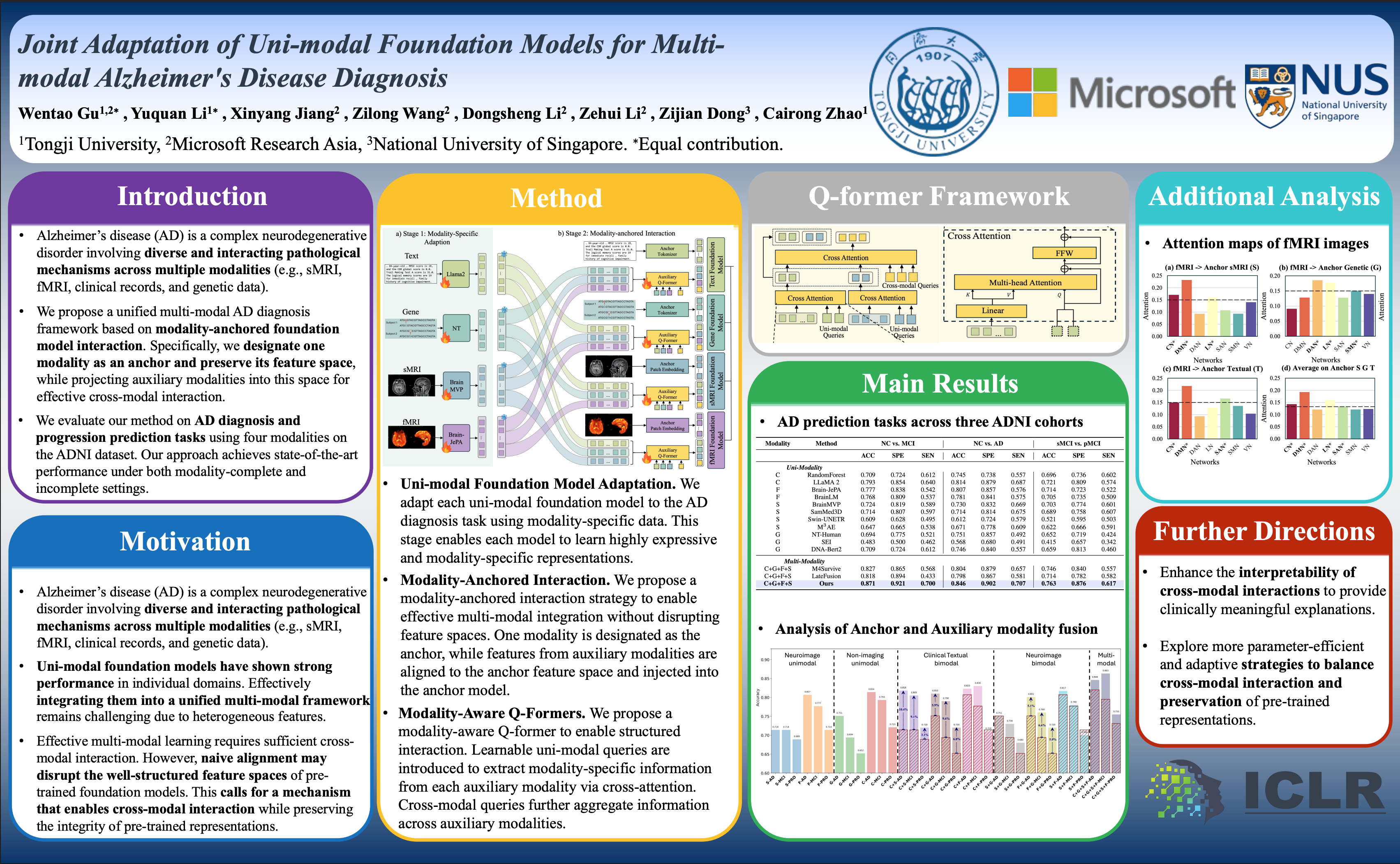
Alzheimer’s Disease (AD) is a progressive neurodegenerative disorder and a leading cause of dementia worldwide. Accurate diagnosis requires integrating diverse patient data modalities. With the rapid advancement of foundation models in neurobiology and medicine, integrating foundation models from various modalities has emerged as a promising yet underexplored direction for multi-modal AD diagnosis. A central challenge is enabling effective interaction among these models without disrupting the robust, modality-specific representations learned from large-scale pretraining. To address this, we propose a novel multi-modal framework for AD diagnosis that enables joint interaction among uni-modal foundation models through modality-anchored interaction. In this framework, one modality and its corresponding foundation model are designated as an anchor, while the remaining modalities serve as auxiliary sources of complementary information. To preserve the pre-trained representation space of the anchor model, we propose modality-aware Q-formers that selectively map auxiliary modality features into the anchor model’s feature space, enabling the anchor model to jointly process its own features together with the seamlessly integrated auxiliary features. We evaluate our method on AD diagnosis and progression prediction across four modalities: sMRI, fMRI, clinical records, and genetic data. Our framework consistently outperforms prior methods in two modality settings, and further demonstrates strong generalization to external datasets and other neurodegenerative diseases such as Parkinson’s disease.