
Barriers for Learning in an Evolving World: Mathematical Understanding of Loss of Plasticity
Abstract
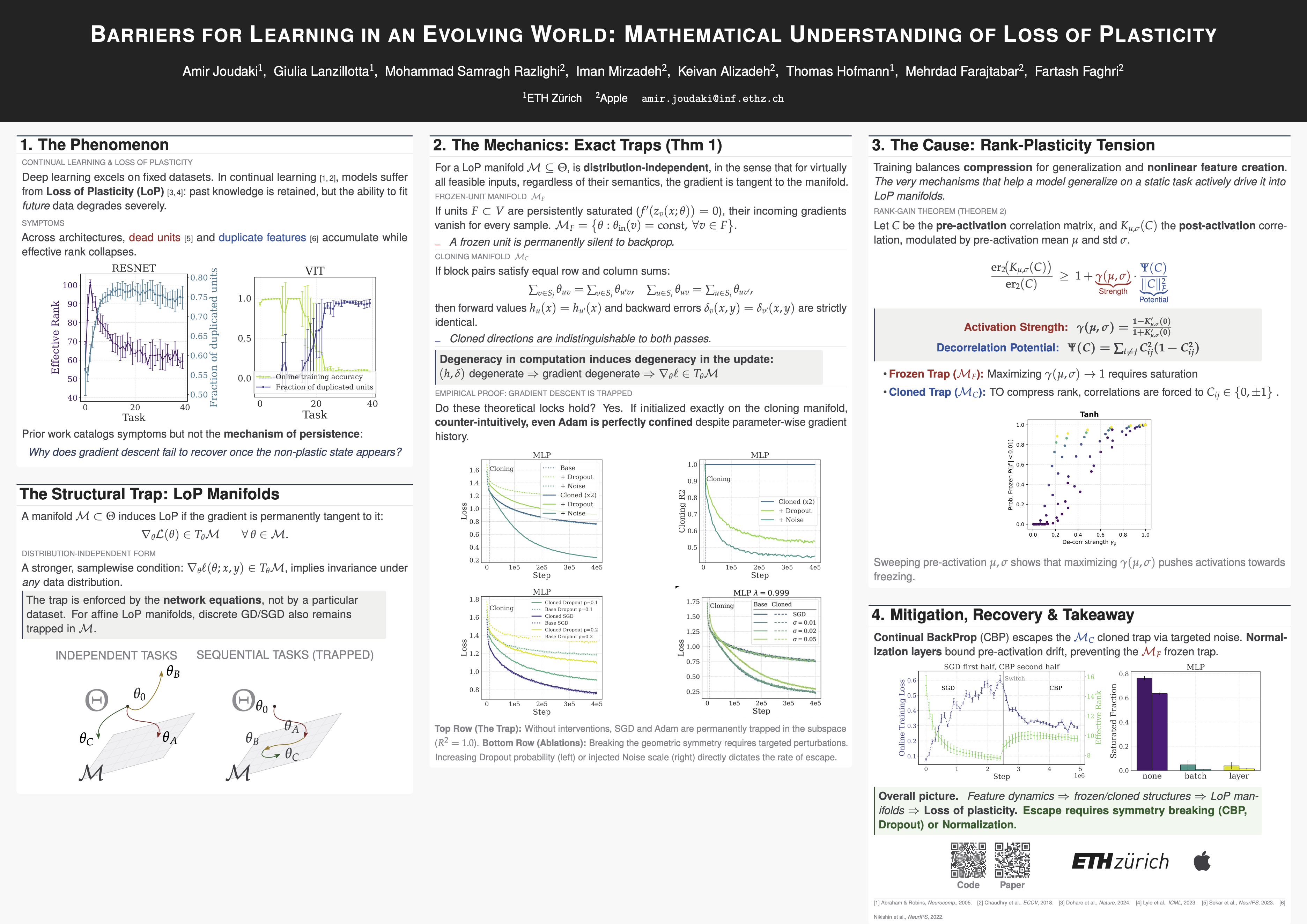
Deep learning models excel in stationary settings but suffer from loss of plasticity (LoP) in non-stationary environments. While prior literature characterizes LoP through symptoms like rank collapse of representations, it often lacks a mechanistic explanation for why gradient descent fails to recover from these states. This work presents a first-principles investigation grounded in dynamical systems theory, formally defining LoP not merely as a statistical degradation, but as an entrapment of gradient dynamics within invariant sub-manifolds of the parameter space. We identify two primary mechanisms that create these traps: frozen units from activation saturation and cloned-unit manifolds from representational redundancy. Crucially, our framework uncovers a fundamental tension: the very mechanisms that promote generalization in static settings, such as low-rank compression, actively steer the network into these LoP manifolds. We validate our theoretical analysis with numerical simulations and demonstrate how architectural interventions can destabilize these manifolds to restore plasticity.