
Reducing Symmetry Increase in Equivariant Neural Networks
Abstract
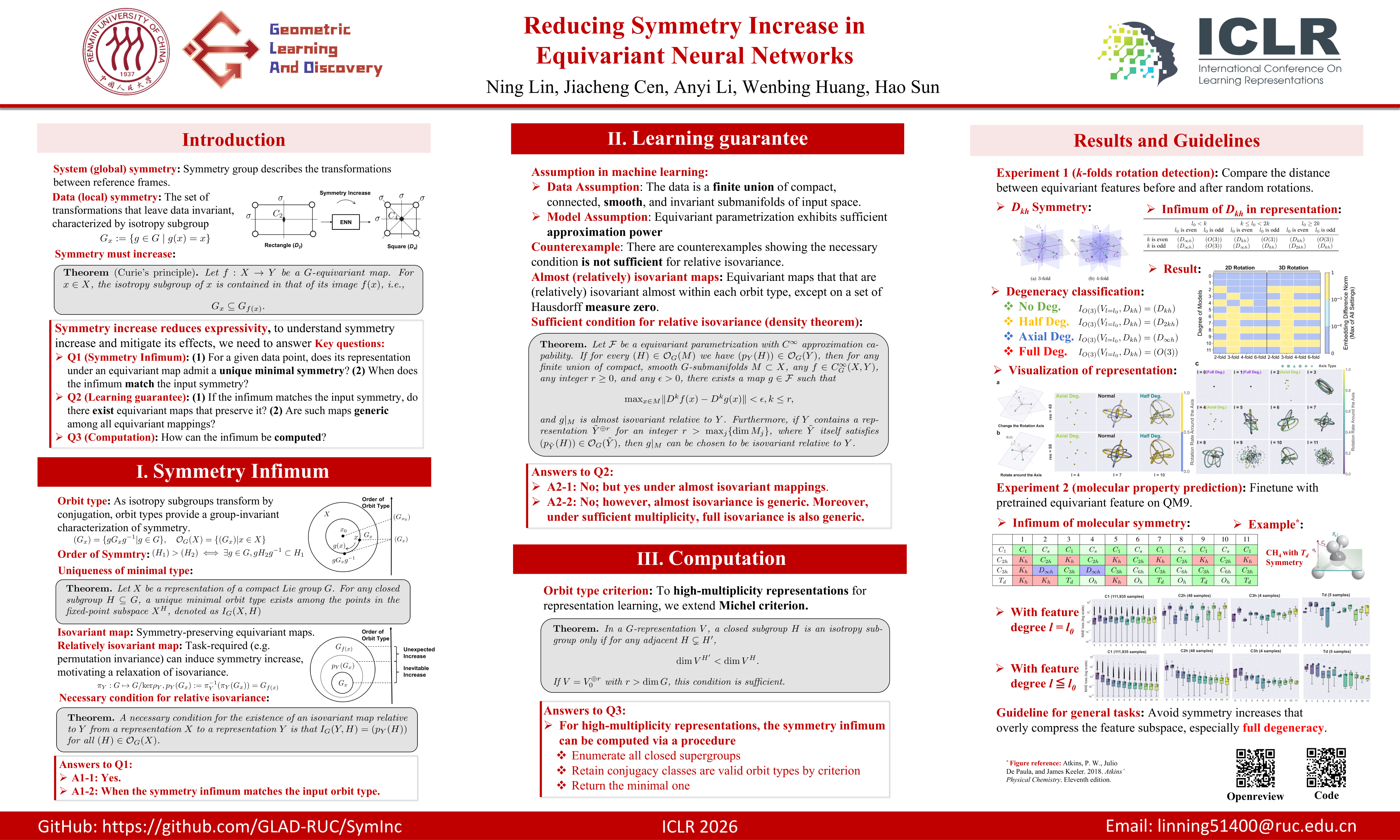
Equivariant Neural Networks (ENNs) have empowered numerous applications in scientific fields. Despite their remarkable capacity for representing geometric structures, ENNs suffer from degraded expressivity when processing symmetric inputs: the output representations are invariant to transformations that extend beyond the input's symmetries. The mathematical essence of this phenomenon is that a symmetric input, after being processed by an equivariant map, experiences an increase in symmetry. While prior research has documented symmetry increase in specific cases, a rigorous understanding of its underlying causes and general reduction strategies remains lacking. In this paper, we provide a detailed and in-depth characterization of symmetry increase together with a principled framework for its reduction: (i) For any given feature space and input symmetry group, we prove that the increased symmetry admits an infimum determined by the structure of the feature space; (ii) Building on this foundation, we develop a computable algorithm to derive this infimum, and propose practical guidelines for feature design to prevent harmful symmetry increases. (iii) Under standard regularity assumptions, we demonstrate that for most equivariant maps, our guidelines effectively reduce symmetry increase. To complement our theoretical findings, we provide visualizations and experiments on both synthetic datasets and the real-world QM9 dataset. The results validate our theoretical predictions.